
CO2 Cannon Risk Assessment and Risk Management
CO2 Cannon Risk Assessment and Risk Management | CryoFX®
CO2 cannon risk assessment and risk management
A CO2 cannon risk assessment isn't a formality. It's the document that determines whether you can legally operate at a venue, get a permit approved, or keep a show running after a fire marshal walks in. Without one, you're one complaint away from a shutdown, a fine, or worse.
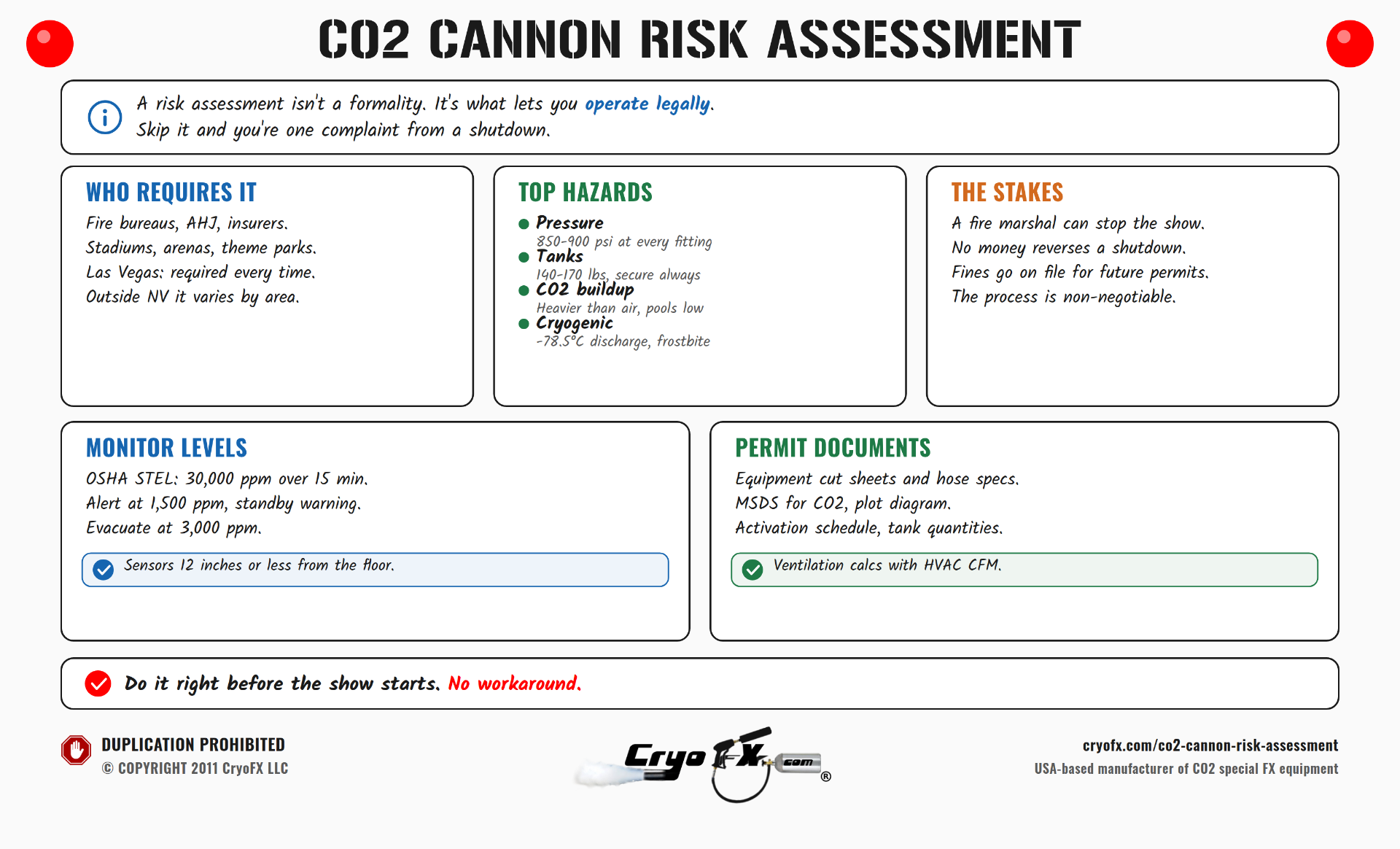
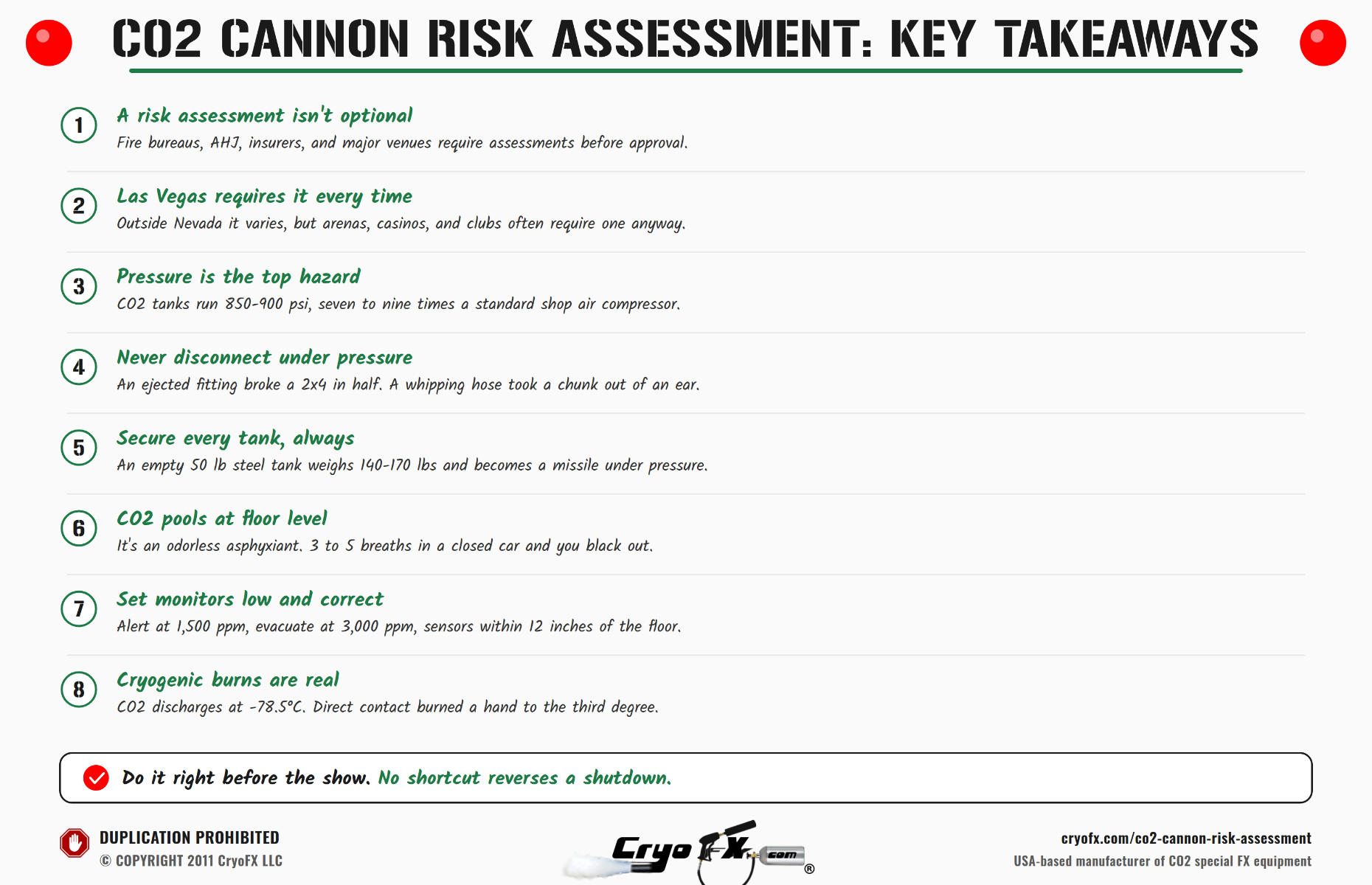
Fire prevention bureaus, authority having jurisdiction (AHJ), insurance carriers, and the management bodies of major stadiums and theme parks all require documented risk assessments before approving CO2 special effects. In Las Vegas, this isn't optional under any circumstances. Outside Nevada, it varies by jurisdiction, but major arenas, casino properties, and large nightclubs typically require them regardless of local codes.
The stakes of skipping this step are significant. If a fire marshal shuts down a show mid-event, no amount of money or urgency fixes it quickly. The process takes time, and the process is non-negotiable.
The real hazards, ranked by severity
Risk assessments need to reflect actual hazard priority. Here's how those hazards rank in practice, based on years of operating CO2 cannon systems at events, installations, and live performances.
1. Pressure hazards and disconnecting under pressure
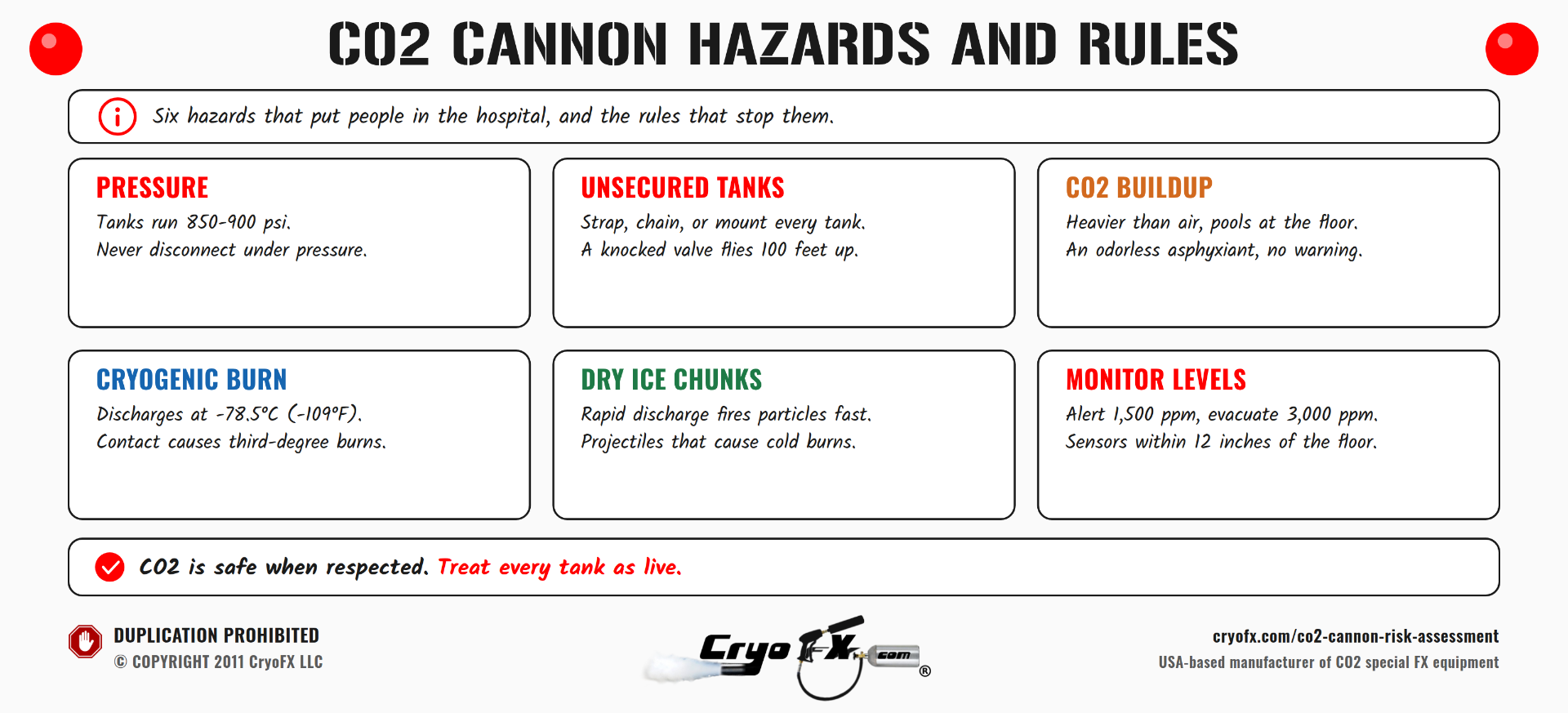
Anything that deals with pressures is the primary concern. CO2 tanks operate at 850-900 psi. That's seven to nine times the output of a standard air compressor. If you've ever seen what a shop compressor can do when a fitting blows, multiply that by seven or nine.
Never disconnect a CO2 fitting or hose while the system is under pressure. A fitting ejected under pressure will not just fall to the floor. At a job site, a CO2 cannon fitting was improperly disconnected while the line was still live. The fitting launched upward, blasted through a ceiling, and broke a 2x4 in half. The people involved laughed. A fitting that breaks a 2x4 will crack a skull and kill someone.
Whipping hoses under pressure are equally dangerous. A hose disconnected mid-show will thrash around at force. CryoFX has seen this happen. A hose end took a chunk out of someone's ear on its way by.
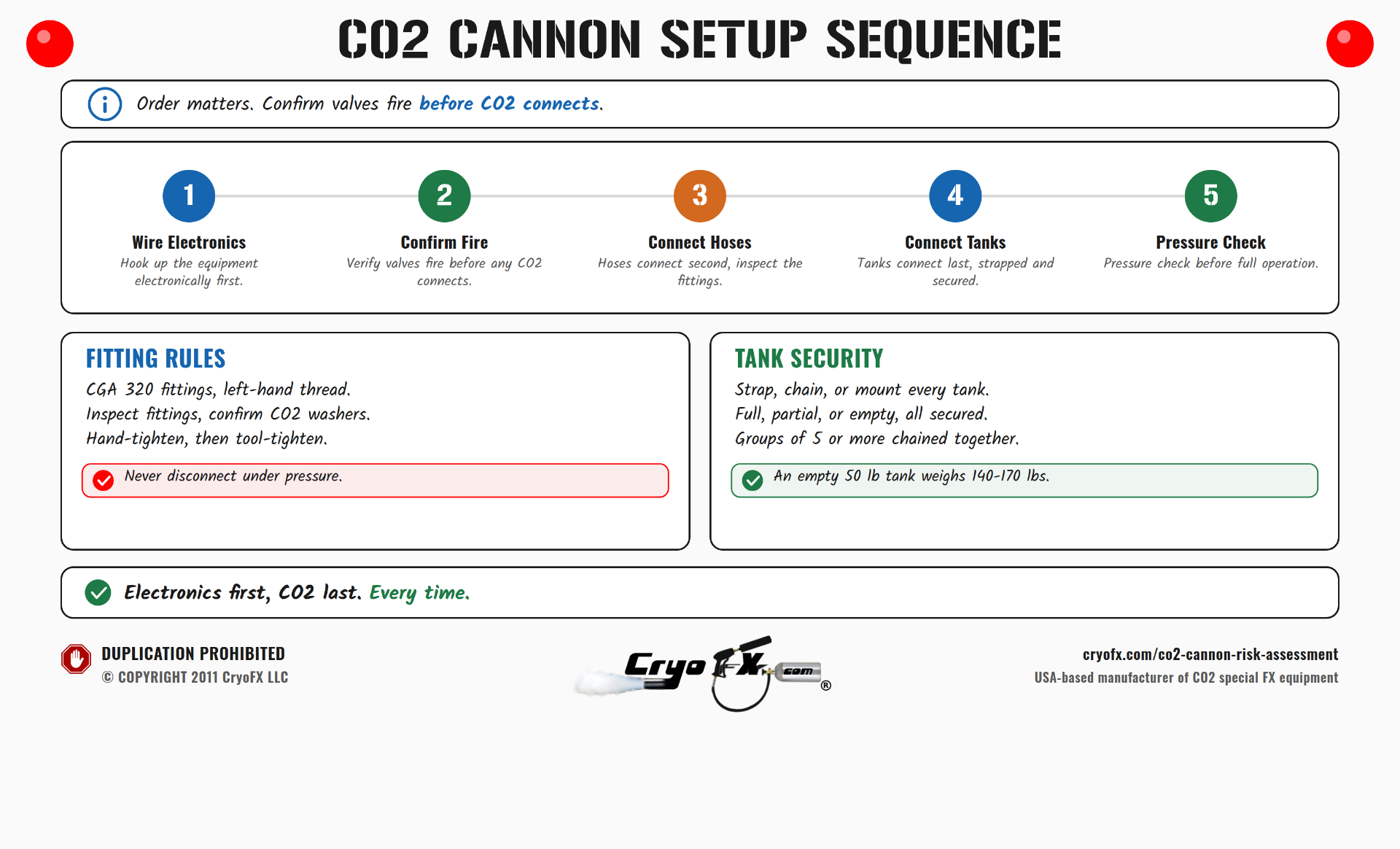
CGA 320 fittings use left-hand thread. They're designed specifically for CO2 service. Always inspect them before connecting, and never remove them while a system is pressurized.
2. Unsecured tanks
CO2 tanks must be strapped, chained, or mounted securely at all times. This applies whether the tank is full, partially full, or empty. An empty 50 lb steel CO2 tank weighs 140-170 lbs. That mass under pressure is a missile.
There are videos online that demonstrate exactly what happens when a tank valve is purposefully knocked off. The tank punches through a house wall, exits through the roof, and travels roughly 100 feet into the air. The pressure is real and the risk is catastrophic.
Code typically requires tanks to be individually strapped to a wall, chained together in groups of five or more, or secured to a mounting point that cannot tip. This isn't a suggestion. It's a life safety requirement.
3. CO2 accumulation
CO2 is heavier than air. It accumulates at floor level. This is where it becomes most concentrated, and it's where people are most exposed in ways they don't expect.
Here's a useful frame for venue managers who haven't thought about this before: imagine putting a 20 lb CO2 tank inside a closed vehicle and releasing the entire tank. You'd have 3 to 5 breaths before losing consciousness. There's no smell, no choking, no warning sign until the third breath when your body is already going under. CO2 is an asphyxiant, and we inject it into enclosed spaces with crowds.
CryoFX founder Kris experienced this firsthand. He had a tub of dry ice sitting overnight in the back of a station wagon. He got in, forgot about it, shut the door, and by the time he'd turned the key, he was already on his second breath. He had one or two left. He got the door open just in time. That's the severity of what CO2 accumulation looks like in practice.
Outdoor accumulation is not safer by default. Tanks positioned behind a chest-height brick wall with wind blowing can still create a dangerous CO2 pocket at low levels. Workers at such a site, bending down to pick up a wrench or a phone that dropped, have lost consciousness and died from CO2 accumulated at the ground in what appeared to be open outdoor conditions.
OSHA's short-term exposure limit (STEL) for CO2 is 30,000 ppm (3%) over 15 minutes. CO2 monitors should be set to alert at 1,500 ppm as a standby warning and to trigger evacuation at 3,000 ppm. Sensors must be mounted 12 inches or less from the floor where accumulation actually occurs.
Additional hazards
Cryogenic burn hazard. CO2 discharges at -78.5°C (-109°F). Direct skin contact causes frostbite and third-degree burns. CryoFX has documented this personally: someone held a handheld CO2 cannon without releasing their grip, and the cold burned their hand to the third degree. Never hold the valve body or nozzle during discharge, and never aim at exposed skin.
Dry ice chunks. Rapid discharge can produce dry ice particles that exit the nozzle at velocity. These are projectiles and can cause cold burns on impact.
Fire detector note. CO2 does not trigger standard smoke detectors. CryoFX has tested this. The effect produces no combustion byproduct. However, it does not interact with CO2 detection systems used in life safety equipment, which is a separate category.
Control measures
Controls should be specific and documented. A good risk assessment doesn't just list hazards. It describes what's being done about each one.
CO2 monitoring. Place CO2 monitors at floor level before any equipment is connected. At 1,500 ppm, the system should alert operators to increase ventilation. At 3,000 ppm, show operations stop and the space is evacuated. Permanent installations should integrate CO2 monitor alerts into the venue's life safety system.
Ventilation calculations. NFPA calculations should document CFM airflow in the venue, whether the HVAC system is single-pass or recirculating (dual-pass recirculates CO2 back into the space), and how quickly CO2 can clear. A recirculating system in a small enclosed venue with active CO2 cannons is a high-risk combination that requires explicit documentation.
Tank security. All tanks secured before any hose connections are made. No exceptions.
Fitting inspection. Every CGA 320 fitting inspected before use. CO2 washers confirmed present. Fittings hand-tightened, then tool-tightened. Never disconnected under pressure.
Operator qualifications. The risk assessment should identify who is operating the equipment, what training they have, and what their role is during the show and during an emergency.
Setup sequence. Equipment is hooked up electronically first. Valves are confirmed to fire before any CO2 is connected. Hoses connect second. Tanks connect last. Pressure check before full operation.
What fire prevention bureaus actually require
Las Vegas is the benchmark. Clark County Fire Prevention reviews all CO2 cannon permits, and their requirements are among the strictest in the country. Fire codes in Las Vegas were actually amended in part because of documentation and systems CryoFX developed during the permit process for a nightclub installation.
That installation is worth describing. CryoFX completed a permanent CO2 cannon system for a Las Vegas nightclub, and during the initial rollout, the fire department shut the system down. The inspector required new electronic flow monitoring equipment tied directly to the venue's life safety system, real-time CO2 sensor integration, and documented reporting back to fire prevention.
CryoFX manufactured the required components from scratch. The system was approved after that work was completed. Fire codes were subsequently amended to incorporate elements of what CryoFX built. The documents fire marshals require for any CO2 cannon permit include:
- Equipment cut sheets showing pressures, specifications, and capabilities
- Hose specifications (manufacturer-provided; CryoFX manufactures its own hose and provides these directly)
- MSDS for CO2
- Plot diagram showing exact equipment placement, distances from audience, and tank locations
- Activation schedule with blast duration, frequency, and show length
- CO2 tank quantities and total CO2 volume to be discharged
- CO2 monitor specifications and placement
- Ventilation calculations based on venue size, HVAC CFM, and stage dimensions
Fire marshals read everything. They focus on life safety items and look for compliance with international fire code, NFPA, and local amendments. The most common pushback comes from incomplete calculations, missing cut sheets, or ventilation documentation that lacks specifics.
What a complete risk assessment document covers
A CO2 cannon risk assessment for a live performance or permanent installation should include:
Event or installation details. Venue name, date(s), type of event, number of attendees, venue dimensions, HVAC type and CFM.
Equipment list. Every CO2 cannon, hose, fitting, and monitor. Include model numbers and rated specifications.
Hazard table. Each identified hazard, its severity, likelihood, and the control measure assigned to it.
Control measures. Detailed descriptions of each control, who is responsible, and how it's verified before the show.
Operator credentials. Who is operating, what their experience is, and how they're reachable during the event.
CO2 volume calculations. How much CO2 is being discharged based on tank quantities, blast durations, and activation schedule.
Emergency procedures. What happens at each CO2 monitor alert level, who is responsible for evacuation, how to shut the system down safely, and what to do if a fitting blows or a hose separates.
MSDS attachment. Included as an appendix.
For a CO2 cannon safety and operations guide covering everything from equipment specs to operating procedures, CryoFX publishes detailed technical information for professional users.
If you're ready to source equipment from a manufacturer that can also provide documentation support, CO2 cannons for sale from CryoFX include manufacturer cut sheets and hose specs needed for the permit package.
FAQs
Do I need a CO2 cannon risk assessment for a one-time event? It depends on your jurisdiction and venue. Las Vegas requires it for every CO2 use without exception. Outside Nevada, many major venues, stadiums, and casino properties require documented risk assessments even when local codes don't mandate a formal permit. If your venue, insurer, or AHJ asks for one, you need one.
What's the difference between a risk assessment and a permit? A risk assessment is the document that identifies hazards and control measures. A permit is the government approval to operate. The risk assessment is typically a supporting document required to get the permit approved, but venues and event organizers may require a risk assessment independently of any government permit.
Can CO2 trigger fire alarms or sprinklers? No. CO2 does not produce smoke, combustion gases, or heat. Standard smoke detectors won't activate from CO2 cannon output. CryoFX has tested this directly. CO2 detection systems used in life safety are a separate category and should be documented in your risk assessment separately.
What CO2 monitor reading should stop a show? 1,500 ppm is a standby warning. At that level, increase ventilation and hold activations until levels drop. At 3,000 ppm, the show stops and the space evacuates. Monitors must be placed at floor level, within 12 inches of the ground, because that's where CO2 accumulates.
What happens if the fire marshal shuts down a show that didn't have a risk assessment? The show stops immediately. Code violations in jurisdictions like Las Vegas carry fines and are recorded on file, which affects future permit applications. There is no workaround. No amount of money paid on the day will reverse a shutdown order from fire prevention. The process has to be done correctly before the show starts.
What is the correct sequence for setting up CO2 cannon equipment before a show? Equipment is connected electronically first and valves are confirmed to fire before any CO2 is connected. Hoses connect second. Tanks connect last. After tanks are connected, a pressure check confirms the system is sealed and all fittings are tight before the show starts. This sequence ensures the system is electrically verified before high-pressure CO2 is introduced.
What happens when a CO2 fitting is disconnected while the system is under pressure? A fitting disconnected under pressure doesn't fall to the floor. At 850-900 psi operating pressure, a CGA 320 fitting ejected from a live CO2 line will move at projectile velocity. CryoFX has documented an incident where a fitting improperly disconnected while the line was live launched upward, traveled through a ceiling, and broke a 2x4 in half. Fittings must never be disconnected while the system is pressurized.
What information goes into a CO2 cannon risk assessment document? A complete risk assessment covers: event and venue details including dimensions, attendees, and HVAC type; a full equipment list with model numbers; a hazard table with each hazard's severity and assigned control measure; control measure descriptions with responsible parties; operator credentials; CO2 volume calculations based on tank quantities and activation schedule; emergency procedures for each CO2 monitor alert level; and an MSDS attachment for carbon dioxide.
What ventilation requirements should a CO2 cannon risk assessment document for an enclosed venue? The assessment should document HVAC CFM airflow, whether the system is single-pass or recirculating, and how quickly CO2 can clear the space under operating conditions. A recirculating HVAC system in a small enclosed venue with active CO2 cannons is particularly high-risk because CO2 cycles back into the space rather than exhausting out. Venues with recirculating systems require explicit documentation of how CO2 accumulation is controlled.
Co2 Cannon Risk Assessment | CryoFX®
Updated - 07/25/2026.