Cold Stage Fireworks: Where the Machines Go and What Each Position Gives You
Cold Stage Fireworks: Where the Machines Go and What Each Position Gives You
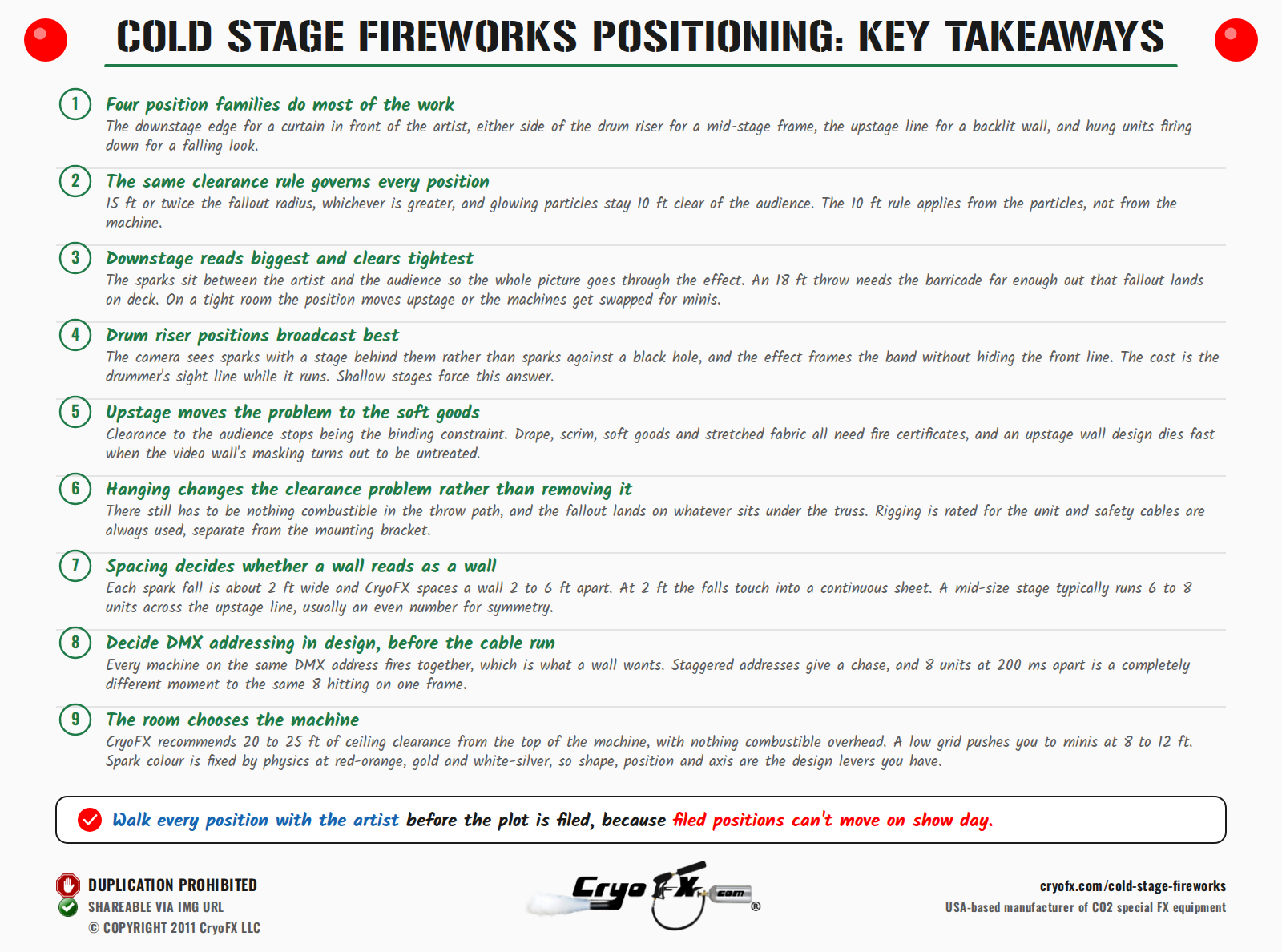
Cold stage fireworks live in 4 position families: the downstage edge for a curtain in front of the artist, either side of the drum riser for a mid-stage frame, the upstage line for a backlit wall, and hung units firing down for a falling look. Each one buys a different picture, and each one is limited by the same clearance geometry.
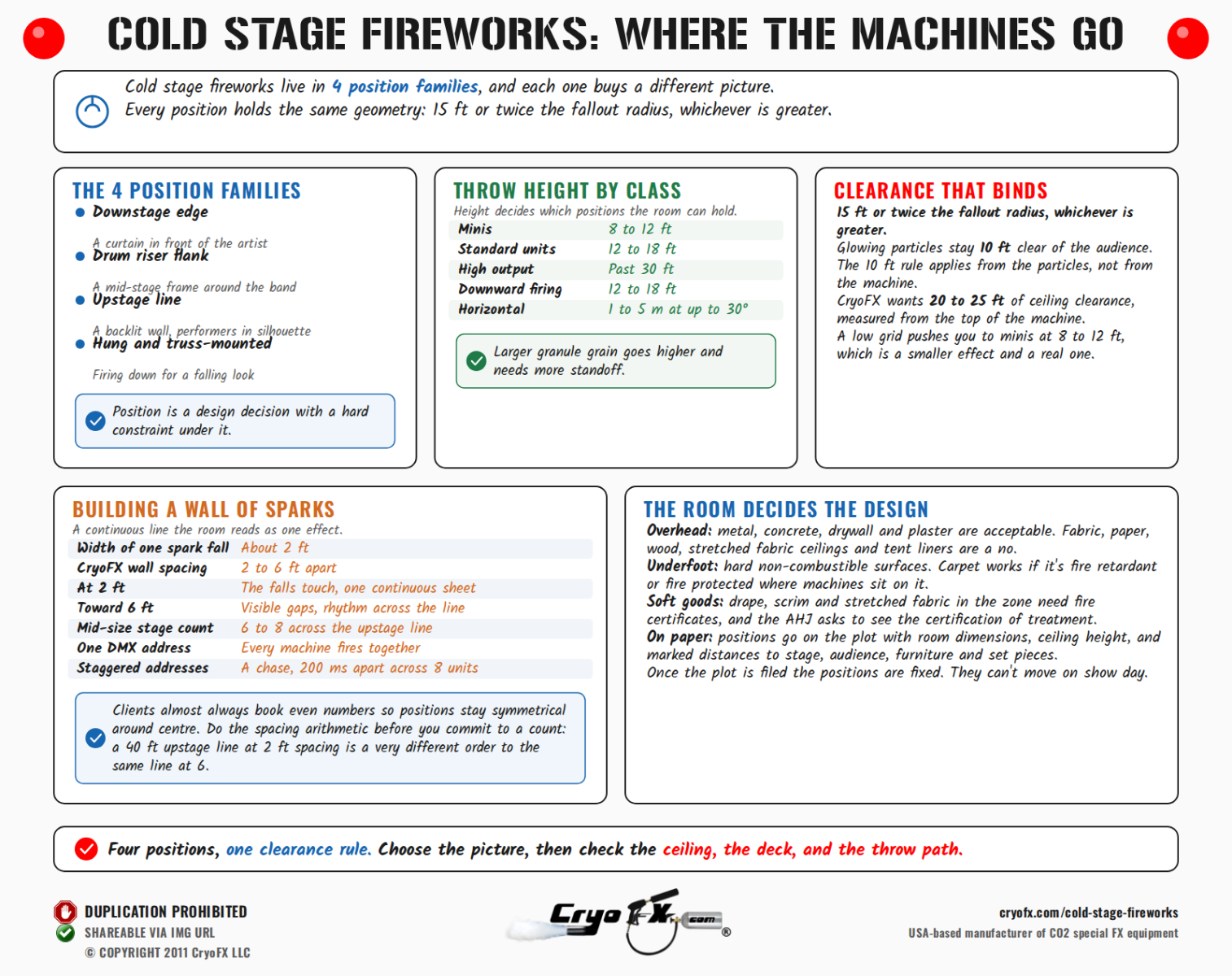
Position is a design decision with a hard constraint under it. Output height runs 8 to 12 feet on minis, 12 to 18 feet on standard units, and past 30 feet on high-output machines, and larger granule grain goes higher and needs more standoff, which is covered in detail in how cold spark machines work. Every position has to hold 15 feet or twice the fallout radius, whichever is greater, and keep glowing particles 10 feet clear of the audience.
This page is the design side. Road cases, patching, cue programming and granule supply across dates sit on the concert touring and stage integration page.
The 4 positions that do the work
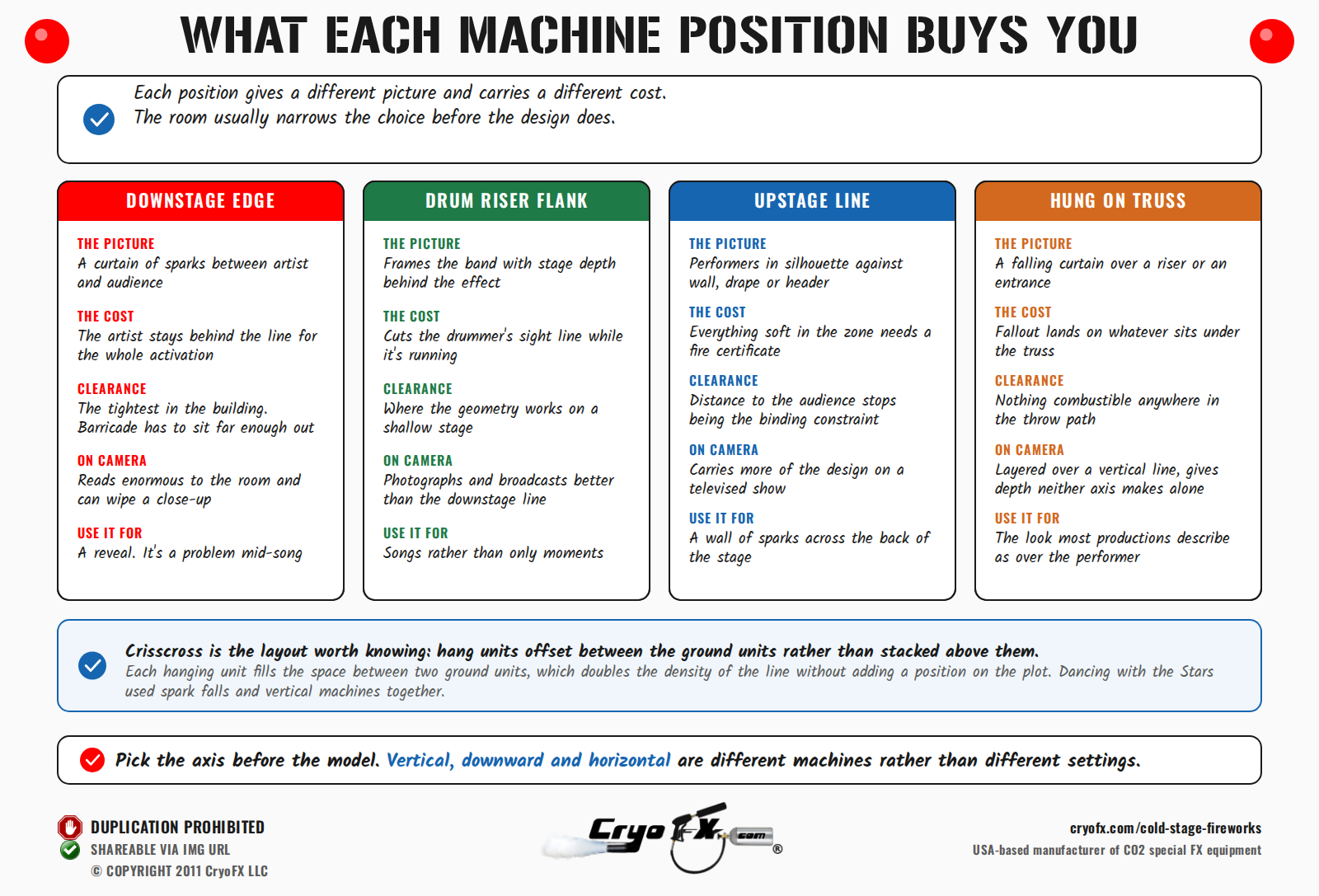
Downstage edge
A line of vertical fountains at the downstage edge reads bigger to the room than anything else you can do with these machines. The sparks sit between the artist and the audience, so the whole picture goes through the effect, which is why it's the position productions ask for first.
It's also the tightest clearance in the building. The 10-foot rule on glowing particles applies from the particles, not from the machine, so a downstage position with an 18-foot throw needs the barricade far enough out that fallout lands on deck rather than on the first two rows. On a room with a barricade tight to the stage lip, this position either moves upstage or the machines get swapped for minis.
The artist has to be behind the line for the duration of the activation. That's fine on a reveal, where the curtain of sparks is the point. It's a problem mid-song when the singer's instinct is to walk to the edge.
Drum riser flank
Fountains either side of the drum riser frame the band with depth behind the effect, which is why this position photographs and broadcasts better than the downstage line does. The camera sees sparks with a stage behind them rather than sparks against a black hole.
It frames a band without hiding the front line, so it works on songs rather than only on moments. The cost is that it cuts the drummer's sight line to the front of the stage while it's running, which the drummer will tell you about in rehearsal if you're lucky and after the show if you're not.
Rooms with shallow stages force this answer. When there isn't enough depth to put the effect downstage and still hold clearance to the audience, the riser flank is where the geometry works.
Upstage line
The upstage line puts the effect behind the performers and turns them into silhouettes, reading against a video wall, a drape line, or a scenic header. It's the cleanest position for a wall of sparks because clearance to the audience stops being the binding constraint.
What's soft in that zone becomes the problem instead. Drape, scrim, soft goods and stretched fabric need fire certificates, and the AHJ will ask to see the certification of treatment rather than take a word for it. Fire certificates are needed for everything in the zone, and a beautiful upstage wall design dies fast when the video wall's masking turns out to be untreated.
Hung and truss-mounted
Downward-firing and multi-axis units are built for this, and a hung machine over a riser or an entrance gives a falling curtain instead of a rising fountain. Dancing with the Stars used spark falls and vertical machines together, which is the look most productions are describing when they ask for something over the top of a performer.
[INSERT DANCING WITH THE STARS SPARK FALL FOOTAGE STILL HERE]
Hanging changes the clearance problem rather than removing it. There still has to be nothing combustible in the throw path, and the fallout lands on whatever sits under the truss, so the floor, the risers, and any set legs underneath get checked before the effect is designed around the position.
Rigging is rated at whatever the equipment weighs plus a safety margin, and safety cables are always used on hanging equipment, separate from the mounting bracket. That's not optional on a CryoFX build. The blower runs for the length of every activation and the vibration works on hardware over a full show, so the bracket is the primary and the cable is what catches it.
Building a wall of sparks
A wall is a continuous line of vertical fountains that the room reads as one effect rather than as separate jets. Spacing is what decides whether that happens.
Each spark fall is about 2 feet wide, and CryoFX spaces a wall between 2 and 6 feet apart. At 2 feet the falls touch and the line reads as a continuous sheet. As you open the spacing toward 6 feet you get visible gaps between units, which is a legitimate look on a wide stage where you want rhythm across the line rather than a solid curtain. Past that it stops reading as a wall and starts reading as several machines in a row.
Count follows stage width and the spacing you chose. A mid-size stage typically runs 6 to 8 across the upstage line, and clients almost always book even numbers so the positions stay symmetrical around centre. Do the spacing arithmetic before you commit to a count, because a 40-foot upstage line at 2-foot spacing is a very different order to the same line at 6.
Every machine on the same DMX address fires together, which is what a wall wants. Staggered addresses across the line give you a chase, and a chase across 8 units at 200 milliseconds apart is a completely different moment to the same 8 units hitting on one frame. Decide it in design, because the addressing shapes how the cable run gets built.
Mixing vertical, downward, and horizontal machines
Horizontal side-spark units throw 1 to 5 metres at up to 30 degrees, which makes them the tool for a cross over a walkway or a low gateway across a runway. Layering a downward curtain over a vertical line gives depth on camera that neither axis produces alone.
Crisscross is the layout worth knowing: hanging machines and ground machines offset rather than stacked, so each hanging unit fills the space between two ground units and each ground unit fills the space between two hanging ones. Stacking them vertically wastes the second machine. Offsetting them doubles the density of the line without adding a single position on the plot.
CryoFX has spelled words on stage and built boxes and letters out of combinations of spark machines where the stage had room for it. It takes machine count, floor space, and a plot the AHJ will accept, and it's the closest this effect gets to graphic design.
Choose the axis before you choose the model, because a vertical unit and a downward unit and a horizontal unit are different machines rather than different settings, and the axis decides which line on the cold spark machines for sale page you're shopping.
Spark colour is fixed by physics. The particles are incandescent metal and black-body radiation puts them in red-orange, gold, and white-silver, with no blue, no green, and no electronic colour control. Shape, position, and axis are the design levers you actually have.
Designing around the room you're actually in
CryoFX recommends 20 to 25 feet of ceiling clearance measured from the top of the machine, and the machine choice follows the room rather than the room being asked to accommodate the machine. A low grid pushes you to minis at 8 to 12 feet, which is a smaller effect and a real one.
Nothing combustible overhead disqualifies positions outright: fabric, paper, wood, stretched fabric ceilings, and tent liners are all a no. Metal, concrete, drywall and plaster are acceptable. Ballroom and theatre grids are where this gets found late, because the drawing shows a height and doesn't show what the height is made of.
Underfoot, hard non-combustible surfaces are what you want. Carpet is workable with conditions: it has to be fire retardant or fire protected where machines are used on it, and the AHJ wants to see the certification of treatment before it signs anything.
Positions go on the plot diagram with room dimensions, ceiling height, and marked distances to stage, audience, furniture and set pieces, and once the plot is filed the positions are fixed. They can't move on show day.
Sight lines and performer safety
Walk every position with the artist before the design is locked. A downstage line blocks the artist for the length of the activation, which is the whole point on a reveal and a problem in the second verse. Riser fountains cut the drummer's view. A performer who has never seen where the machines are is a performer who walks into a fallout zone.
That failure is not hypothetical. CryoFX was operating spark machines at a California ranch wedding when the machines were moved while the operator stepped away for a minute, and because of the line of sight from where he came back to, he couldn't tell they'd been shifted. The new position put them next to real flowers and ferns treated with an extremely flammable holding agent, and both flower sets went up in flames as the couple walked down. It was extinguished. It could have been catastrophic. Positions get taped, marked, and guarded for exactly this reason.
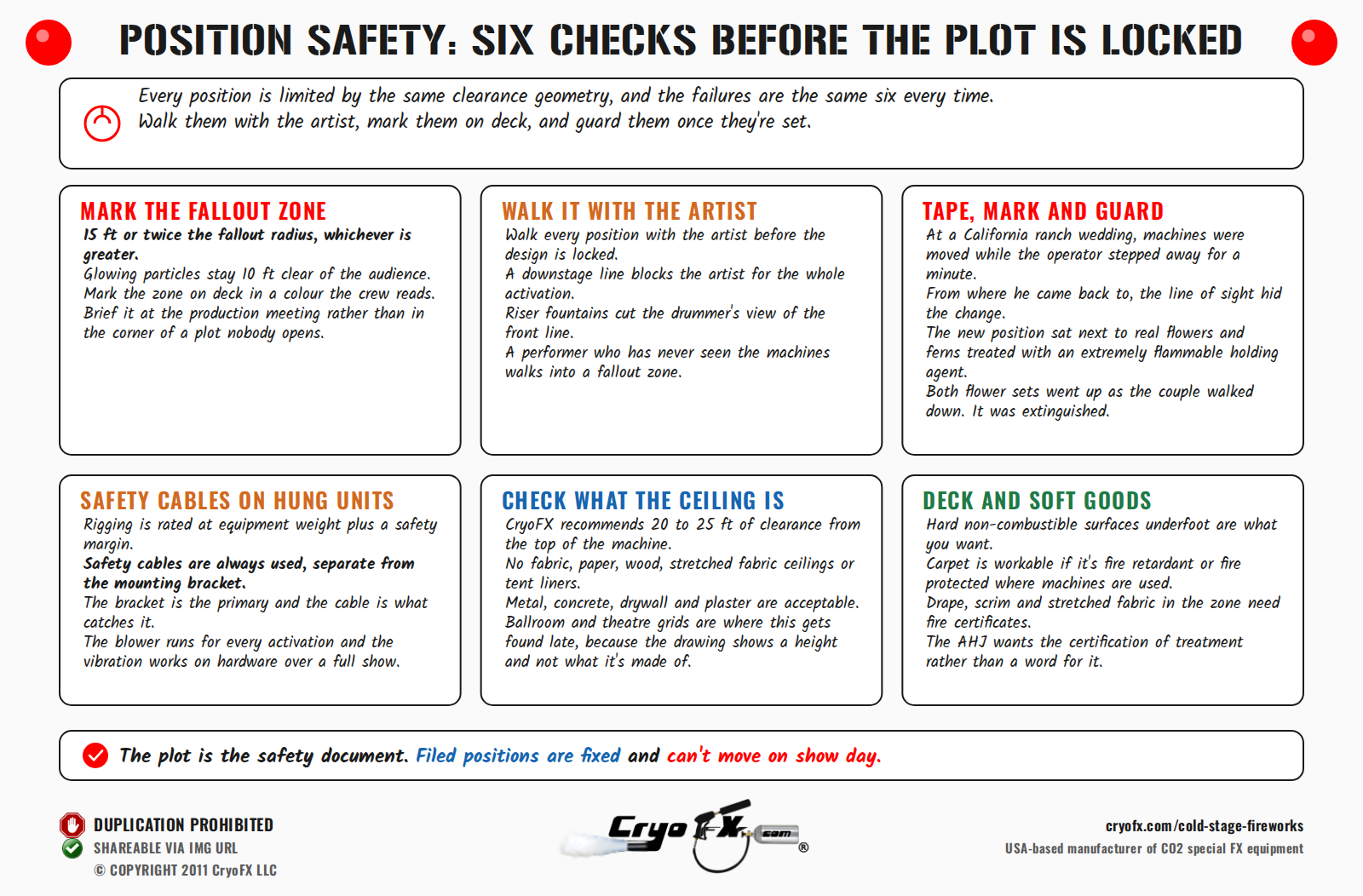
Mark the fallout zone on deck in a colour the crew reads, and brief it at the production meeting rather than in the corner of a plot nobody opens.
Camera positions want thinking about early. A spark curtain between a camera and the talent costs you the shot, and an operator riding exposure through a 30-second activation is fighting a moving target. Downstage lines look enormous to the room and can wipe a broadcast close-up, which is one more reason riser and upstage positions carry more of the design on a televised show.
Frequently asked questions
Where are cold spark machines positioned on a stage?
4 positions do most of the work: the downstage edge for a front curtain of sparks, either side of the drum riser for a mid-stage frame, the upstage wall for a backlit wall, and hung units firing down. Every position has to hold 15 feet or twice the fallout radius, whichever is greater, and keep glowing particles 10 feet off the audience.
What is a wall of sparks and how many machines does it take?
A continuous line of vertical fountains across the stage, read as one effect rather than separate jets. Spacing decides the count: full-size units at 12 to 18 feet of throw sit further apart than minis at 8 to 12. A mid-size stage typically runs 6 to 8 across the upstage line, all on one DMX address so they fire together.
Can cold spark machines be hung from truss?
Yes, and downward-firing and multi-axis units are built for it. Hanging changes the clearance problem rather than removing it: you still need nothing combustible in the throw path, and the fallout lands on whatever is under the truss. Rigging has to be rated for the unit and secured against the blower's vibration over a full show.
Should machines go at the drum riser or downstage?
Drum riser positions frame the band and read well on camera because there's depth behind the sparks. Downstage positions read bigger to the room and put a curtain between the artist and the audience, which is the stronger moment but the tighter clearance. Rooms with shallow stages usually force the drum riser answer.
How do downward-firing machines change the look?
They turn the effect into a falling curtain instead of a rising fountain, which is what makes a hung unit read as a waterfall over a riser or an entrance. Height caps around 12 to 18 feet on downward and horizontal units. The floor under them has to be non-combustible, so drapes, risers, and set legs get checked before the effect is designed around them.
What ceiling height does a stage need?
CryoFX recommends 20 to 25 feet of clearance from the top of the machine, and the machine choice follows the room rather than the other way round. Nothing combustible overhead: no fabric, paper, wood, stretched fabric ceilings, or tent liners. Metal, concrete, drywall, and plaster are acceptable. A low grid pushes you to minis at 8 to 12 feet.
How do cold stage fireworks affect performer sight lines?
A downstage line of vertical fountains blocks the artist for the duration of the activation, which is the point on a reveal and a problem mid-song. Fountains at the drum riser cut the drummer's view of the front line. Walk every position with the artist before the show, because a performer who moves into a fallout zone is the failure everyone remembers.
Cold Stage Fireworks | CryoFX®
Updated - 08/08/2026.