
LED Co2 Cannons for SFX with RGB Features
LED Co2 Cannons for SFX with RGB Features | CryoFX®
LED CO2 cannons for SFX with RGB features
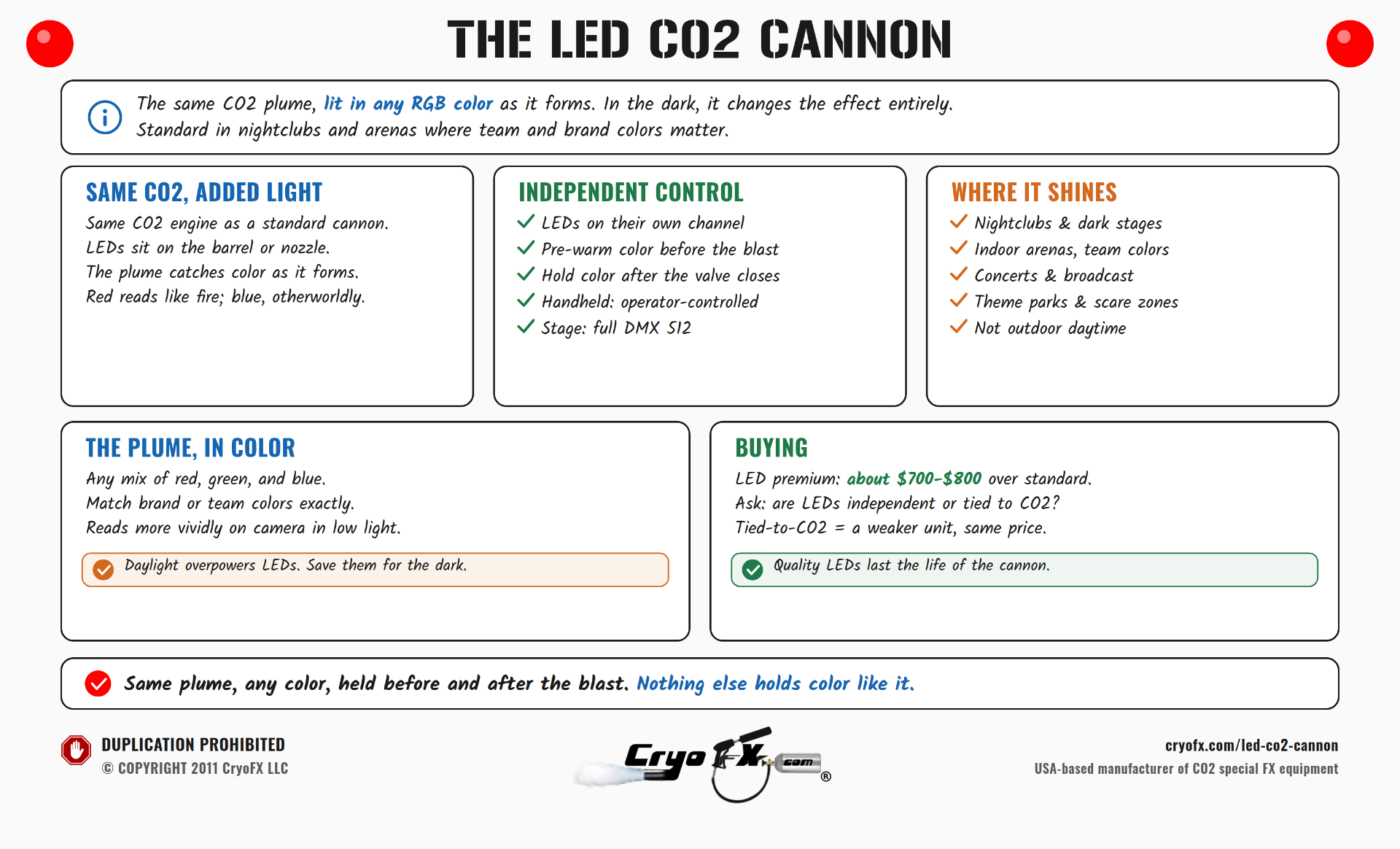
A standard CO2 cannon fires a white plume in complete darkness and it looks like a white plume. An LED CO2 cannon fires that same plume and it lights up, red, green, blue, any mix of the seven primary colors your lighting console can produce, and in a dark environment, it transforms the effect entirely. The CO2 output is identical. What changes is what you see when it fires.
LED CO2 cannons are one of the most requested SFX products in nightclubs, arena productions, and any live performance where the environment is dark enough for LED illumination to register. Understanding how they work, where they're most effective, and how to program them correctly will save you from buying the wrong unit or setting it up in a way that defeats the purpose.
What an LED CO2 cannon is
An LED CO2 cannon is a CO2 special effects device, either handheld or stage-mounted, with an integrated LED lighting system that illuminates the CO2 discharge as it exits the nozzle.
The CO2 output mechanism is exactly the same as a non-LED cannon: a siphon CO2 tank delivers liquid carbon dioxide through a high-pressure hose, the liquid undergoes a phase change at the nozzle, and the frozen ambient humidity creates the visible white plume at approximately -78.5°C (-109°F) discharge temperature.
The LED system is independent of the CO2 mechanism. The lights are positioned either on the barrel exterior or at the base of the nozzle pointing toward the discharge direction. On CryoFX handheld LED CO2 cannons, the barrel itself may be constructed with an illuminated white plastic outer shell, the internal barrel remains metal; it's the outer layer that lights up. On stage-mounted models, the LEDs point forward from the base of the cannon toward the direction of the CO2 discharge.
The effect in a dark environment is striking. The plume catches the LED color as it forms and expands outward, turning what is normally a white vapor cloud into a fully colored atmospheric effect. Red LEDs turn the plume into something that reads like fire. Blue turns it into something otherworldly. Mixed colors, like orange mixed from red and green channels, can be fine-tuned to match brand colors, team colors, or specific creative looks. This is why LED CO2 cannons are standard equipment in hockey arenas, basketball arenas, and other indoor sports venues where matching team colors matters.
How LED CO2 cannons work technically
The CO2 system and the LED system operate independently of each other, which is the most important design distinction between a quality LED CO2 cannon and a cheap one.
On lower-cost LED CO2 cannons, and even on some competitors' products, the LED is wired to the CO2 activation circuit. When CO2 fires, LEDs turn on. When CO2 stops, LEDs turn off. This sounds logical until you use it in production: it means you can't pre-warm the LED color before the blast, and the LEDs cut off the moment the CO2 valve closes, which eliminates the opportunity to light up the dissipating plume in the air after the blast ends.
CryoFX LED CO2 cannons run the LED system on a separate control channel. The CO2 fires when told to. The LEDs do whatever the DMX console tells them to do, regardless of whether CO2 is currently firing.
For stage-mounted LED CO2 cannons, DMX control is standard. The DMX channel assignment for CryoFX units is:
- Channel 1: CO2 fire (on/off)
- Channel 2: LED dimming
- Channel 3: Red
- Channel 4: Green
- Channel 5: Blue
- Channels 6 and 7: Model-dependent (strobe on some units, preset colors on others)
Handheld LED CO2 cannon models don't use DMX, the LED and trigger are operator-controlled. Stage-mounted models use full DMX 512 control, which means they integrate into any standard lighting console setup. Power requirements vary by model, confirm your venue's available power source before purchasing or renting.
The LED driver quality matters. CryoFX uses LEDs rated for extended use that don't overheat, don't melt, and don't fade over time under regular professional cycling. The most common failure mode on cheap LED CO2 cannons isn't the CO2 valve, it's the LED driver or the LED elements themselves, especially when the unit is used outdoors in rain or sustained moisture, or when it takes physical impacts from handling or transport.
Best applications
Nightclubs are the primary home for LED CO2 cannons. In a dark environment with strobes, beam lights, and lasers already working, an LED CO2 cannon firing a colored plume over the dance floor is a significant visual moment. The plume catches and holds color in a way that nothing else on the effects menu does.
Indoor arenas and sporting events, hockey, basketball, any venue with low ambient light during a pre-game or halftime show, get tremendous value from LED CO2 cannons. Red and gold for one team, blue and white for another. The LED CO2 cannon installed at the tunnel entrance for player introductions, firing with the team's colors as players take the floor or ice, is a setup CryoFX has implemented across multiple stadiums across the country.
Concert productions and touring shows use LED CO2 cannons for televised visual moments. The camera captures LED-lit CO2 differently depending on ambient lighting conditions, in low light, the LED color registers on camera more vividly than it does to the naked eye in person. For broadcast-quality productions, this is an advantage.
Theme parks and seasonal events like Halloween Horror Nights use LED CO2 cannons to build atmospheric color around specific scare zones or entertainment moments. The ability to shift from blue-white cryo fog to red-orange fire-color fog in real time via DMX gives creative directors significant flexibility.
Private parties and corporate events benefit from LED CO2 cannons when the event aesthetic calls for a specific color palette and the space is dark enough for the LEDs to read.
Where LED CO2 cannons don't add value: outdoor daytime events. Natural light overpowers the LED output completely. If your event runs entirely during the day with no covered or low-light environment, the LED premium isn't worth it, a standard CO2 cannon machine will look the same. If the event starts during the day and continues into the evening, LED CO2 cannons become relevant once the sun goes down. Plan accordingly.
Buying an LED CO2 cannon
The price premium for an LED CO2 cannon for sale compared to a standard non-LED unit is approximately $700 to $800, give or take depending on the specific model. Some models will be a bit more, some a bit less. The cost is in the LED system itself, the independent control module, and the engineering required to make the two systems work together without interference.
What you should ask about before buying any LED CO2 cannon: are the LEDs independently controllable or tied to the CO2 activation? If they're tied to CO2 activation, you're buying a less capable product for the same price bracket. The independent control architecture is the feature that makes LED CO2 cannons useful in actual production environments.
Also ask about the LED lifespan and what failure looks like. Quality LEDs under normal professional use will last the life of the cannon. Failures typically come from two causes: sustained heavy rain in outdoor use, or physical impacts that damage the LED housing or driver board. Neither is a design failure, they're use-condition failures. For outdoor events in wet conditions, consider a rain cover or confirm your unit's weather resistance rating.
CryoFX LED CO2 cannons, both handheld and stage-mounted versions, are available with current pricing and specifications at cryofx.com/products/co2-cannon-products. For a full CO2 cannon overview including how LED models fit into the broader product family, see cryofx.com/co2-cannon.
Setup and DMX programming
For anyone patching an LED CO2 cannon into a lighting console for the first time, the most common mistake is treating the unit like it has preset modes.
Most lighting consoles have a workflow built around assigning fixture profiles and using preset color selections or chase programs. LED CO2 cannons don't behave well with presets because the DMX channel values are continuous (0 to 255 per channel), not binary. Setting a channel to "on" in a preset often snaps it to a specific value that may not be what you want. The right approach is to build the LED CO2 cannon as a custom fixture in your console, then assign individual zero-to-255 values to each channel. Zero is off; 255 is full on. Everything in between is a proportional value for that channel's output.
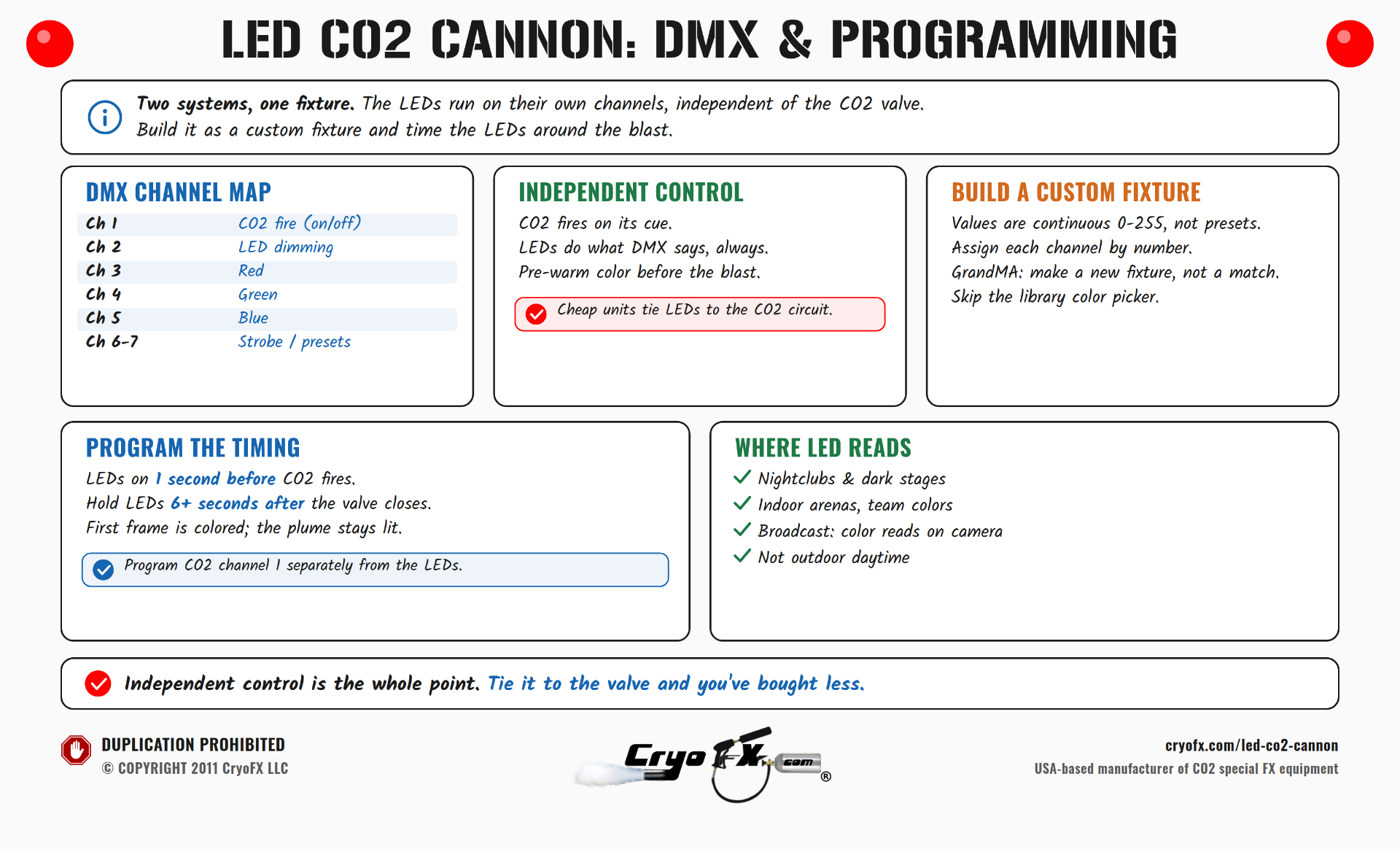
For GrandMA programming specifically: create a new fixture definition for the LED CO2 cannon rather than trying to match it to an existing profile. Assign each channel individually. Program the channel values as explicit numeric entries rather than using the fixture library's color picker, which may not map correctly to the specific channel assignment on your unit.
Timing is the other major programming element. The most effective LED CO2 cannon programming turns the LEDs on one second before the CO2 blast fires, then holds the LEDs on for at least six seconds after the CO2 valve closes. This accomplishes two things: the LEDs are already illuminating the area when the plume forms (so the first frame of the blast is fully colored), and the LEDs continue illuminating the dissipating plume in the air for several seconds after the blast ends, extending the visible effect duration. The plume in the air after the blast ends is still visible in a dark environment, and if your LEDs cut off the moment CO2 stops firing, you're losing several seconds of usable effect.
Program CO2 channel 1 separately from the LED channels. The CO2 blast timing should match your cue triggers, beat drops, highlight moments, or specific show cues. The LED timing wraps around the CO2 cue with the pre-delay and post-hold described above.
FAQ
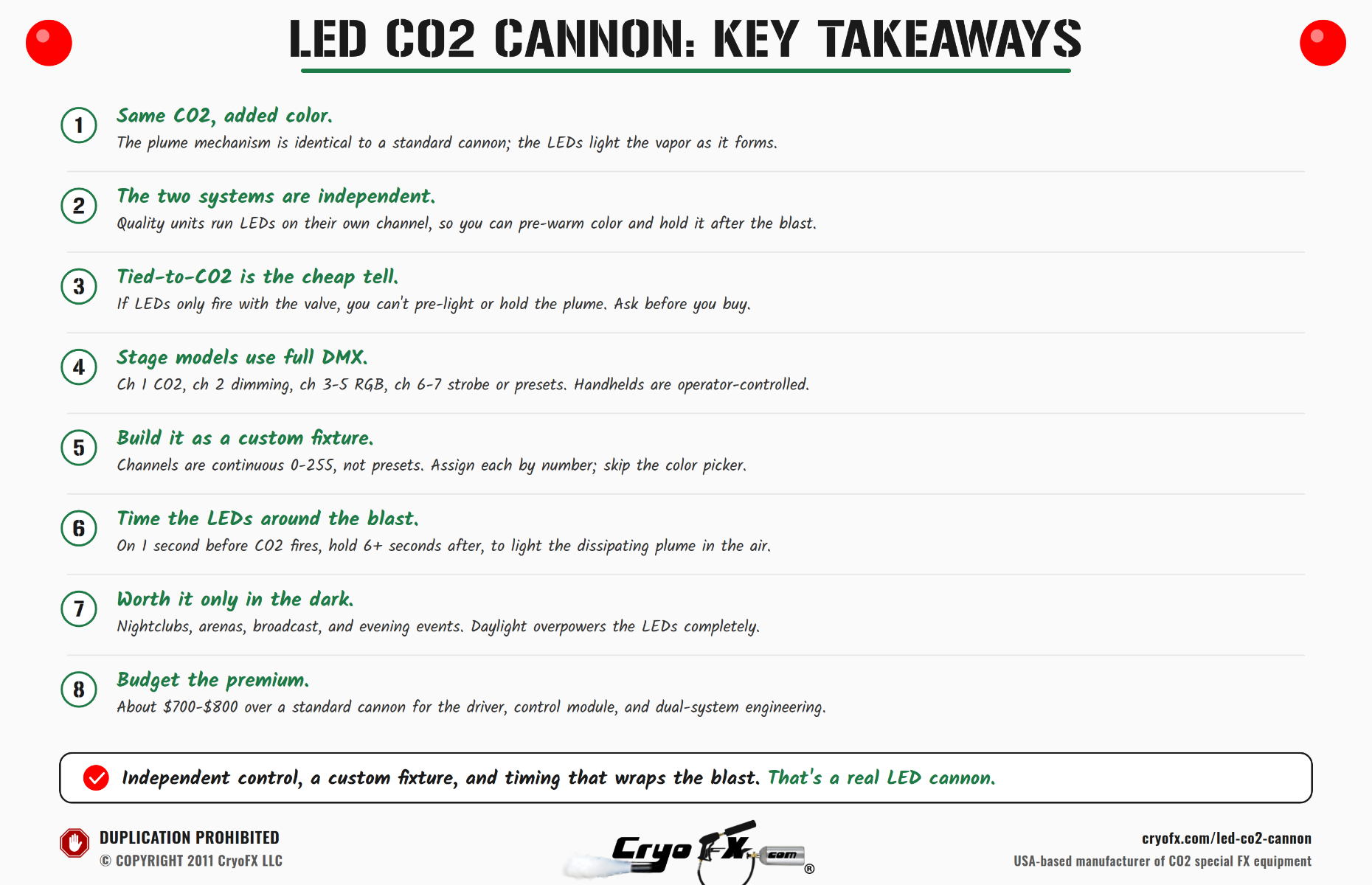
What is an LED CO2 cannon? An LED CO2 cannon is a CO2 special effects device with an integrated RGB LED lighting system that illuminates the CO2 plume as it discharges. The CO2 mechanism and LED system operate independently, allowing the LEDs to be pre-warmed before a blast and held on after the blast ends.
What colors can an LED CO2 cannon produce? Standard LED CO2 cannons use red, green, and blue channels with full DMX mixing, giving access to the full range of RGB color combinations. All seven primary colors and any mixed hue are available through proportional channel control on a DMX console.
How many DMX channels does a CryoFX LED CO2 cannon use? Typically 5 to 7 channels: channel 1 for CO2 fire, channel 2 for LED dimming, channels 3-5 for red/green/blue, and channels 6-7 depending on the model (strobe or preset colors on some units).
How much more does an LED CO2 cannon cost than a standard one? Approximately $700 to $800 more, depending on the model. The premium covers the LED driver, independent control module, and the engineering required to run both systems separately.
Is an LED CO2 cannon worth it for outdoor daytime events? No. Natural daylight overpowers the LED output entirely. LED CO2 cannons deliver their full value in dark environments: nightclubs, indoor arenas, covered stages, or outdoor events that continue into the evening. If your event is purely daytime in full sunlight, a standard CO2 cannon produces the same visual result for less cost.
Why does it matter whether an LED CO2 cannon has independently controllable LEDs? When the LEDs are tied to the CO2 activation circuit, they turn on only when CO2 fires and cut off the moment the valve closes. Independent LED control lets you pre-warm the color one second before the blast fires and hold the LEDs on for several seconds after the CO2 stops, illuminating the dissipating plume in the air and extending the visible effect duration.
What are the best venues or events for an LED CO2 cannon? LED CO2 cannons deliver maximum value in dark environments: nightclubs, indoor arenas, covered stages, concert productions, and theme park seasonal events. Hockey and basketball arenas use them to match team colors during player introductions. Nightclubs use them to produce colored atmospheric plumes over the dance floor. Any event operating in low ambient light will see the full value of the LED premium.
How do you program an LED CO2 cannon on a DMX console? Build the LED CO2 cannon as a custom fixture in your console rather than using an existing profile or preset. Assign individual zero-to-255 values to each channel. Program LEDs to activate one second before the CO2 blast fires and hold them on for at least six seconds after the blast ends. For GrandMA users, create a new fixture definition and assign channels with explicit numeric entries.
What causes the LEDs to fail on an LED CO2 cannon? Quality LEDs under normal professional use will last the life of the cannon. Failures typically come from two causes: sustained heavy rain in outdoor use, which can damage the LED driver or housing, or physical impacts during transport and handling that damage the LED board. For outdoor events in wet conditions, use a rain cover or confirm the unit's weather resistance rating before deployment.
LED Co2 Cannon | CryoFX®
Updated - 07/24/2026.