Co2 Cannon Gun for SFX - Features, Benefits, Info | CryoFX®
CO2 cannon gun for SFX, features, benefits, info
When someone searches "CO2 cannon gun," they're almost always looking for one thing: a handheld CO2 special effects cannon. It's the most widely searched term for this product category in the entertainment industry, and for good reason. The handheld CO2 cannon gun is the entry point for most DJs, event planners, and performers getting into cryo special effects for the first time.
One important clarification before going further: "CO2 gun" can also refer to BB guns, pellet guns, and other pneumatic firearms powered by CO2 gas cartridges. That's a completely different product. In the context of special effects, stage productions, and live performances, a CO2 cannon gun means a handheld special effects device that discharges liquid carbon dioxide to create a dramatic burst of white vapor. If you're here for the SFX version, you're in the right place.
What a CO2 cannon gun is
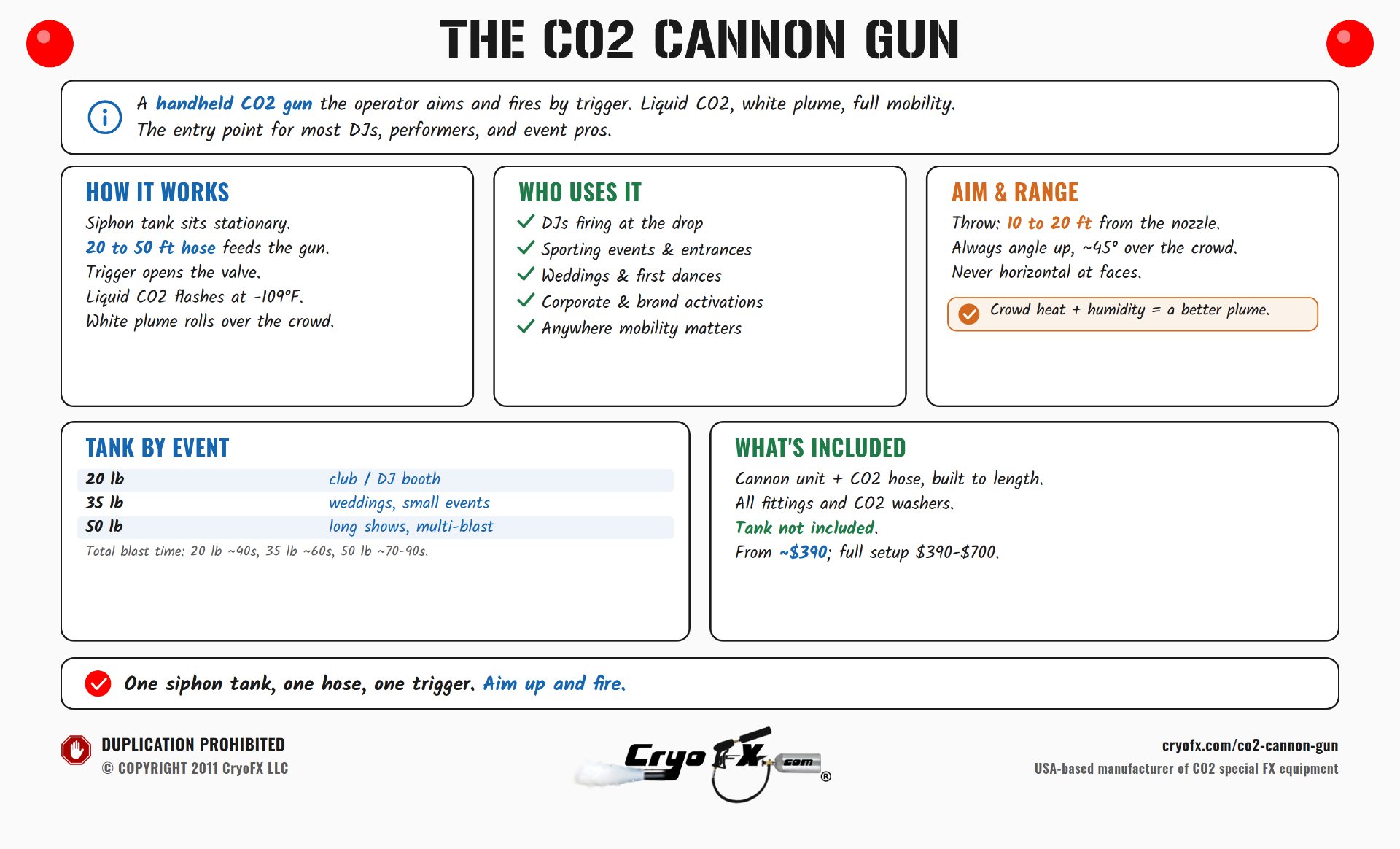
A CO2 cannon gun is a handheld device that an operator holds and fires manually to produce a burst of cryo fog effect. The operator holds the handle, squeezes or pulls a trigger, and liquid CO2 from a connected tank discharges through the nozzle as a cold, white, fast-dissipating plume.
The form factor looks something like a high-pressure steam wand or pressure washer handle, purpose-built for CO2 pressures, not similar at all internally but recognizable in shape. CryoFX produces multiple handheld CO2 cannon models, including standard versions, LED CO2 cannons, CO2 blasters, and the well-known CryoFX infamous handheld cannon. They also carry the CO2 Cannon brand's handheld units as a cost-efficient alternative.
DJs are the most common operators by far. A DJ with a handheld CO2 cannon gun firing a blast at the drop of a track is one of the defining images of nightclub and festival culture in the last decade. But the cannon gun is used just as often at sporting events, grand entrance moments, private parties, weddings, corporate events, and anywhere a fast, impactful visual effect is needed in a space where the operator needs mobility.
The term "cryo gun" is used interchangeably with CO2 cannon gun within the entertainment industry. Technically, a cryo gun can also refer to medical devices, pest control equipment, or industrial CO2 spray tools used in other fields. In special effects contexts, cryo gun and CO2 cannon gun describe the same handheld SFX product. For a detailed CO2 cannon guide that discusses every product type and use case extensively, you can check out cryofx.com/co2-cannon.
How it works in operation
The setup is simple. A CO2 siphon tank sits stationary, in the DJ booth, on the stage floor, or behind a set piece. A CO2 hose connects the tank to the handheld cannon gun. Hose lengths typically run 20 to 50 feet, giving the DJ or operator enough range to move across a stage or DJ booth without dragging the tank with them.
The siphon tank is the only source of CO2 that works for this application. It contains liquid CO2 drawn through an internal dip tube, which sends liquid (not gas) through the hose and into the cannon. The tank operates at 850 to 900 psi. When the operator pulls the trigger, a valve inside the cannon opens, the liquid CO2 reaches the nozzle, and a phase change occurs: liquid immediately becomes gas, the temperature at discharge hits approximately -78.5°C (-109°F), and the moisture in the surrounding air freezes temporarily into the visible white plume.
For a DJ operating at a nightclub or club performance, the tank is usually a 20 lb CO2 tank positioned in or just behind the DJ booth. The hose feeds into the booth, giving the DJ reach to spray upward over the crowd, or to stand on top of the DJ booth and fire out toward the audience from above. For wedding DJs and smaller events, a 20 lb or 35 lb tank works. For longer shows or multiple blast sequences, multiple tanks or a larger 50 lb siphon tank is the right call.
Throw distance from a handheld CO2 cannon gun is typically 10 to 20 feet from the nozzle. That's shorter than a stage-mounted CO2 jet with a fixed position and a more direct discharge angle, but plenty of range for a DJ operating in a booth or on a stage. The operator should always angle the nozzle upward, aiming just above the crowd at roughly a 45-degree angle.
At that angle, the CO2 blast rises, the heat from the crowd below (combined with the higher humidity from the sweat and perspiration of packed dancers) reacts with the cold CO2 to produce a visually excellent effect.
Pointing the cannon horizontally or downward at the crowd is never the right call, safety aside, the effect simply doesn't look as good and raises the risk of the cold gas hitting someone at face level.
CO2 cannon gun vs. cryo gun vs. fixed cannon
There are meaningful differences between handheld CO2 cannon guns, cryo guns, and stationary CO2 jets, even though they all run on the same liquid CO2 mechanism.
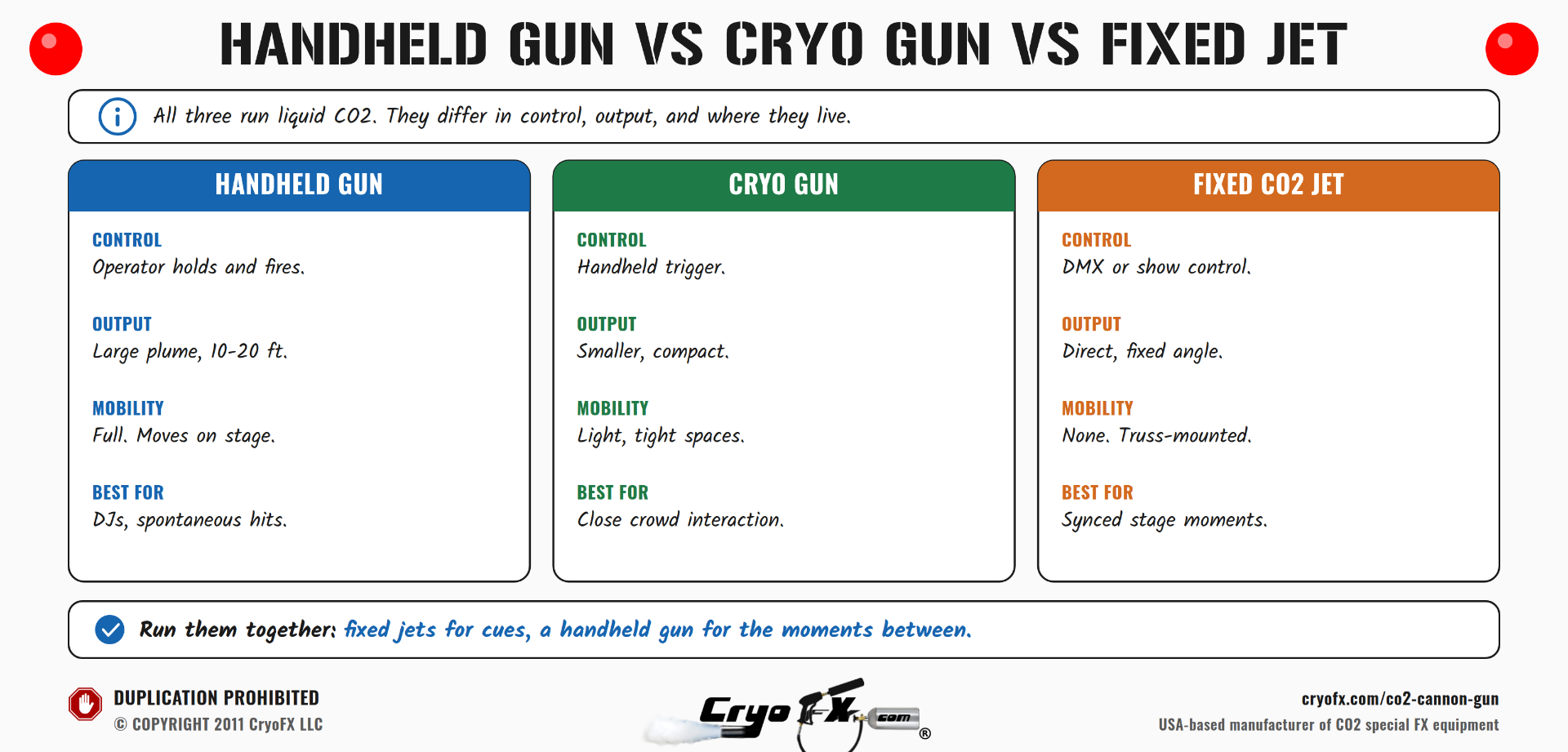
A handheld CO2 cannon gun is operator-controlled and mobile. The operator carries it, aims it, and fires it manually. It produces a larger output and throw distance than a cryo gun, and it gives the operator full directional control during the performance.
A cryo gun is smaller, more compact, and designed for close crowd interaction. It's lighter, easier to maneuver in tight spaces, and often used for audience engagement moments where the operator walks into or near the crowd. Output is smaller than a full CO2 cannon gun.
A fixed CO2 cannon or CO2 jet is truss-mounted, ceiling-mounted, or stage-mounted, controlled via DMX control or cycled power rather than a human trigger. These are the stage show and permanent installation workhorses. A fixed CO2 jet doesn't move; the operator doesn't interact with it directly during the show. It fires on cue from a lighting board or show control system.
All three can be used in the same show. A touring DJ might have fixed CO2 jets wired into the stage rig for synchronized moments and also carry a handheld CO2 cannon gun for additional mobility and spontaneous effect during their set. The two formats complement each other rather than replacing each other.
Buying and renting
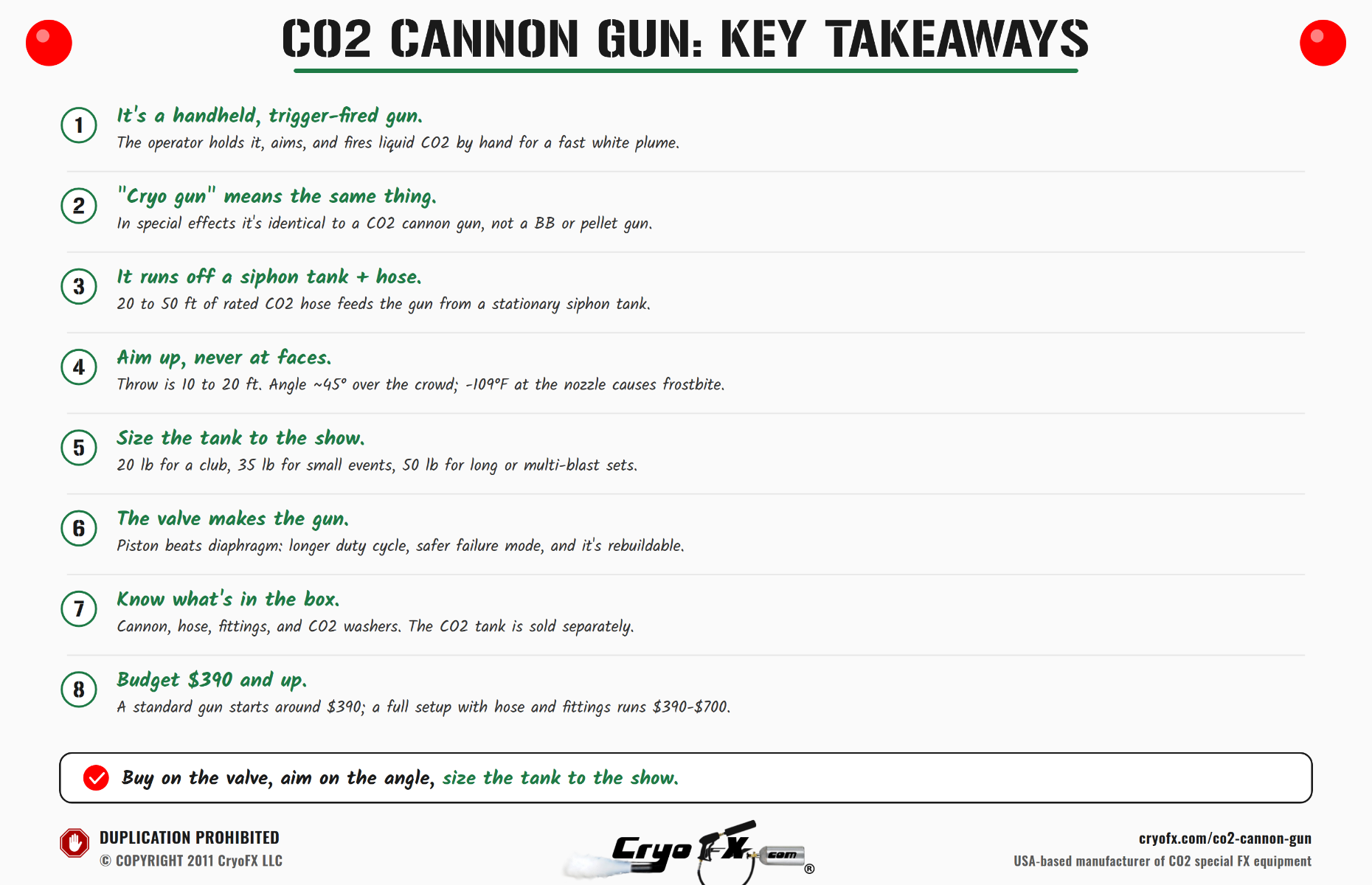
When you're buying a CO2 cannon gun, the most important specification isn't what you see on the outside, it's the valve inside. CryoFX builds their handheld cannons with piston solenoid valves, not diaphragm valves. Piston valves handle CO2's high-pressure cycling over a much longer duty cycle (50,000 to 60,000 activations), fail more safely, and are rebuildable. Diaphragm valves use a thin membrane that wears out under sustained CO2 use, especially with the temperature swings involved in liquid CO2 discharge.
The most common failure points on lower-cost handheld units are the seats and seals, these freeze, crack, or degrade over time when built to cheap specifications. The nozzle can also fail if it isn't designed correctly for CO2 pressures. And the hose is frequently overlooked: not any high-pressure hose will work.
The hose must be rated for CO2 temperatures as well as CO2 pressures, and it must be constructed in a way that doesn't transfer smell to the CO2 discharge. Using the wrong hose will produce an unpleasant odor in the plume. CryoFX manufactures their own hoses, and these are certified for permanent installation by fire prevention authorities in numerous venues.
What's included with a CryoFX handheld CO2 cannon gun out of the box: the cannon unit itself, the CO2 hose (in the length you select at purchase, built to order), all fittings, and CO2 washers. The CO2 siphon tank is not included. See the separate accessories article for full setup details.
CryoFX backs their handheld CO2 cannon line with a limited lifetime warranty on manufacturer defects, as long as you own the unit.
Rental is a solid option if you're doing occasional events and don't want to own and maintain the equipment. CryoFX's rental program typically includes a 2-day rental window (not counting shipping days), and CO2 tanks can be arranged depending on your market. There's a minimum order quantity on rented tanks. Rental works well for event planners who need the effect once or twice a year, or for performers testing the equipment before committing to a purchase.
The price range for a standard handheld CO2 cannon gun from CryoFX starts around $390 and goes up depending on the model and included options. A complete professional setup including hose, washers, and fittings (before adding a tank) comes in somewhere between $390 and $700. For a CO2 cannon gun for sale with current pricing and package options, visit cryofx.com/products/co2-cannon-products.
Safety and operating rules
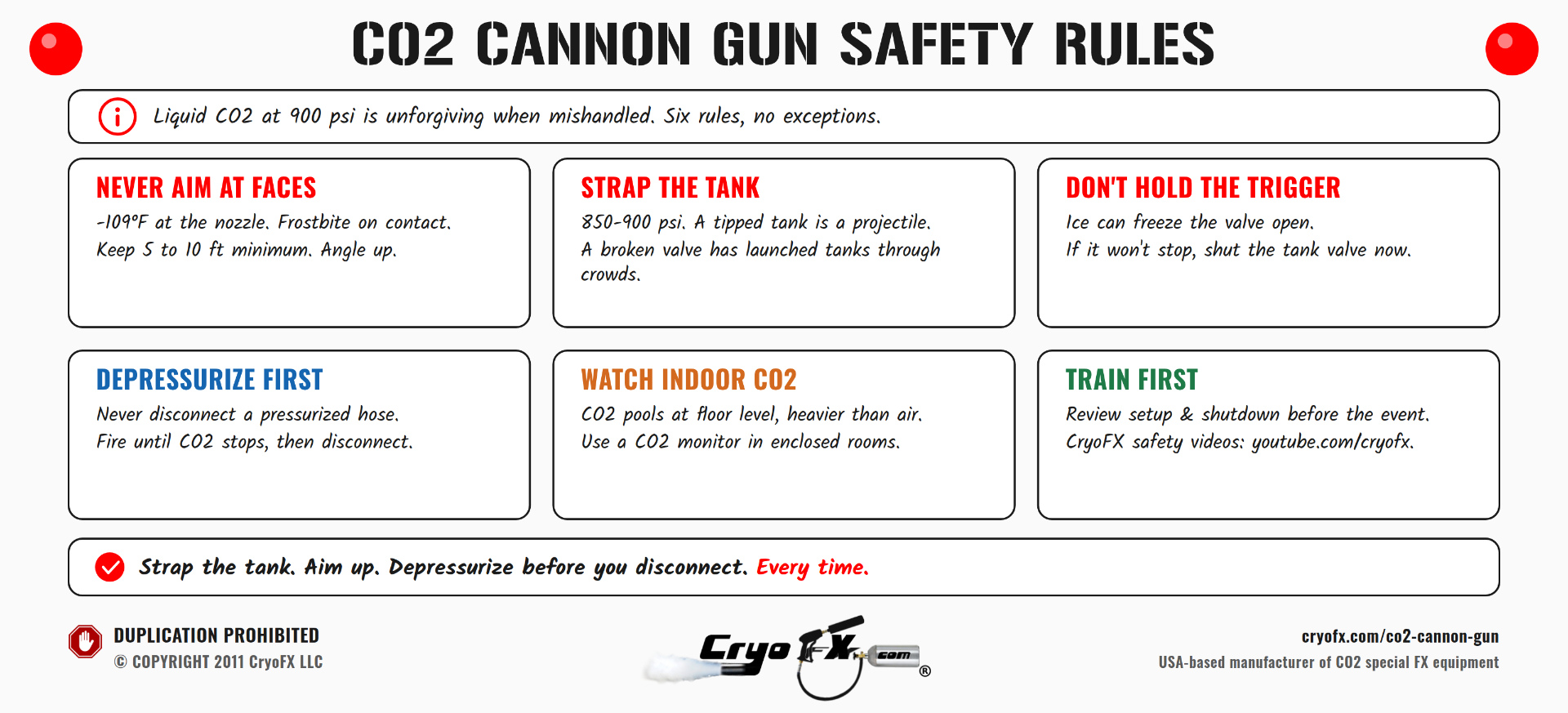
Liquid CO2 at 850 to 900 psi is unforgiving when mishandled. The most dangerous thing an untrained operator can do is also the most obvious: aim the cannon at someone's face. Never do it. The discharge temperature at the nozzle is -78.5°C, and direct sustained contact causes frostbite immediately.
The minimum safe distance from the nozzle to any person in the path of the blast is 5 to 10 feet, and even then, the cannon should be aimed above the crowd rather than directly at anyone. Never aim horizontally at people's faces. Always angle upward. This protects the audience and also produces a better visual effect.
If the trigger is held down too long, or if the cannon is cycled repeatedly without giving the valve time to reset, ice can build up inside the valve. This can cause the cannon to freeze open, which means it won't stop firing until you shut off the tank. In more serious cases, ice chunks can develop inside the barrel. If those eject through the nozzle, they can injure someone. If you notice the cannon isn't shutting off when you release the trigger, shut the tank valve immediately.
The tank must be strapped down or otherwise secured before any use. A CO2 siphon tank at 850 to 900 psi is extremely heavy and will knock over objects and people if tipped. If the valve on top of the tank breaks off from a fall, the tank can become a dangerous projectile. CryoFX has direct knowledge of an incident where an unstrapped tank was pulled over by a hose, the valve broke off, and the tank launched through a crowd. One person reportedly lost a leg. Strap the tank down. Every time.
Never disconnect a hose from a CO2 tank while the hose is still under pressure. Release pressure from the hose first by firing the cannon until CO2 stops coming out, then disconnect. A pressurized hose that disconnects suddenly will whip violently.
For indoor events and private parties, CO2 accumulates at floor level because it's heavier than air. In enclosed spaces or areas with poor ventilation, high CO2 concentration is an asphyxiation hazard. Use a CO2 monitor for any sustained indoor use in smaller or low-ceiling venues.
CryoFX publishes full safety training resources on their YouTube channel (youtube.com/cryofx) covering setup, operation, and safe shutdown procedures. First-time operators should review these before their first event, not during it.
FAQ
What is a CO2 cannon gun used for in special effects? A CO2 cannon gun is used to produce dramatic cold-fog burst effects at DJ shows, nightclubs, concerts, festivals, sporting events, weddings, and corporate events. The operator holds the gun, connects it to a CO2 siphon tank via a hose, and fires liquid CO2 that creates a white vapor plume on discharge.
Is a CO2 cannon gun the same as a cryo gun? In the special effects industry, yes, the terms are used interchangeably. Technically, a cryo gun can also refer to equipment used in medicine, pest control, and other industries. In the SFX context, CO2 cannon gun and cryo gun both describe a handheld device that discharges liquid CO2 for visual effect.
How long does a CO2 tank last with a handheld cannon gun? Runtime depends on tank size and how the operator fires. A 20 lb siphon tank gives approximately 40 seconds of total blast time. A 35 lb tank provides roughly 60 seconds. A 50 lb tank yields around 70 to 90 seconds. Most DJs spread their blasts throughout a set rather than depleting a tank continuously.
What's the safe way to aim a CO2 cannon gun? Always aim upward or at a 45-degree angle above the crowd. Never aim horizontally at faces. Maintain at least 5 to 10 feet of distance between the nozzle and any audience member. The discharge at the nozzle is -78.5°C, which can cause frostbite on direct skin contact.
What happens if you hold the trigger too long on a CO2 cannon gun? The valve can freeze open due to ice buildup, preventing it from shutting off when you release the trigger. If this happens, shut off the CO2 tank valve immediately. Repeated rapid cycling without rest time can also build ice inside the barrel, which creates a risk of ice chunks discharging through the nozzle.
How does a CO2 cannon gun differ from a fixed CO2 jet? A CO2 cannon gun is handheld and operator-controlled, giving the user full mobility and directional control. A fixed CO2 jet is truss-mounted or stage-mounted and controlled via DMX or cycled power. Fixed jets fire on cue from a lighting console; the cannon gun fires when the operator pulls the trigger. Both use the same liquid CO2 mechanism.
What type of valve does a CryoFX CO2 cannon use, and why does it matter? CryoFX builds their handheld CO2 cannons with piston solenoid valves rather than diaphragm valves. Piston valves handle CO2's high-pressure cycling over a much longer duty cycle, rated at 50,000 to 60,000 activations. They are rebuildable, fail closed for safety, and hold up better under the temperature swings involved in liquid CO2 discharge.
How much does a CryoFX CO2 cannon gun cost? A standard handheld CO2 cannon gun from CryoFX starts around $390. A complete professional setup including hose, washers, and fittings comes in between $390 and $700 depending on the model and included options. The CO2 siphon tank is not included in that price and must be sourced and filled separately.
Is it safe to use a CO2 cannon gun indoors? Yes, with proper ventilation. CO2 is heavier than air and accumulates at floor level in enclosed spaces. In smaller or low-ceiling venues, sustained indoor use can raise CO2 concentrations to an asphyxiation hazard. Use a CO2 monitor for any extended indoor operation. CO2 does not trigger smoke detectors, which makes it suitable for most indoor venues.
Co2 Cannon Gun | CryoFX®
Updated - 07/23/26.