The Ultimate Guide To Co2 Jets: Everything You Need To Know About Cryo Jets And Co2 Jet Systems
Co2 Jet | CryoFX
Co2 Jet from CryoFX. Largest Selection of Co2 Jets for Sale!
LED Co2 Jet • Swing Co2 Jet • DMX Co2 Jet • Co2 Jet Rental • Custom Co2 Jet
Order NOW...Call:1.855.527.9639

CryoFX LLC • 3859 S Valley View Blvd, Suite 2, Las Vegas, NV 89103 • 1.855.527.9639
24/7 Rental Inquiry Submission: https://cryofx.com/rental#amform-form-6
The Ultimate Guide To Co2 Jets: Everything You Need To Know About Cryo Jets And Co2 Jet Systems
CO2 Jet Special Effects: How Cryo Jets Work, Types, And Rental
A CO2 jet is the stage-mounted version of the CO2 cannon. Same liquid CO2 and the same white plume. The difference is that no one is holding it. It bolts to a stage, a truss, a DJ booth, or a ceiling, it fires from a DMX console or a switch, and it delivers the same plume on the same cue every night for years.
That repeatability is why every touring production, mega club, arena, and theme park that wants CO2 ends up with jets rather than handhelds. It's also why the terminology is a mess. Production crews call them CO2 jets or cryo heads. Consumers and DJs call them cryo jets, or just CO2 cannons. Architects and general contractors who've seen one on a site visit call them CO2 jet cannons. Search engines add a few more: cryogenic fog cannons, cryogenic fog systems, cryogenic jet smoke machines, stage mounted cryogenic CO2 jets, CO2 cannon machine, cannon CO2, special atmospheric CO2 effects, and plumes of theatrical smoke. It's the same device, different names, and this guide covers all of them.
CryoFX LLC (CryoFX USA to our international clients) manufactures, designs, installs, rents, and services CO2 jet systems, and other production companies in the entertainment industry hire our cryogenic experts to evaluate systems they didn't build. Our jets and systems are in nightclubs and dayclubs in Las Vegas and Miami, NFL, NBA, and NHL arenas, theme parks, cruise ships, touring rigs, TV and film sets, custom speedboats, and a few penthouses where you'd never know a CO2 line runs through the wall. We've also walked hundreds of venues over the last 15 years to evaluate somebody else's installation, and most of what we found there is in this guide too, because the mistakes are as instructive as the builds.
If you only read one section, read the one on valves. Most CO2 jets look similar from the outside. The difference is what's inside.
What is a CO2 jet?
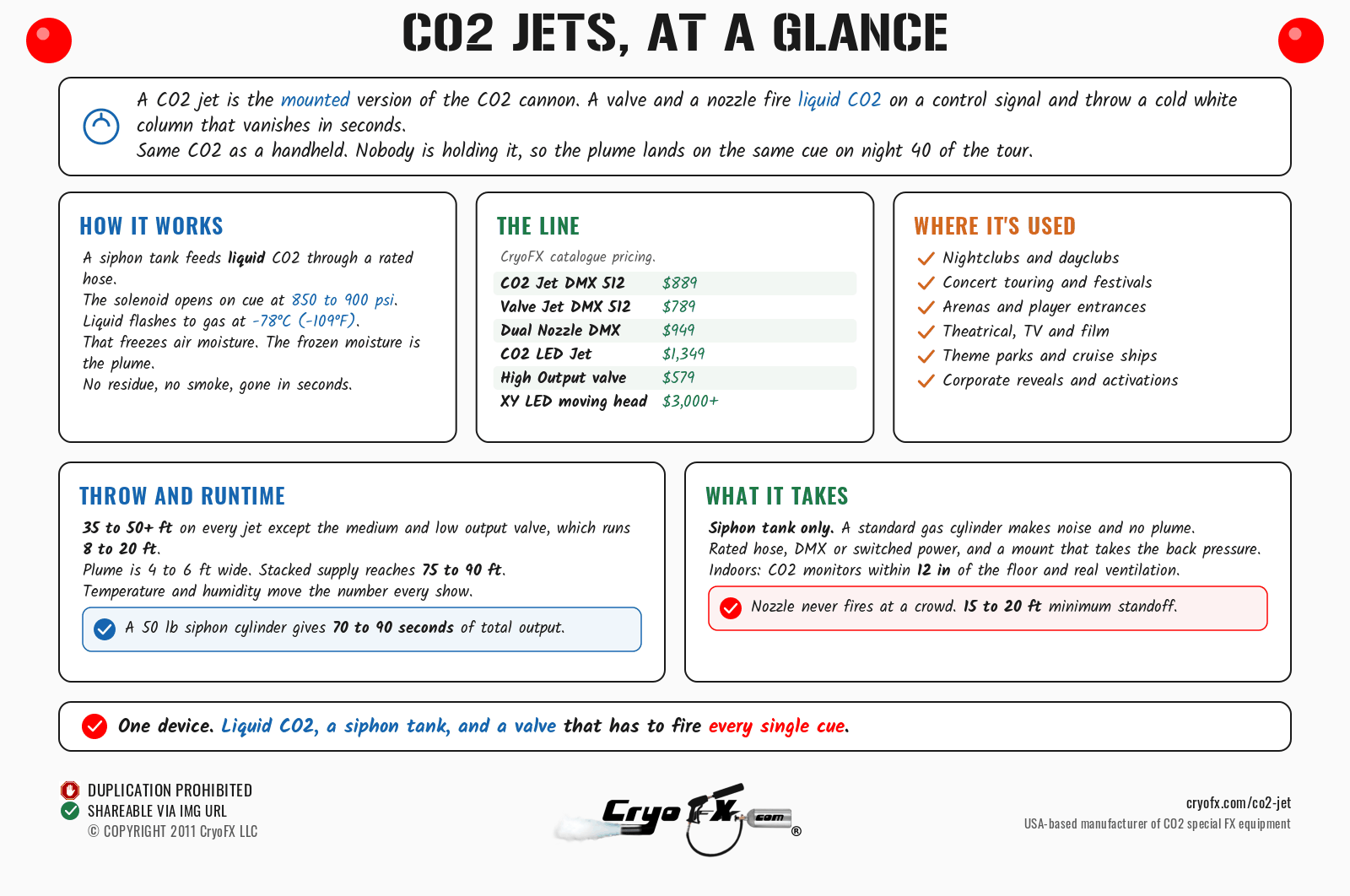
By production definition, a CO2 jet is a valve, a nozzle, and a housing that let liquid CO2 be switched on and off from a control signal. Crews also call them cryo heads. Stripped to the core, a CO2 jet is a CO2 hose, a valve rated for liquid CO2, and a nozzle, and that's it. Everything else on the unit (the case, the DMX input, the LCD display, the power switching, LEDs, pan and tilt) is built around that valve.
The question we get most often is what is a CO2 jet cannon, and the answer is naming. CO2 cannon is the umbrella term for every CO2 effect device. Under that umbrella, a handheld unit is a CO2 cannon gun or cryo gun, and a fixed, mounted unit is a CO2 jet. A cryo jet is the same mounted device under a second name. CO2 jet cannon is a third name for the same thing, usually from someone outside the production industry who has seen the effect and is describing it the only way they know how. When a client asks us for any of these, we ask 2 or 3 clarifying questions (fixed or moving, features, where it mounts) and then prescribe the right equipment. The use is what tells us which unit to send.
How a CO2 jet works mechanically
A hose runs from a liquid carbon dioxide (liquid CO2) tank to the jet. Inside the jet is a solenoid valve, which is a valve with an electrical coil wrapped around it. Energize the coil and the valve opens. Liquid CO2 at roughly 850 to 900 psi rushes through the valve orifice, out the nozzle, and into the room.
The nozzle does two jobs. It shapes the stream, and it creates an air exchange at the outlet so the liquid atomizes into the plume you see. Nozzle design dictates what the output looks like: a tight column, a wide cone, a flat fan, a split stream across multiple heads. Change the nozzle and you change the effect without changing anything upstream.
De-energize the coil and a spring drives the valve closed. That's the whole cycle. One channel of DMX, one relay click, or one switch throw opens it; releasing it closes it. CryoFX jets time out at about 6 seconds per activation as a safety measure and can be re-fired immediately. Some models run longer by design. A bare valve with no timer will stay open as long as the operator holds the signal or until the tank runs dry.
What the white plume actually is
The white plume is liquid CO2 flashing to gas at the nozzle. Liquid CO2 leaves the valve at around -78°C (-109°F), and that cold instantly freezes the water vapor already in the air around the nozzle. You're seeing frozen humidity, briefly, before it thaws back out. That's why the plume disappears in seconds and leaves nothing behind, and it's why CO2 effects look different from one room to the next. Humid, cool air gives you a longer, denser plume. Hot, dry air gives you a shorter plume that vanishes faster. A 2-second blast in San Diego at 60°F and 65% humidity looks better than a 5-second blast in Las Vegas at 90°F and 10%.
For the full chemistry of the phase change and why a siphon tank is non-negotiable, see our page on the properties of carbon dioxide. The short version: only liquid CO2 makes the plume. Gaseous CO2 out of a standard upright tank makes noise and nothing else.
How cold, how high, how far, how long
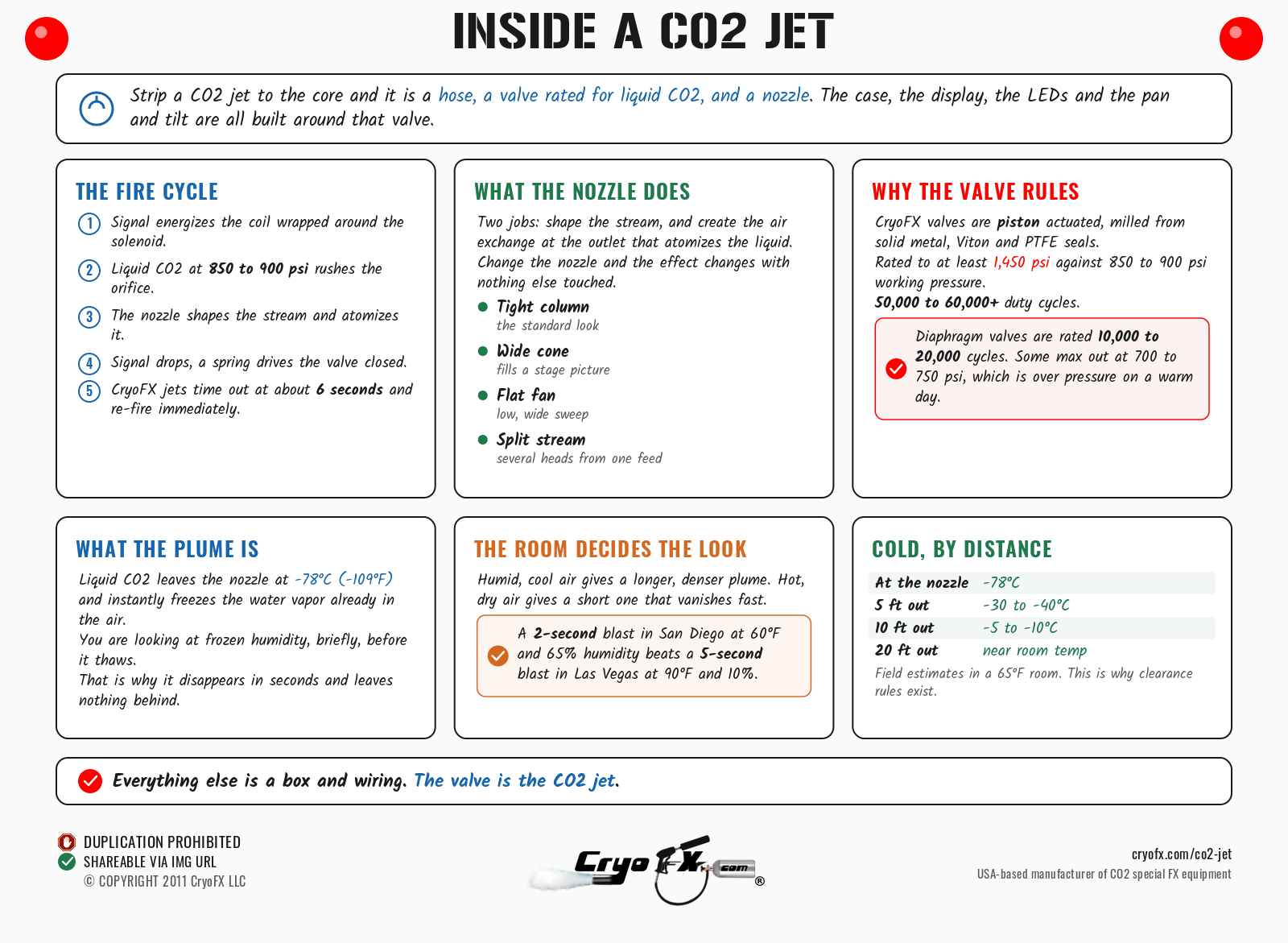
The liquid itself is far below zero. At the nozzle it's around -78°C. Five feet out in a 65°F room it's still in the -30°C to -40°C range, by 10 feet it's around -5°C to -10°C, and by 20 feet it's approaching room temperature. Those are field estimates, and they're the reason audience clearance rules exist.
A single standard jet on a single 50 lb siphon tank throws 35 to 50 feet and sometimes more, depending on temperature, humidity, and how the system is plumbed. Stack the supply (multiple tanks, multiple hoses, multiple valves and nozzles side by side) and a CryoFX power configuration reaches 75 to 90 feet. The plume from a single head is roughly 4 to 6 feet wide. Because the plume is a directional stream, height and distance are the same question: point the nozzle up and the number is height, angle it and the number is throw.
How long a blast lasts is an operator decision, capped by the timer on the jet and by the tank. CryoFX jets time out at about 6 seconds. The tank sets the real ceiling: a 50 lb siphon cylinder gives roughly 70 to 90 seconds of total liquid output through one jet, and every second of activation comes off that total. Tank runtimes for every size are in the tank section below.
What "fixed atmospheric effect" means
Designers use the phrase, and clients repeat it, so it's worth pinning down. A fixed atmospheric effect is a device in a fixed position that changes the atmosphere of a space on cue. A CO2 jet qualifies. So does a permanently plumbed fog system, a rain effect, or a snow machine.
When a client asks us for one, the phrase is where the conversation starts. Which atmosphere: fog, cold, steam, rain, snow? Does it need to dissipate instantly or linger? Will there be residue, and if so what does it land on? What are the limiting factors in the space (ceiling height, HVAC, sensors, sight lines)? Kris Mullins, CryoFX's founder and designer, has designed some of the most complex, fully interconnected liquid CO2 and special effects systems in theme parks, stadiums, and mega clubs in Las Vegas and around the world, and every one of them started with those questions.
Why fixed mounting makes a jet more show-accurate than a handheld
A handheld CO2 cannon goes where the operator points it, for as long as the operator holds the trigger, which varies with adrenaline and crowd noise. A mounted jet fires the same direction, for the same duration, on the same channel, every time the console sends the cue. That's why people buy jets. Lighting designers can program CO2 into a cue stack alongside strobes and movers and know that what they saw in rehearsal is what the audience sees on night 40 of the tour.
Types of CO2 jets
Each type below has its own search term, its own page on this site, and its own reason to exist. What they share is the valve.
Standard fixed CO2 jets
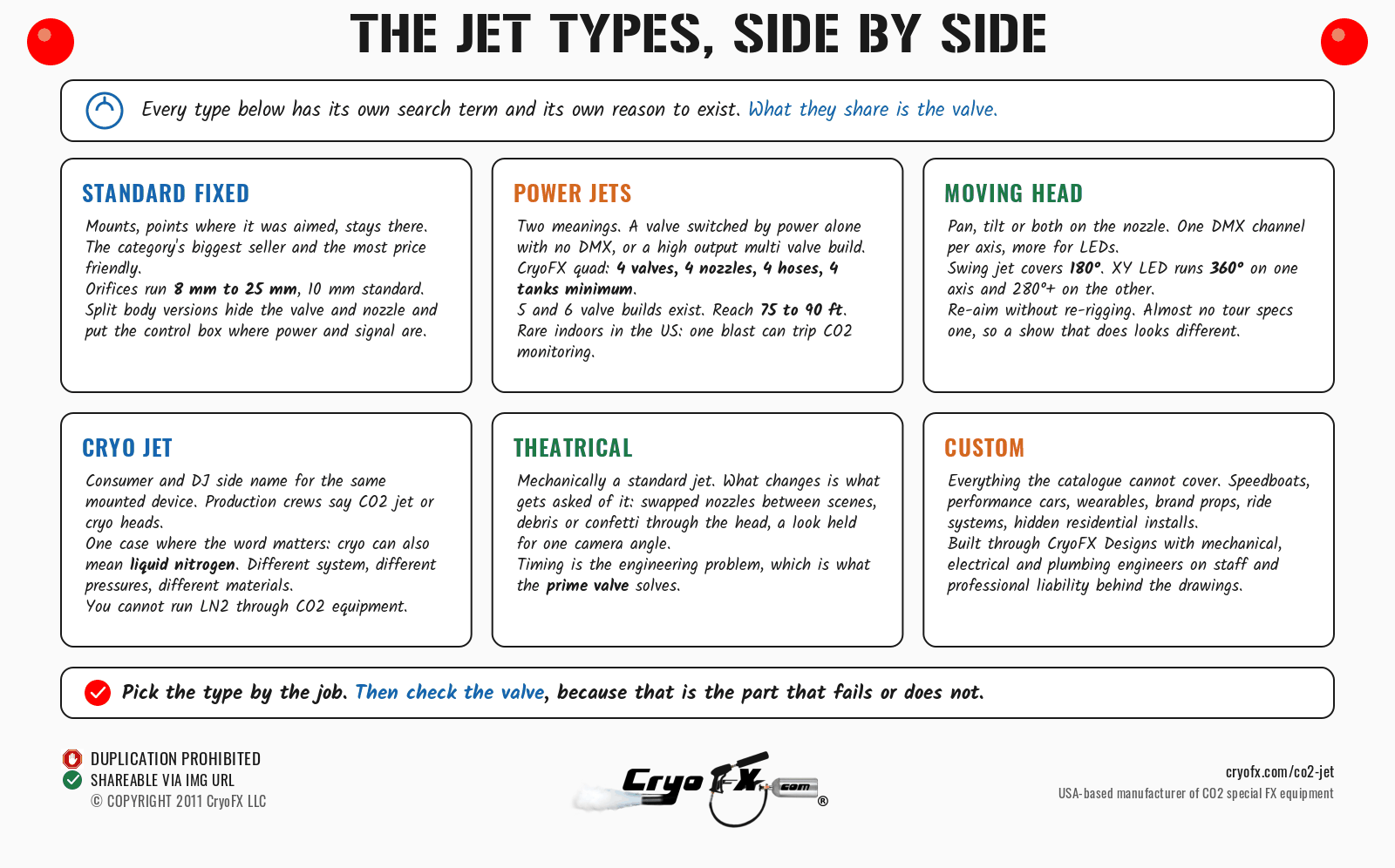
A standard fixed CO2 jet mounts somewhere, points where it was aimed, and stays there until a technician physically moves it or re-aims the nozzle. It's the most common configuration in the category and CryoFX's biggest seller in the form of the DMX 512 CO2 jet. It's the most common for a plain reason: it's the most price-friendly jet available. Anything with LEDs, pan and tilt, or multiple heads costs more, so when a venue wants 8 jets across a stage, 8 standard jets is where the budget lands.
Inside a standard CryoFX jet you'll find a valve machined from a solid block of metal (steel, stainless, or brass depending on the model) with a piston inside rather than a diaphragm. CryoFX stays away from diaphragm valves. They appear in competitors' equipment and they fail sooner, and the section on the CryoFX jet below explains why. Orifice sizes across the range run from 8 mm up to 25 mm, with 10 mm as the standard, and we've built 15 and 20 mm orifices on request.
One misconception worth killing here: a larger valve orifice does not mean a bigger output by itself. The whole fluid path has to be sized together. The CGA fitting on a standard CO2 cylinder has an opening of about 3.5 mm. A CryoFX hose has a 10 mm bore. A standard CryoFX valve has a 10 mm orifice. Put those in series with a 5-foot hose and the fitting is the choke point: the valve drains the short hose instantly and then it's pulling through a 3.5 mm hole, so your output is effectively a 3.5 mm stream. Replace that valve with a 15 mm orifice and nothing changes, because the restriction is still the fitting.
Now run the same tank into a 50-foot hose. The hose becomes a reservoir. When the valve opens it pulls the whole 10 mm column of liquid sitting in that hose before the 3.5 mm fitting has to keep up, so the first seconds of output are a full 10 mm stream. At some point the hose bleeds down to what the fitting can feed and output settles, but the opening of the blast is noticeably bigger. Add a second tank on a Y into the same hose and you have two 3.5 mm feeds (call it 7 mm combined) filling a 10 mm path. Add a third and you're around 10.5 mm of feed into a 10 mm hose and a 10 mm valve, which is the largest output that setup can produce. Only at that point does stepping up to a 15 mm valve, a larger-bore hose, and non-restrictive fittings start to pay off. A bigger orifice is worth specifying when every part in line can feed it. Otherwise it's money spent on a number.
In clubs, standard jets mount to the DJ booth, to the hanging truss over the dance floor, behind the stage lip, and at bottle service tables. CryoFX also builds split-body jets where the control enclosure is separate from the valve and nozzle. The valve and nozzle hide under the booth, behind a wall, or inside a ceiling, and the control box sits wherever there's power and signal. Jets from CryoFX have gone into moving set pieces, trusses, stages, boats, and trucks. The category page for CO2 jets covers the full range of configurations we stock.
Power CO2 jets
"Power CO2 jet" means one of two things, and we clarify which before quoting. Some clients mean a jet that runs on power alone, with no DMX: a valve that opens when it gets 12 V or 24 V DC or 110 or 220 V AC and closes when it doesn't. That's a valid product and we sell plenty of them, usually into installs where a show controller or relay is doing the switching.
The second meaning is industry slang for a jet with more output than a standard unit. At CryoFX that's our quad jet: 4 valves, 4 nozzles, 4 hoses, a minimum of 4 tanks, and a cloud that reaches the far wall of a 200-foot room. We've also built 5- and 6-valve configurations, and for outdoor work we've fed 5 hoses into a single 20 mm orifice valve to produce a massive cloud at festival main stages and stadiums.
A single hose, valve, and nozzle throws 35 to 50 feet. Doubling the setup adds a few feet. Doubling again adds more. Around 4 or 5 parallel setups the gain flattens out, and that's where the 75 to 90 foot figures come from. Spacing between nozzles, nozzle type, valve orifice, hose bore and length, and tanks per hose all decide where a given power jet lands inside that range.
Two cautions. First, a power CO2 jet at full output in a US venue will put one or two blasts' worth of CO2 into the room, and that's enough to trip CO2 monitoring tied to the fire alarm. You don't see quad jets indoors in the United States very often for that reason. Other countries have looser protocols and we won't speak for them. Second, output of that size has to be designed before it's bought. CryoFX sells power jets off the shelf and builds them to order, and the order process includes the monitoring and supply design around them.
Moving head CO2 jets
A moving head CO2 jet adds pan, tilt, or both to the nozzle. One DMX channel drives the X axis, one drives the Y axis, and further channels handle LEDs or other features on the unit. CryoFX's original moving head was nicknamed R2D2 for its dome, and many of those units went to the largest names in US entertainment, including Disney and stadium clients. The current models are smaller, add LEDs, and do the same job.
The reason to buy one is directional flexibility without re-rigging. A theme park can re-aim the same jet for a different show on a different day. A lighting designer can give the audience 3 distinct looks from one fixture during one song. Our XY LED CO2 jets went into a Miami club recently, and the venue liked the result enough that they're bringing CryoFX to their other properties.
Concert tours, theatrical productions, and broadcasts mostly still spec standard jets, partly from habit. We've had specific theatrical requests for moving heads, including productions that used the nozzles to throw things other than CO2. And we'll say this directly to every LD reading: almost no tour specs moving head CO2, so a show that does will look different from the one before it. CryoFX will help you choose models and program them.
Theme parks and stadiums that buy moving heads usually also buy spares: valves, wiring harnesses, circuit boards. These are electromechanical fixtures. When one stops working, a component has failed, and swapping that component is far cheaper than replacing the fixture.
CO2 cryo jets
"Cryo" means cold. "Jet" means something that sprays forward. A cryo jet, by the dictionary, is anything that sprays out cold, and in the entertainment industry that's been shorthand for a CO2 jet for as long as the effect has existed. CO2 jet is the term hard-core production people use (or cryo heads, which sounds odd until you've heard a stage manager say it 30 times in a night). Cryo jet is the consumer-side, DJ-side term. It's the same equipment.
There is one case where the word matters. Because cryo means cold rather than CO2, a "cryo jet" can also mean a liquid nitrogen head. CryoFX installs liquid nitrogen effect systems too. They're rarer than they used to be because of cost, installation complexity, and additional safety concerns, and they run at lower pressure with different materials throughout. So when anyone asks us for a cryo jet, we always confirm: CO2 or LN2? Those are different systems and you cannot run LN2 through CO2 equipment, which the FAQ covers.
The CO2 cryo jet page has the full terminology breakdown. It's the page to send to a client who keeps calling the thing three different names on the same call.
One more thing the "cryo system" label brings up. Over the last 15 years CryoFX has walked hundreds of venues across almost every US state to run feasibility studies on repairing or replacing an existing cryo system, CO2 or LN2. Most of them were installed wrong. Most of those systems were soldered together by someone who normally does residential or commercial plumbing, using copper that mostly wasn't rated for the service, with no engineering behind the design and no understanding of how liquid CO2 behaves in a long line.
The client then spends years paying to keep a system alive that was never designed as a whole. We've had clients with buckets hanging under leaking liquid nitrogen lines over patrons' heads, believing the bucket would catch it. In several of those cases CryoFX declined the repair and issued a cease-operation advisory instead, because you cannot repair a system that was designed incorrectly from the start. We produce the full feasibility report, the testing, and the recommendation, and the recommendation is usually to redo it.
Theatrical CO2 jets
A theatrical CO2 jet is, mechanically, a standard jet. What's different is what gets asked of it. Theatre and theme park clients want to fire debris, confetti, or other materials through the head, swap nozzles between scenes, or get a specific look (steam off a prop, low fog over water, a cloud that holds for one camera angle). Often the "jet" we deliver is a valve and a set of interchangeable nozzles the client changes themselves.
Timing is the real engineering problem. Theatrical cues have to fire instantly and identically, but the system may sit idle with CO2 in the lines for a long time between cues. In that idle period, especially in a warm building or on a long run, some liquid in the line converts to gas, starting at the far end near the valve. Fire the show valve then and you get a spurt of gas, then a stutter, then liquid. That's unacceptable on a cue.
CryoFX solves this with a prime valve. It's a second valve on a tee immediately upstream of the show valve, with a muffler or an exhaust hose that vents outside or somewhere quiet. The show controller opens the prime valve for a moment seconds (or minutes) before the cue, bleeding the gas off and pulling liquid all the way up to the show valve. When the show valve fires, it fires full and clean, every time. We specify prime valves on theme park rides, in theatres, and on the cruise ships we've built for, and we always ask the client for their usage schedule (how long each activation, how long between activations) before we design, because that schedule is what decides whether a prime valve is needed.
Show control integration gets decided in a consultation. Some productions run a show master with relays. Some run DMX. Some want 110 or 220 V AC switching, some want 12 or 24 V DC, some want a custom voltage, and CryoFX can supply valves and coils for any of them.
Broadcast adds its own requirements. For our NFL, NBA, and NHL clients there's a review process and a hard rule of zero residue. The NHL is especially particular, because anything that lands on the ice is a problem for the game. TV and film adds repetition: a shot might need 20 takes, so the jet has to fire 20 times in a row with the same output.
The CryoFX CO2 jet
The original CO2 jet designs CryoFX built for its own rental fleet are the basis of the current CryoFX CO2 jet line, which starts with the DMX 512 CO2 jet, available as a single enclosed unit or as a split unit where the control box is separate from the valve and nozzle for hidden installs. Other models in the line, including LED and XY LED jets, are on the site. All of them were designed around what production, touring, and theme park use actually does to a jet, which is abuse it. Setup, strike, trucks, rain, heat, dust, and thousands of activations.
Two things separate a CryoFX jet from imported alternatives, and we'll be specific.
The housing. CryoFX cases run 3 to 5 mm thick (roughly 1/8 to 3/16 in) depending on the model. Price-friendly imports and the consumer-tier jets run about half that, and a thin case dents at the first load-in.
The valve. CryoFX valves are piston-actuated and milled from solid metal, with high-compression springs and Viton and PTFE sealing materials. They're rated to at least 1,450 psi against a working pressure of 850 to 900 psi. They last 50,000 to 60,000 or more duty cycles, where one cycle is one open and close. Competitors' valves are diaphragm-actuated. We've taken them apart and we've spoken with the overseas manufacturers who make them, and those valves are rated for 10,000 to 20,000 cycles. Some of them max out at 700 to 750 psi, which means they're over pressure the moment they're connected to a tank on a warm day. The diaphragm is also a thin membrane that clogs and tears far more easily than a piston.
On the "made in America" claims you'll see elsewhere: CryoFX has dissected competitors' jets and we know where their valves come from. Almost every one is manufactured in China or elsewhere overseas. An imported valve makes the product "assembled in America" under the FTC rule, and the label has to say so. CryoFX labels its products exactly as they are, some designed, some manufactured, some assembled in the US, in part or in full. We haven't published the teardowns out of respect for the people involved. We have the findings.
Warranty is where every brand sounds the same: manufacturer defects, parts not labor, roughly a year. Damage from operation isn't covered by anyone. Where CryoFX differs is that we offer extended coverage, parts or parts and labor, for longer periods, at the time of sale or on request. Given how a CryoFX valve is built, that's a bet we're comfortable making.
CO2 jet cannon
A CO2 jet cannon is a mounted CO2 cannon, which is a CO2 jet, which makes the phrase redundant. We don't fault anyone for it. CryoFX works with architecture firms, engineering firms, general contractors, and private clients who've never dealt with this equipment, seen something online, and call it what the caption called it. Our job is to define the request. When a client asks for a jet cannon, we ask whether it should move or stay fixed, whether they want LEDs or other features, where it mounts, and what the use is. Then we prescribe. The configurations don't differ from a standard jet because the hardware is the same hardware.
Custom CO2 jets
Custom CO2 jets cover everything off-the-shelf equipment can't. Every project starts with the budget, the space, and the output the client wants, and we build or modify to fit all three. Some clients need a jet that sprays 6 feet. Some need one mounted under the lid of a $3 million speedboat with people standing a few feet away. Some need a TV shot where only part of the CO2 lingers as low fog over water, which gets looped in post to look like constant fog.
Vehicles: speedboats (our own enclosures and nozzles, with real mechanical and electrical engineering behind them), race cars wanting a nitrous-style blow-off at the front, performance cars where the CO2 system isn't visual at all and is plumbed to increase engine performance, Lamborghinis, custom semi trucks. The Optimus Prime truck had multiple jets, valves, hoses, and nozzles spraying from several points on the rig. We've also built low-lying fog systems for boats using water alone.
Performer integrations: the CO2 trumpet for Timmy Trumpet and two other artists, wrist nozzles hidden in sleeves, costume builds for female performers that fire from the chest, and boot rigs that spray at the feet so a performer appears to walk across the stage on a cloud. T-shirt launcher and confetti cannon builds fire from the same control systems. Brand builds like the Smirnoff chimney came together in 2 weeks and toured festivals.
Theme parks: we'll always look at off-the-shelf equipment first, then modify, dissect, or combine it to fit the ride. CryoFX ran volcano and mushroom cloud tests on top of Disneyland's Matterhorn, one of very few companies ever allowed up there, with hundred-foot hose runs and 100 lb tanks hauled up from the ground. We designed a mushroom cloud effect for a drop tower at Meadowlands in New Jersey that combined 50 CO2 jets, strobes winding up like a machine, and air cannons firing a few seconds later through the middle. That one was designed and tested and never built, which is how some projects go.
The process runs through CryoFX Designs LLC, our design company, which carries professional liability insurance on the designs we produce. We keep to the equipment's rated parameters, and when a spec needs more than the equipment allows, we find the component or module that raises the tolerance. We don't run a part past its rating. Mechanical, electrical, and plumbing engineers are on staff. Equipment is built in house and shipped to the client for modular installation, which has worked well on dozens of projects. Where the client wants it, we design full electronics enclosures, motion control, audio and video triggering, and show control sequencing so one effect fires before or after another.
CO2 jet applications
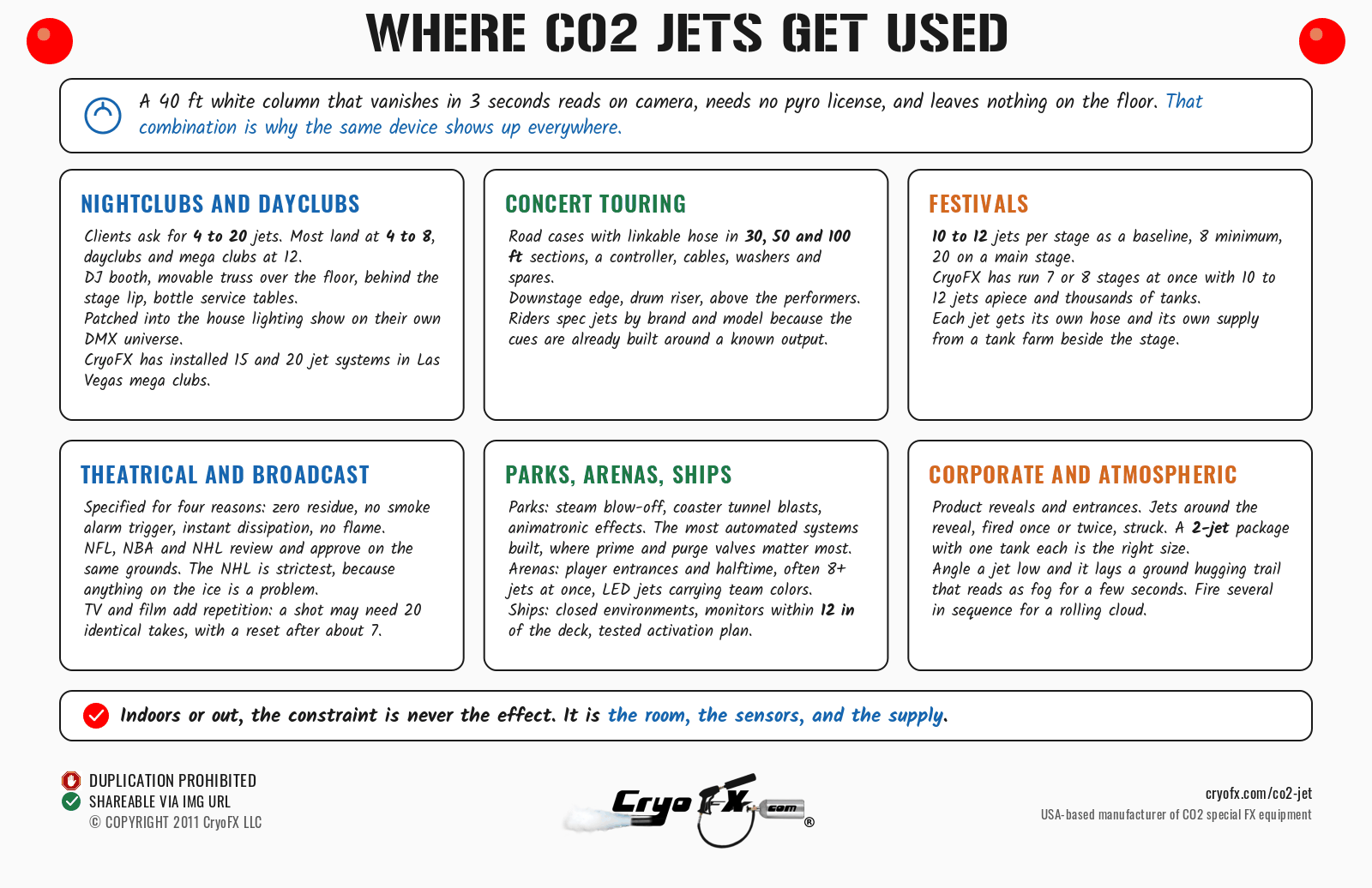
Any event that wants the CO2 look uses CO2 jets. Event planners, event producers, production companies, and professional entertainers book them for live events and special events of every size, because a 40-foot white column that vanishes in 3 seconds reads as a stunning visual effect on camera, needs no pyro license, and leaves nothing on the floor. Of the major visual special effects in the trade, CO2 is the cleanest, and the amazing special effects in a show are usually the ones that leave nothing behind. There are fog machines now that imitate the effect, and they have their place (see the alternatives section), but plenty of clients want the real plume, can't run fog past the venue's sensors, or can't get the imitation units at all.
Indoors and outdoors both work. Outdoor use in rain or a wet environment needs specific protection on the jets, which CryoFX builds. TV and film are fine, with attention to the space, the number of takes, the camera angles, and the dissipation time between takes.
Nightclubs and dayclubs
Club clients call us wanting anywhere from 4 to 20 jets. Most land between 4 and 8, with dayclubs and mega clubs going to 12. CryoFX has installed 15- and 20-jet systems in mega clubs in Las Vegas and around the world, with jets at the DJ booth, on movable truss over the floor, at bottle service tables, and in other positions the club's designer wanted. The jets program into the house lighting show on their own DMX universe, and the club fires them from the booth or from a wireless control a manager carries. For a permanent install, jets beat handhelds because they need no operator and they disappear into the architecture.
For anyone searching for the best CO2 jet for nightclubs: the standard DMX 512 jet, one tank per jet, 4 to 8 positions. That's the configuration in most of the clubs we've built.
Concert touring
Touring rigs carry jets in road cases with linkable hoses (30, 50, and 100 foot sections are typical), a DMX controller, cables, washers, and spares. Jets go along the downstage edge, at the drum riser, above the performers, and throughout the set depending on the design. Many tours place different jets at different points of the stage so the LD can build different looks for different songs, often lit with LEDs or on a moving head. Riders spec CO2 jets by brand and model because the tour has already built cues around a known output.
Festivals
Festival stages run 10 to 12 jets per stage as a baseline, 8 at minimum and 20 on a main stage, because the effect has to be worth it at that scale. At the largest festivals (EDC, Ultra Music Festival, Hard, Lost Lands) CryoFX has run 7 or 8 stages at once with 10 to 12 jets apiece, thousands of CO2 tanks, and a CO2 truck pumping into a given stage for effectively unlimited use. Each jet gets its own hose and its own supply. Tanks sit in a tank farm in front of or beside the stage. Festival producers usually work backward from artist riders: what the headliners require, plus a budget for the festival's own moments.
Theatrical and broadcast
CO2 is specified for broadcast for four reasons: zero residue, no smoke alarm trigger, instant dissipation, and no flame. Those are the same reasons the leagues review and approve it. For stage production the theatrical jet section above covers the timing engineering. For TV and film CryoFX has supplied car reveals, steam simulation, sandstorm effects, and tunnel fog, and has built systems for music videos including the Nicky Romero shoot.
Theme parks and attractions
Parks use jets for steam blow-off on themed environments, cold blasts and fog inside roller coaster tunnels, operator-fired effects in walk-through attractions, and steam effects on animatronics and props. CryoFX has designed systems for multiple parks, both for the intended effect and for effects the equipment was never intended for. Park systems are the most automated we build, and they're where prime valves, purge valves, and spares inventories matter most.
Sporting events
Stadium special effects design starts with player entrances, tunnel effects, and halftime configurations, often firing 8 or more jets at once, usually with LED jets in hockey and basketball arenas where the LEDs can make the plume read as team colors. We run cold sparks alongside CO2 at player entrances because each effect does a different job on camera. Broadcast rules apply: no residue, especially on ice.
Cruise ships
CryoFX has installed CO2 jets on multiple ships across multiple cruise brands and has produced shipboard events for Tony Robbins and Grant Cardone productions. Ships are closed environments. CO2 is an asphyxiant and heavier than air, so every shipboard system gets CO2 monitors (which CryoFX sells) mounted within 12 inches of the deck, a tested activation plan, and a hard look at the space before anything fires.
Corporate events
Product reveals, a CEO's grand entrance, keynote moments. Jets are positioned around whatever is being revealed, fired once or twice, and struck. These are the events where a 2-jet package and a single tank per jet is the right size.
Atmospheric effects
Angle a jet low and it lays a ground-hugging vapor trail that reads as fog for a few seconds. Fire several in sequence and you get a rolling cloud, and various effects in between come from nozzle choice and angle. It's a powerful effect for the few seconds it lasts. CryoFX has used this for stage reveals and TV shots where a lingering effect is looped in post. The CO2 cryo fog and smoke effects page covers the positioning and the limits, the main limit being that CO2 dissipates in seconds by nature, so a sustained fill needs a fog machine.
CO2 jet rental guide
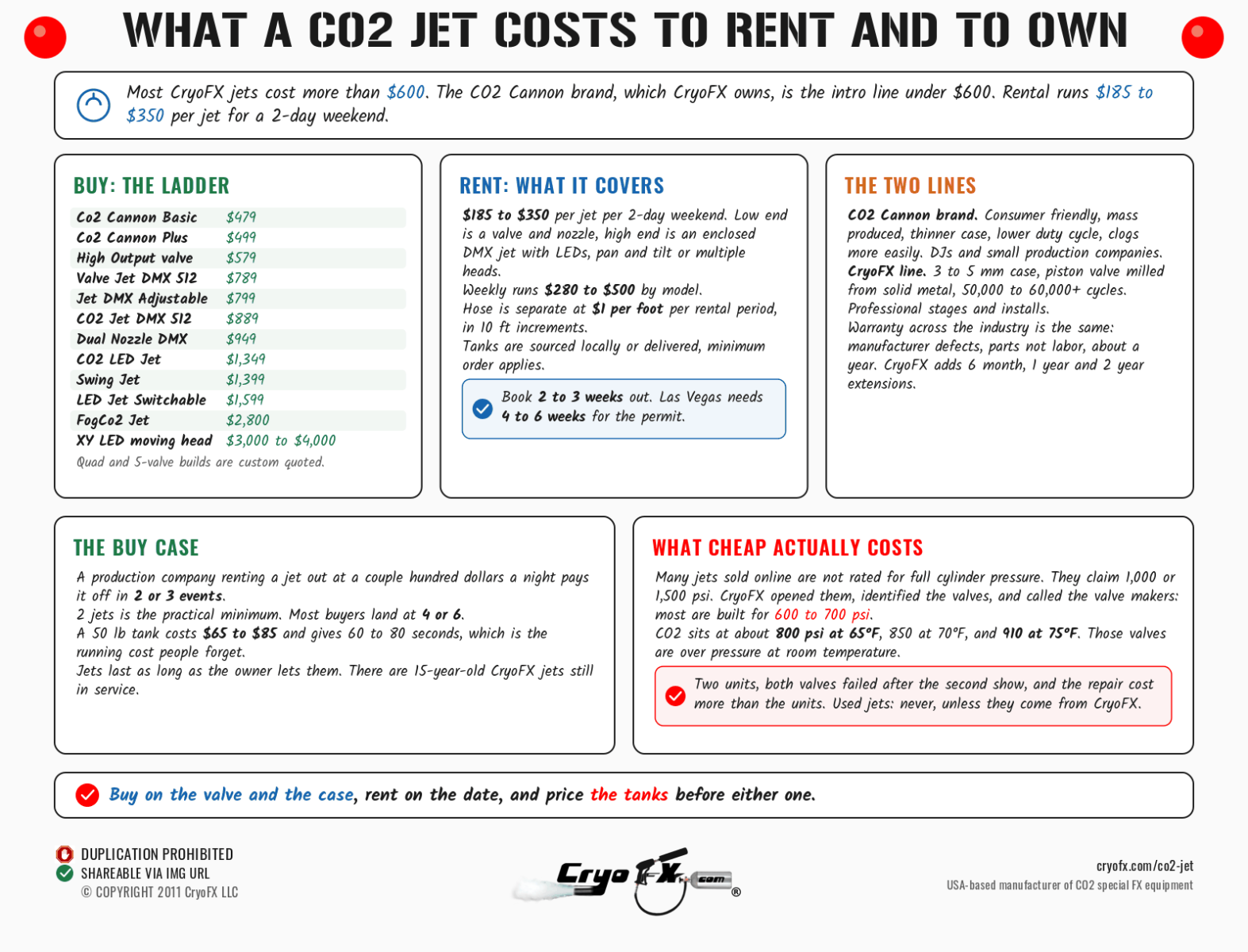
A CO2 jet rental from CryoFX runs $185 to $350 per jet for a 2-day weekend period. The low end is a valve and nozzle. The high end is an enclosed DMX jet with power switching, LEDs, pan and tilt, or multiple valves and nozzles in one head. Multi-head jets that split the stream in several directions sit at the top of the range.
The rental price covers the jet. Hoses rent separately at $1 per foot per rental period, in 10-foot increments, because hose length, fittings, and quick-disconnect versus direct-attach are specific to each job. Tanks are sourced locally or delivered, with a minimum order, and the tank section below covers sizing.
Rates exist for 3-day weekends, holiday weekends (New Year's, Fourth of July), 4-day periods, weekly, monthly, and custom terms. You can rent for a day, a weekend, a week, or longer. The best pricing comes from booking at least 2 to 3 weeks out on the site or with a representative. Inside 2 weeks, rush fees and availability complications apply. Large events should book 30 days out, and in Las Vegas the permit timeline (4 to 6 weeks, covered below) sets the floor.
CryoFX staffs the event when the configuration calls for it, which in practice means anything over 4 to 6 jets, any permitted event in Las Vegas, and any job where the client would rather not own the setup. Smaller self-operated rentals ship with instructions, and we're reachable during the show.
The difference between a CO2 jet machine rental and a system rental is scope. A machine rental is 1 or 2 jets, hose, nozzle, and a way to trigger them (a button, a relay, a DMX controller). A system rental is multiple jets, multiple hoses, DMX cabling, the controller, tanks or splitters, and additional nozzles, delivered as one package. Rental versus CO2 cannon rental is a different question: if the effect needs to be programmed, repeatable, and mounted, rent jets; if it needs to chase the crowd in an operator's hands, rent cannons.
Before you call, have this ready: jet count, hose lengths from tank position to each jet, tank plan, power available at each position, control method (DMX or switch), and whether the jurisdiction requires a permit.
CO2 jets for sale
Most CryoFX jets cost more than $600. The CO2 Cannon brand, a partner brand offered of CryoFX, is the intro line and costs less than $600. The DMX 512 jet, the workhorse of the line, is $889. LED jets run roughly $1,350 to $1,600. The swing jet is $1,399. XY LED moving head jets run $3,000 to $4,000, less in quantity. Quad and 5-valve power configurations are custom quoted.
The two lines are built for different buyers. CO2 Cannon brand jets are consumer-friendly, mass-produced, with a thinner case and lower-grade components that work but have a lower duty cycle and clog more easily. They're for DJs, small production companies, and anyone who wants an entry product. CryoFX-line jets are for professional stages and productions, with the 3 to 5 mm case, the piston valve, and the duty cycle described above. The CO2 jet machine page walks through what's in each.
What to look for when buying: a reputable manufacturer and distributor. We recommend CryoFX because it's our brand, and because no other company publishes as much information on installs, manufacturing, and CO2 as we do. Beyond that, look at the valve (piston or diaphragm, pressure rating, cycle rating), the housing thickness, the fitting gauge, the hose connector type, and whether you can get to the valve for service.
How long a jet lasts is almost entirely up to the owner. We have customers with 15-year-old CryoFX jets that work like they were bought yesterday. We have others who treat their jets badly: dirt in the hose, debris in the valve, fog fluid somewhere it should never be. Those jets develop problems, and most of what comes back to us with "functionality issues" has something inside it that tells the story. None of that is covered under warranty. Dirt and fog fluid in a valve are a care problem, and they turn into a repair bill.
Cheaper jets are never worth it. Many of the CO2 jets sold from China or on Amazon aren't rated for the full pressure of a CO2 cylinder. They claim 1,000 or 1,500 psi. CryoFX has opened them, identified the valve models, and contacted the valve manufacturers directly (who had no idea which product the questions were about). Most of those valves are built for 600 to 700 psi. CO2 sits at roughly 800 psi at 65°F, 850 psi at 70°F, and 910 psi at 75°F, so those valves are over pressure at room temperature. When one fails, the buyer running it is the one liable. The return gets fought if the seller knows the product. And now you're buying a second jet, at which point you've spent more than a single CryoFX unit would have cost. We've watched this exact sequence play out with a buyer who ran two Amazon units, had both valves fail after the second show, and paid more in repair than the units cost.
Used jets: never, unless they come from CryoFX. You don't know what went through the valve. We open used valves and look at the internals (oily, clean, greasy, scored) and that's the only way to know.
CryoFX stocks a wide variety of products for CO2 effects, from jets and hoses to fittings, tanks, and controllers, and dealers can request an account for trade pricing. For the full range of available products, view the CO2 jets for sale on the CryoFX catalogue and request a quote on a package.
CO2 jet packages and system configurations
A package is a jet with the nozzle assembled, a hose with its fittings, a DMX cable, and a power cable. Larger packages add hoses, 2-to-1 tank splitters, more jets, a DMX controller, and more cable.
How many jets you need depends on budget and event, and we recommend 2 as the minimum for almost anything. Most buyers end up with 4 or 6. For a production company, that's an investment: rent each jet out at a couple hundred dollars a night and the jet pays for itself in 2 or 3 events. For a club buying for its own use, it's a fixed asset that fires every weekend.
A few reference configurations:
Small venue, 2 to 4 jets. Individual hose runs, one tank per jet, simple DMX or hardwired on/off. Boutique venue, private event, corporate reveal.
Club or residency, 4 to 8 jets. Full stage-width coverage, individual runs, jets patched into the house lighting system, permanent or semi-permanent mounting. Most clubs choose one tank per jet and swap nightly on price grounds; a club running heavy activations puts 2 to 4 tanks on each hose.
Festival or concert, 12 to 20 jets. Tank farm stage left and stage right, each jet on its own hose and supply, road-cased, with a CO2 pump or truck where the activation count justifies it.
Large venue or stadium, 20 to 50 or more jets. Bulk supply, pump and distribution plumbing, full show control, engineered by CryoFX Designs.
Connecting multiple jets to one supply
CryoFX sells splitters (a CO2 tee for 2 jets, a 1-to-3 block) and manifolds, either assembled from fittings or milled from a stainless block with whatever count of inlets and outlets the job needs. There's a custom manifold builder on the site. Three jets on one feeder hose and one tank produce no measurable loss in output, and we've tested that for Fortune 50 clients and for Disney. Add a fourth jet and every jet on that line loses output, because one hose bore and one tank are now the bottleneck.
A fully manifolded system, where every jet and every tank ties into one manifold, is something we'll build on request and rarely recommend. If one jet on the manifold sticks open or one fitting leaks, the whole stage loses CO2. CryoFX designs the opposite way: one tank (or set of tanks), one hose, one jet, and that mini-system multiplied by the jet count. Four jets on a stage is four isolated systems. If one goes down, three still fire, and the show goes on.
CO2 pump systems
A CO2 pump system connects a bulk source, usually a CO2 truck, to a pump that pushes liquid into the distribution system at a higher pressure than the truck stores it (trucks hold CO2 in the 300 to 400 psi range). The pump keeps the lines fed for as many jets as the plumbing supports, which is how a festival main stage fires all night without changing a cylinder. CryoFX has deployed pump systems at festivals and on special projects, including some for military clients that we can't describe further.
CO2 jet tank requirements
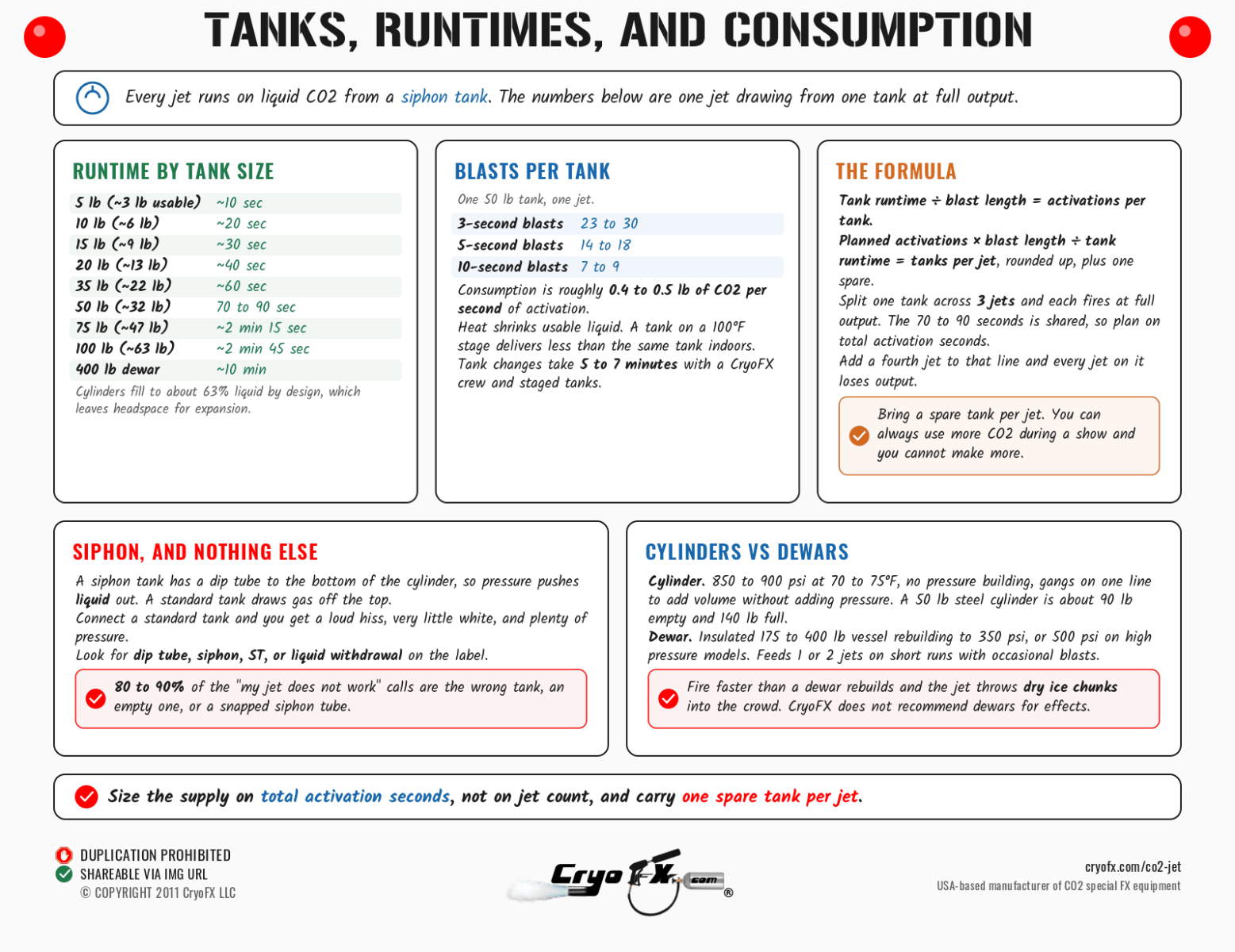
Every CO2 jet runs on liquid CO2 from a siphon tank. CryoFX lists every cylinder size on the site with runtimes and a calculator, and the CO2 jet tank page is the jet-specific version. The numbers below assume one jet drawing from one tank at full output.
| Tank size | Usable liquid (approx.) | Total output through one jet |
|---|---|---|
| 5 lb | ~3 lb | ~10 seconds |
| 10 lb | ~6 lb | ~20 seconds |
| 15 lb | ~9 lb | ~30 seconds |
| 20 lb | ~13 lb | ~40 seconds |
| 35 lb | ~22 lb | ~60 seconds |
| 50 lb | ~32 lb | 70 to 90 seconds |
| 75 lb | ~47 lb | ~2 minutes 15 seconds |
| 100 lb | ~63 lb | ~2 minutes 45 seconds |
| Dewar, 175 to 400 lb | varies | ~10 minutes on a 400 lb dewar, with the pressure limits below |
A high-pressure cylinder is filled to about 63% liquid by design (roughly two-thirds liquid, one-third gas headspace) to leave room for the liquid to expand as temperature rises, which is where the usable figures come from. Heat shrinks the liquid volume further. A tank on a 100°F outdoor stage delivers less than the same tank in a climate-controlled room, so plan conservatively in heat.
Blasts per tank is that total runtime divided by blast length. A 50 lb tank at 3-second blasts is 23 to 30 blasts. At 5 seconds, 14 to 18. At 10 seconds, 7 to 9. Split one tank across 3 jets and each jet fires at full output, because the CO2 expands on exit; the 70 to 90 seconds of liquid is shared between them, so plan the tank around total activation seconds across all 3.
Siphon tanks, and why there's no alternative
A siphon tank (also marked dip tube, ST, or liquid withdrawal) is a compressed gas cylinder with a tube inside running from the valve to the bottom of the cylinder, like a straw in a soda cup. The tank is under pressure, so opening the valve pushes liquid up the tube and out.
A standard tank with no tube draws gas off the top. Connect a standard tank to a jet and you'll hear a loud hiss, see very little white, and feel plenty of pressure. That tells you one of three things: the tank is empty, it isn't a siphon tank, or the siphon tube broke off inside. Between 80 and 90% of the "my jet doesn't work" calls we take are the wrong tank. Siphon tubes can also snap off inside a cylinder that's been dropped, which is the rarer version of the same symptom.
A standard tank turned upside down does put liquid at the valve, and the CO2 backpack uses exactly that principle with inverted 20 lb tanks. For a jet system, CryoFX never recommends inverting a cylinder. It's a safety issue and it isn't advised.
High-pressure cylinders versus low-pressure dewars
A high-pressure cylinder holds CO2 at about 850 to 900 psi at 70 to 75°F, has no pressure-building mechanism (when the pressure is gone, the tank is empty), weighs less, and can be ganged on one line to add volume without adding pressure. Cylinders come in aluminum and steel; a 50 lb steel cylinder weighs about 90 lb empty and 140 lb full per the CryoFX tank sheet. Cylinders are transported on a dolly and in a truck.
A dewar tank is an insulated low-pressure vessel of 175 to 400 lb with a pressure-building circuit that slowly brings it back up to 350 psi, or 500 psi on the high-pressure models, after a draw. You'll get about 340 psi out of a 350 psi dewar and about 480 psi out of a 500 psi dewar before the relief valve opens. A dewar will feed 1 or 2 jets on short runs (5 to 10 feet) with occasional blasts. Fire faster than the dewar can rebuild and the pressure drops, liquid stops atomizing, and the jet throws chunks of dry ice into the crowd.
That's why clubs running several jets off a dewar get weak output and burned patrons, and why CryoFX doesn't recommend dewars for CO2 effects. We use dewars ourselves to transfer-fill bulk tanks, and for permanent installs we've built a micro bulk tank with a built-in heater that holds the volume of 3 dewars and outputs at cylinder pressure with CO2 that comes out colder and denser. That setup is on our YouTube channel and it's the right answer for a venue that wants bulk supply without the pressure problem.
CryoFX jets and systems work with both high- and low-pressure supply unless the product manual says otherwise. Which one a given venue should run is a design decision, and the section on choosing covers it.
CO2 consumption for jets: runtime math
Consumption per activation comes down to the tank. A 50 lb cylinder holds about 32 lb of usable liquid and gives 70 to 90 seconds through one standard jet, which works out to roughly 0.4 to 0.5 lb of CO2 per second of activation. A power jet with multiple valves multiplies that by the valve count. Hose length, hose bore, orifice size, and tank pressure all move the number at the margins. Blast length and tank size move it the most.
The formula: total tank runtime ÷ blast length = activations per tank. Then: planned activations × blast length ÷ tank runtime = tanks per jet per show, rounded up, plus one spare. Bring a spare tank per jet. You can always use more CO2 during a show, and you can't produce more.
A 2-hour club show, 4 jets, 3-second blasts. A DJ firing 30 to 50 short shots over 2 hours empties one 50 lb tank per jet. Four jets, four tanks, plus one standby. A club that wants heavier activation can burn through twenty 50 lb tanks in the same 2 hours; it's entirely a function of how often and how long.
A festival main stage set, 16 jets, programmed cue by cue. Count the cues in the show file, multiply by cue length, divide by 75 seconds (a working average for a 50 lb tank), and that's tanks per jet for the set. At 16 jets and 4 sets a night it adds up fast, which is why main stages run a pump and a truck instead of cylinders.
A 30-date tour. Most tours run the same show every night. Activations per show × length per activation × jet count gives you seconds of CO2 per show; divide by tank runtime for tanks per show; multiply by dates. CryoFX has done the math for enough tours that we've turned it into a planning tool; see the CO2 tank size calculator for the per-tank figures, and the tank page for the jet-specific calculator.
Tank changes during a multi-set night take 5 to 7 minutes for a CryoFX crew with tanks staged, and 15 to 30 minutes for anyone else. Never rush one. If the activation count makes cylinder changes impractical, that's the threshold for a pump or bulk supply.
Installation requirements for CO2 jets
Permanent installation starts with where the tanks will live, then where the jets go, then the route between them for hose, stainless tubing, or pipe. CryoFX mounts to walls, truss, I-beams, ceilings, equipment, and any structure that can take the load. When the install is hidden behind a wall, Unistrut or a similar mounting rail goes in first.
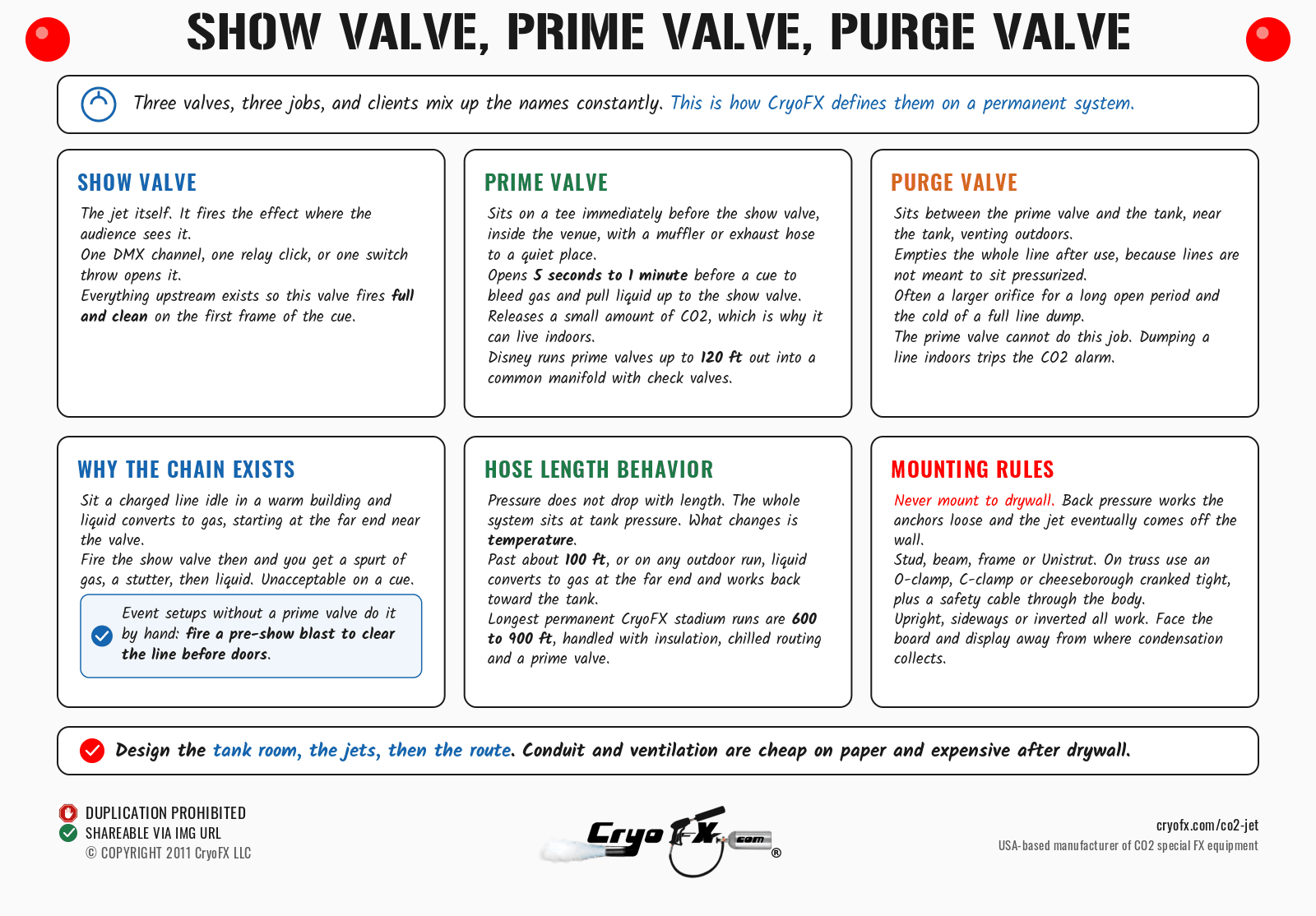
Never mount a jet to drywall or sheetrock. A jet has back pressure every time it fires. On drywall, that pressure works the anchors loose over time and eventually the jet comes off the wall. Mount to a stud, a beam, a frame, or another surface that can take repeated load. On truss, use an O-clamp, C-clamp, or cheeseborough clamp cranked tight, because the truss moves and the jet moves under pressure, and add a safety cable through the jet body so a clamp failure doesn't drop the unit onto the crowd.
Jets mount upright, sideways, or inverted. Jets flown on truss and fired upside down are normal at festivals, at Ultra, in clubs, and on productions of every size. The one rule is orientation of the control board: the LCD and electronics should face away from wherever condensation collects, because the jet sweats every time it fires.
Lines can run through walls and ceilings. Insulate them, consider the condensation (what it drips on and what catches it), and run them in conduit where the route is shared with electrical. CryoFX has routed CO2 hose through electrical conduit with junction boxes so it matches the building's existing services and no one can tell a CO2 system exists. The CO2 jet hose page covers hose types, bores, and insulation options.
Hose length
CryoFX has run CO2 hose thousands of feet. The longest permanent runs in our stadium work are 600 to 900 feet. Pressure doesn't drop with length, because the whole system sits at tank pressure. What changes is temperature. Past about 100 feet, or on any outdoor run, liquid in the hose starts converting to gas at the far end, and the warm gas then converts the liquid next to it, working back toward the tank. Left long enough, the entire line is gas and the first several seconds of the show are a loud hiss with no plume. Insulation, chilled routing, and a prime valve are how a long run gets designed.
Show valve, prime valve, purge valve
Three valves with three jobs, and clients mix up the names constantly, so here is how CryoFX defines them on our larger theme park systems.
The show valve is the jet. It fires the effect where the audience sees it.
The prime valve sits on a tee immediately before the show valve, inside the venue, with a muffler or an exhaust hose to a quiet place. It opens briefly before a cue to bleed gas and pull liquid up to the show valve. It releases a small amount of CO2, which is why it can live indoors.
The purge valve sits between the prime valve and the tank, usually near the tank, outside, or somewhere that vents outdoors. It empties the entire line after use, because lines aren't meant to sit pressurized indefinitely. It may be a larger orifice or a different valve type to handle a long open period and the extreme cold of a full-line dump. The prime valve can't do this job, because dumping a whole line indoors would trip the CO2 alarm.
Event setups without a prime valve handle the same problem manually: fire a pre-show blast to clear the line before doors.
Utilities and documentation
A permanent install needs power at each jet (12 or 24 V DC, or 110 or 220 V AC depending on the unit; 220 draws fewer amps on large installs), a low-voltage DMX run, and the liquid line. On larger CryoFX installations we produce mechanical, electrical, plumbing, and low-voltage plans, including the CO2 alarm, and submit them to the county fire department so the AHJ knows exactly what's installed, where, and how it's mounted. CryoFX Designs produces those drawings, stamped by an engineer. The full process, including mounting details and the permit path for a fixed system, is in the CO2 jet installation guide.
One more thing about installs that costs clients money: put special effects in the initial design alongside lighting and sound. Conduit, a tank room, and ventilation are cheap on paper and expensive after drywall.
DMX programming and show control for CO2 jets
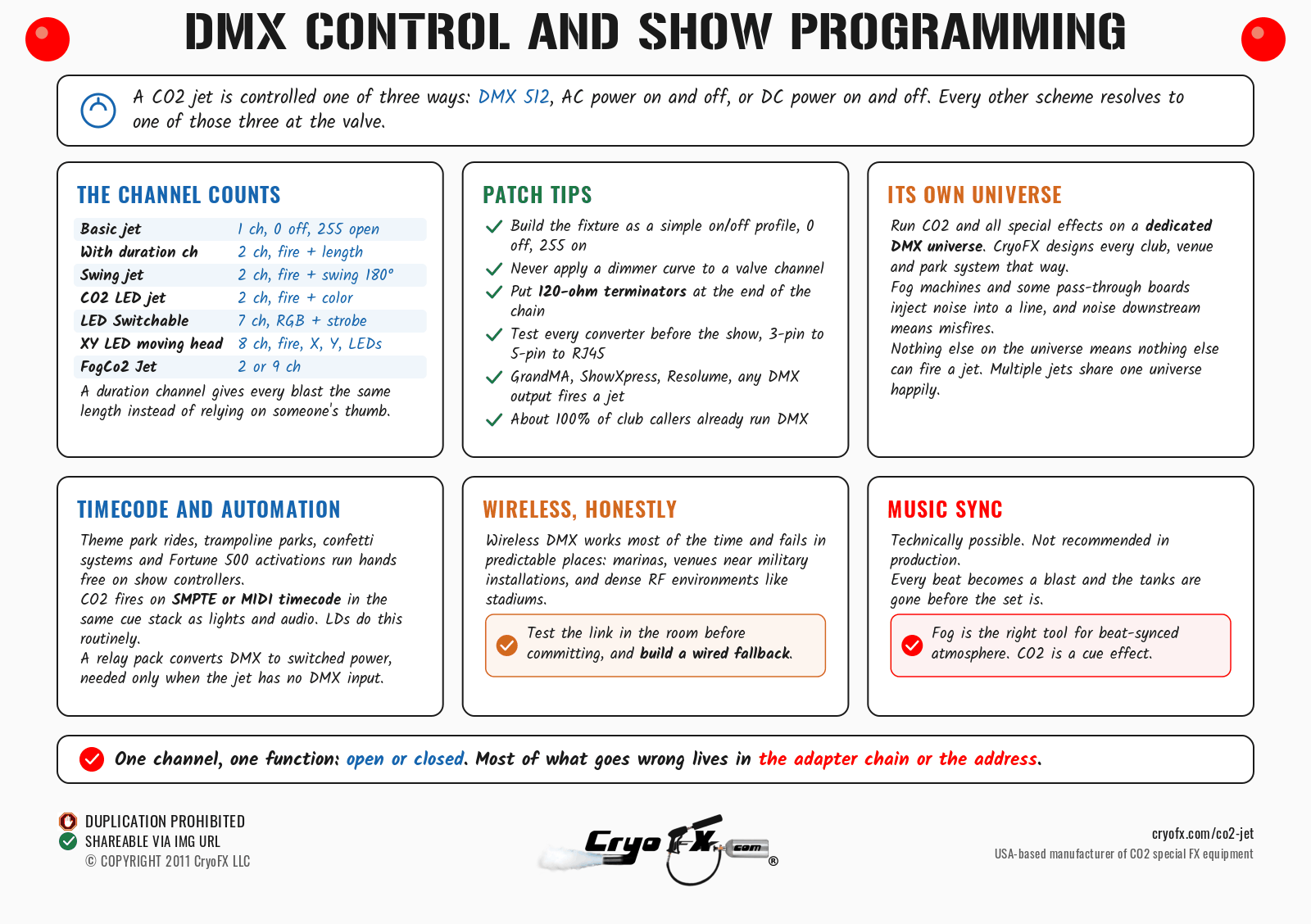
A CO2 jet is controlled one of three ways: DMX 512, AC power on and off (110 or 220 V), or DC power on and off (12 or 24 V). Every other control scheme we've been asked to interface, and there have been many, resolves to one of those three at the valve. The valve is the thing being controlled.
DMX 512 is the lighting industry's control protocol: a single data cable carrying 512 channels, each with a value from 0 to 255, over 3-pin or 5-pin XLR. A lighting console sends values, fixtures on the line listen at their assigned address. A basic CO2 jet takes 1 channel: 0 is closed, 255 is open. Many CryoFX jets use a second channel that sets a hard-coded duration. Channel 1 fires the jet. Channel 2, anywhere above its threshold, fires it for a fixed time (3 seconds, 6 seconds, whatever the position of the fader maps to) and then shuts it regardless of what the operator does. That gives every blast the same length instead of relying on someone's thumb. LED jets add channels for dimmer, red, green, blue, and model-dependent features such as strobe or colour presets. Moving heads add pan and tilt.
Patch tips that save us support calls. Build the fixture as a simple on/off profile: 0 off, 255 on, per channel. Don't apply a dimmer curve to a valve channel; the jet has one function, open or closed. GrandMA, ShowXpress, Resolume, and any other console or software that outputs DMX 512 or triggers a relay can fire a jet. And test every converter before the show. Three-pin to five-pin, five-pin to RJ45, RJ45 back to three-pin: every difficult troubleshooting session in CryoFX's history traces to an adapter that didn't convert the signal cleanly. We've built converters in house for our nightclub venues for exactly this reason.
Run CO2 and all special effects on their own DMX universe. CryoFX designs every club, venue, and park system this way. Fog machines and some pass-through boards inject noise into a DMX line, and noise downstream means misfires. A dedicated universe with nothing else on it means nothing else can fire a jet. Put 120-ohm terminators at the end of the chain. Multiple jets run happily on one universe.
Music sync is technically possible and we don't recommend it in production. DJs try it, and they blow through tanks. Every beat is a blast. Fog is the better tool for beat-synced atmosphere.
Full automation is something CryoFX is known for. Theme park rides, trampoline parks like SkyZone, confetti machine systems firing biodegradable confetti, and Fortune 500 activations run hands-free on show controllers, with CO2 firing on timecode (SMPTE or MIDI) in the same cue stack as lights and audio. LDs put CO2 on timecode routinely.
A relay pack converts DMX to switched power. You need one only when the jet has no DMX input, meaning a power-only unit or a bare valve, power cord, and nozzle. Plug that into a wall and it stays open until you unplug it; put an inline switch on it and it fires on the switch; put a relay pack on it and the console fires it. The CO2 jet DMX controller page covers controller options, patching, and how a CO2 jet cannon configuration patches the same way as any other jet.
Wireless DMX works most of the time and fails in predictable places: marinas, venues near military installations, and dense RF environments like stadiums. Where a wireless link is the plan, CryoFX tests it in the room before committing, and we build a wired fallback. A recent custom system for a high-traffic venue (under NDA) runs wireless control from a button in the DJ booth, from a second fixed control point, and from a handheld a manager carries through the room, with an automatic timer so every press produces the same blast. The client installed it from our drawings and it ran first time.
12 V and 24 V DC operation exists for installs where AC at the jet position isn't practical: vehicles, boats, battery-powered set pieces, and some ride installations.
CO2 jet troubleshooting
Every call starts with one question: is anything coming out of the nozzle? A jet has one function, open or closed. If something is spraying, the jet is working and the problem is upstream, in the supply. If nothing is spraying, the problem is in one of four subsystems: the liquid path, the high-voltage power, the low-voltage electronics, or the DMX signal. The short version follows; the repair videos on the CryoFX YouTube channel cover the rest.
No plume. Pressure and noise but no white means gas, and gas means one of three things: the tank is empty, it isn't a siphon tank, or the siphon tube has broken off inside. This is 80 to 90% of "not working" calls. Check the tank label for dip tube, siphon, ST, or liquid withdrawal, swap to a known-good siphon tank, and the problem usually leaves with the old tank.
Weak output. Almost always a tank near the end of its liquid. The gauge still shows pressure because the gas headspace is still there; the liquid is gone. Ask how many shots the tank has fired and try a fresh one before looking anywhere else.
Won't fire. Is there power? Most jets have a light for that. Does the manual button or the 3-way rocker fire the valve? If the valve clicks on manual but not on DMX, the jet is fine and the DMX side is the problem. If it doesn't click at all with power present, it's internal: a board, a coil, or a frozen valve (wait a few minutes and try again).
DMX won't trigger it. Address mismatch, a dimmer curve applied to an on/off channel, a bad cable, or a converter chain. Daisy-chain logic isolates it fast. If jets 1, 3, and 4 fire and jet 2 doesn't, the fault is inside jet 2, because the signal passed through it to reach 3 and 4. If jet 1 fires and everything after it is dead, it's the cable or jack between 1 and 2. If none fire, it's the controller or the first cable.
And if 5 jets all show the same fault, the odds that all 5 have the same defect are near zero; something outside the jets is the cause, unless someone plugged all 5 into 208 or 220 V and cooked the power supplies. One thing to know: CryoFX supports its jets, and we know our jets. We don't know every DMX controller on the market, and we ask customers to confirm the controller fires another fixture before we chase a fault in the jet.
Inconsistent plume. Slow spurting, with sections of liquid and gas, is a warm hose: a 40, 50, or 70 foot hose left outside or run through a hot building has gas pockets in it. Purge it. Fast, rapid stuttering is the valve itself: a triggering fault, a signal problem, or debris. Chunks in the plume mean dry ice, from a low-pressure tank or from liquid flashing in a cold hose.
First blast is a hiss, second is normal. The hose had air and warm gas in it. The first blast primed the line. That's normal on every cold setup and it's what a prime valve exists to eliminate on a permanent system. Fire a pre-show blast before doors.
Freezing up. Two causes. Holding the jet open for a minute or more runs so much CO2 through the valve that it freezes. Or rapid on-off-on-off cycling never gives the valve time to thaw, condensation builds, refreezes, and the valve sticks, almost always open. A valve sticking open without freezing is debris: a grain from a dirty tank, dust from a hose dragged through dirt, fog fluid. One particle on the seat is enough.
Leaking. At the tank, it's the washer on the CGA fitting, the single most common failure point on any CO2 system. Soap and water finds it. At the nozzle, it's debris on the valve seat: shut the tank, empty the hose, blow CO2 backward through the valve.
CryoFX publishes repair and diagnostic videos on its YouTube channel so an owner can work through most of this at 6 pm on a Saturday.
CO2 jet maintenance and service
CryoFX services its own rental jets every month or two, and the real interval is activations. Jets that go out weekly get a full service after 12 to 15 rentals: activation test, open the unit, clean the valve, inspect the seals. Outside that, maintenance is mostly keeping things clean.
After a show, there are two kinds of cleaning. Internal cleaning is almost nothing as long as only CO2 has gone through the jet. External cleaning is blowing out the nozzle, the DMX and power jacks, the panel mounts, and every crevice, then wiping the unit down. Cap the hose ends, coil the hoses without dragging them through dirt, mud, or grass (grass gets inside hose and ends up in valves), and case the jet. Clean equipment performs better.
Solenoid life on a CryoFX jet is 50,000 to 60,000 or more cycles, which is why some of the jets in our own rental fleet have been in service for over 10 years. What shortens life is thermal cycling without cooldown, debris, and moisture. The O-rings that need the most attention are the ones on quick-disconnect fittings; they dry out, crack, or fall out in dry climates and CryoFX stocks replacements. Internal valve components get inspected by a professional on the service interval.
You can repair your own jet, and CryoFX has the videos to show you how. The one rule that is never optional: never open a jet or a valve under pressure. Disconnect the tank, disconnect the hose, fire the jet with nothing attached so any residual CO2 leaves the line, and then pick up a tool. Send the jet to CryoFX when the fault is inside the valve or on a board, or when you'd rather have it done in a day with the part already on the shelf.
CO2 jet safety
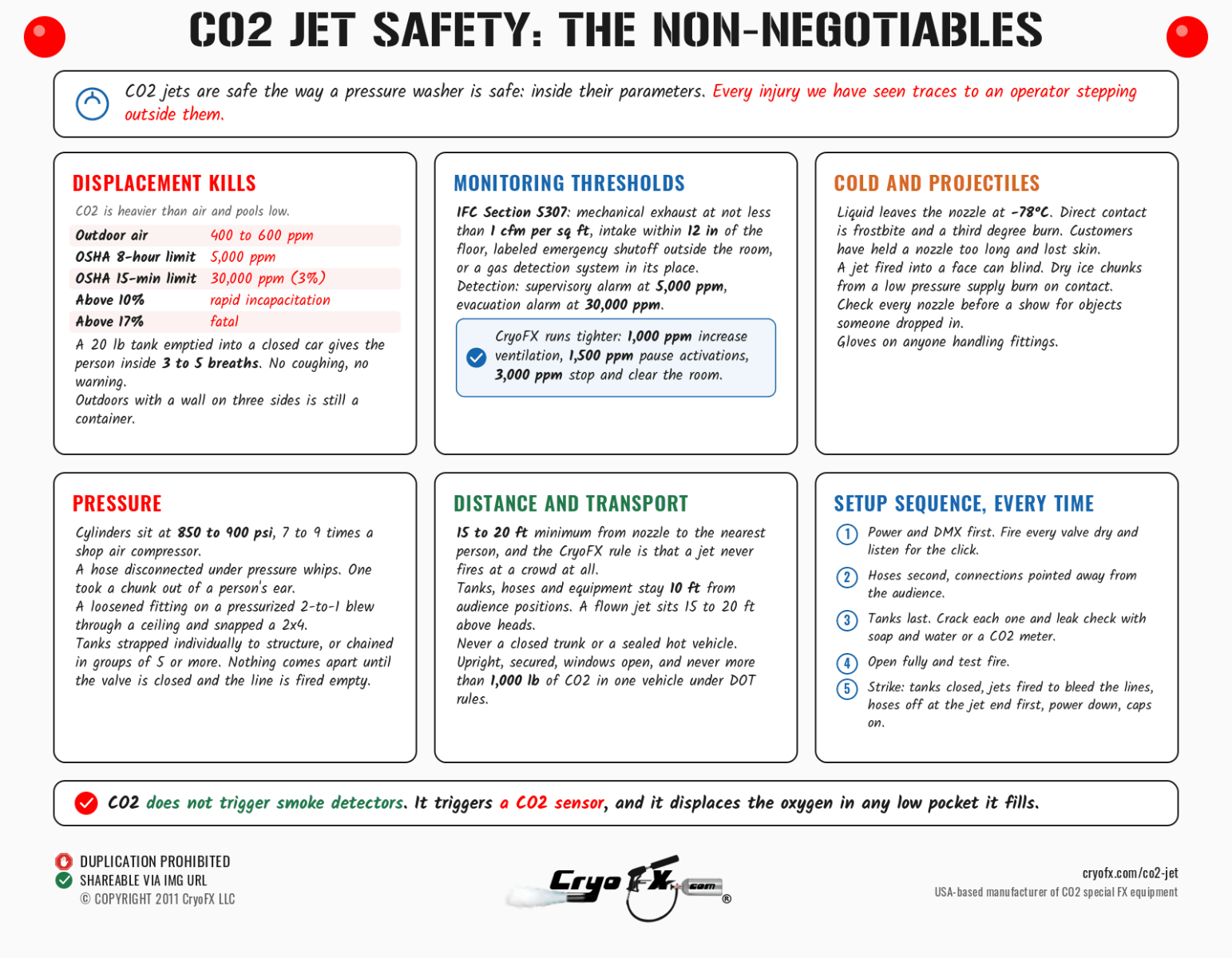
CO2 jets meet every set of safety standards we've been asked to satisfy, and they're safe the way a knife or a pressure washer is safe: in the hands of someone using them inside their parameters. The equipment CryoFX builds is rated and tested for liquid CO2 at cylinder pressure, and it has been reviewed and approved by Clark County, by NFL, NHL, and NBA arenas, by cruise lines, and by more fire agencies than any competitor we know of, because we've filed more permits and submitted more cut sheets than anyone else in the business. Every injury we've seen traces to an operator stepping outside those parameters. The full operating procedure is in the CO2 jet safety guide. The hazards, in order of how often we see them:
CO2 displaces oxygen
This is the one that kills. CO2 is heavier than air and pools low. Normal outdoor air is 400 to 600 ppm. OSHA's 8-hour limit is 5,000 ppm and its 15-minute short-term limit is 30,000 ppm (3%). Above 10% you're incapacitated quickly; above 17% it's fatal. A 20 lb tank emptied into a closed car gives the person inside 3 to 5 breaths before they pass out, and they won't cough or choke first.
You'll feel air go into your lungs and get no oxygen from it. The hazard exists outdoors too. Gas company staff have filled tanks outdoors behind a chest-height wall, dropped a wrench, bent down into the pocket of CO2 that collected there, and died. Outdoors with a wall on three sides is still a container.
Monitoring and ventilation
Fire code treats CO2 as a compressed gas. The 2018 International Fire Code, Section 5307, requires indoor CO2 use areas to be ventilated per Section 5004.3 (mechanical exhaust at not less than 1 cfm per square foot of floor area, running continuously while the space is occupied, with the exhaust intake within 12 inches of the floor because CO2 is heavier than air, and a labeled emergency shutoff outside the room) or, in place of mechanical ventilation, a gas detection system. Where detection is used, sensors mount within 12 inches of the floor, a supervisory alarm sounds at 5,000 ppm, and an evacuation alarm sounds in the room at 30,000 ppm.
CryoFX's own operating thresholds are tighter: at 1,000 ppm increase ventilation, at 1,500 ppm pause activations until it clears, at 3,000 ppm stop everything and clear the room. Monitors go on before a single fitting is connected, and on a permanent install they tie into the building's life safety panel. The Las Vegas club system described in the permits section added electronic flow monitoring that shuts the CO2 off automatically if a valve stays open too long; that's now the standard we design to. Whether a venue's HVAC is single-pass or recirculating matters too, because a recirculating system in a small room with jets firing is the worst combination there is.
Frostbite and burns
The liquid leaves the nozzle at -78°C. Direct contact is frostbite and a third-degree burn. We've had customers hold a nozzle too long and lose skin. We've seen a jet freeze solid at the nozzle from an over-long activation. No one holds a nozzle, no one puts a limb or a face in front of a jet, and anyone handling fittings wears gloves.
Projectiles
A jet fired into a face can blind someone or drive dry ice chunks into an eye. Chunks of dry ice out of a low-pressure supply burn skin on contact and discolor spray tans instantly (a complaint we've fielded more than once). Check every jet before a show for objects someone dropped into the nozzle.
Pressure
Cylinders sit at 850 to 900 psi, 7 to 9 times a shop air compressor. A hose disconnected under pressure whips; one took a chunk out of a person's ear. A fitting loosened on a pressurized 2-to-1 setup blew through a ceiling and snapped a 2x4; the crew laughed, and a 2x4 is a skull.
An unstrapped tank pulled over by its hose lost its valve and went through a crowd, and one person reportedly lost a leg. A 50 lb steel tank with its valve sheared off goes through a house and 100 feet into the air; there's video. Tanks are strapped individually to structure or chained in groups of 5 or more, hoses are strapped everywhere they run, and nothing is disconnected until the tank valve is closed and the line is fired empty.
Transport and storage
Never in a closed trunk or a sealed hot vehicle. Aluminum tanks in a hot car explode and take the car with them. Windows open, tanks upright and secured, and never more than 1,000 lb of CO2 in one vehicle under DOT rules. Cylinders in a 120°F Las Vegas garage in the shade are fine; the relief valve is set at 2,300 to 2,800 psi and a shaded tank never gets there.
Audience distance
A minimum of 15 to 20 feet from the nozzle to the nearest person, and CryoFX's own rule is that a jet never fires at a crowd at all. Tanks, hoses, and equipment stay at least 10 feet from audience positions. A jet flown over the floor is mounted so that the nozzle is 15 to 20 feet above heads.
Fire alarms
CryoFX has tested CO2 against photoelectric, ionization, and laser smoke detectors and it doesn't trigger them, which is the reason broadcast and alarm-sensitive venues specify CO2 over fog. What it does trigger is a CO2 alarm, and it will trigger one in a large room if you fire straight at the sensor, because concentration at the sensor is what the sensor reads.
Setup sequence, every time
Power and DMX first, fire every valve dry and listen for the click, hoses second with the connections pointed away from the audience, tanks last, crack each tank and leak-check with soap and water or a handheld CO2 meter, then open fully and test-fire. If anything fails during the show, shut the system at the console and close the tanks. At strike: tanks closed, jets fired to bleed the lines, hoses disconnected at the jet end first, coiled, power down, caps on.
Permits and regulations for CO2 jets
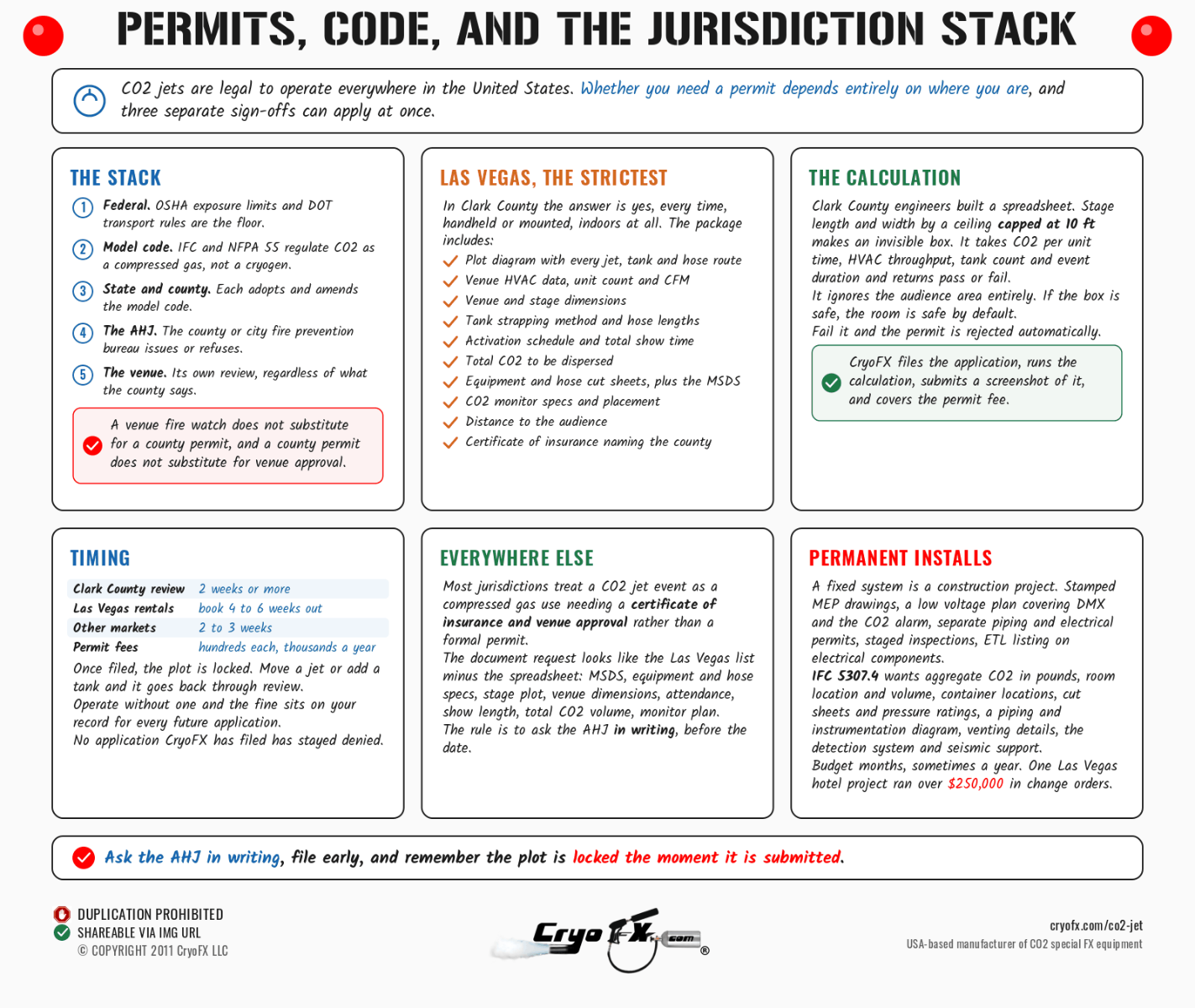
CO2 jets are legal to operate everywhere in the United States. Whether you need a permit to operate them depends on where you are. Fire marshals approve CO2 jets routinely, and they approve CryoFX equipment faster than most because they've seen our documentation before. The full jurisdiction-by-jurisdiction picture is in the CO2 jet permit requirements guide.
The layers stack like this. Federal codes (OSHA exposure limits, DOT transport rules) are the floor. The International Fire Code and NFPA 55, Compressed Gases and Cryogenic Fluids Code, regulate CO2 as a compressed gas (not a cryogen, by default, at CO2 temperatures), and states and counties adopt and amend them.
The county or city fire prevention bureau is the authority having jurisdiction (AHJ) that issues or refuses the permit. Above all of that sits the venue, which can impose its own review regardless of what the county says. A venue's on-duty fire watch doesn't substitute for a county permit, and a county permit doesn't substitute for the venue's approval. Three separate sign-offs, and satisfying one doesn't satisfy the others.
Las Vegas, the strictest common jurisdiction
In Las Vegas the answer is yes, every time, handheld or mounted, indoors at all. Clark County Fire Prevention (not Building, not Planning) issues a compressed gas permit after reviewing a package that includes a plot diagram with every jet, tank, and hose route fixed in position; the venue's HVAC data (number of units and their CFM); venue and stage dimensions; the tank strapping method; hose lengths; jet count and positions; the activation schedule and total show time; total CO2 to be dispersed; equipment and hose cut sheets; the CO2 material safety data sheet; CO2 monitor specifications and placement; distance to the audience; and a certificate of insurance naming the county. Arena and casino events add operator qualifications.
What makes Clark County different is the calculation. The county's engineers built a spreadsheet that takes the stage length, width, and height (capped at 10 feet) as an invisible box, the CO2 per unit time the show will inject into it, the HVAC throughput, the tank count, and the event duration, and returns a pass or fail. It ignores the audience area entirely. If the box is safe, the room is safe by default. Fail the calculation and the permit is rejected automatically. CryoFX submits the calculation and a screenshot of it with every filing.
Timing: 2 weeks or more for the review, so rentals in Las Vegas book 4 to 6 weeks out and other markets 2 to 3 weeks. Once filed, the plot is locked; move a jet or add a tank and it goes back through review. Operate without a permit and the fire marshal fines you, and the violation sits on your record for every future application. Conditional approvals and requests for more information are common, and a complex show can turn into a significant discussion with the bureau before approval; in-person demonstrations happen. No application CryoFX has filed has stayed denied.
CryoFX fills the application, runs the calculation, interfaces with the bureau, and covers the permit fee as part of the documentation package. Clients who file alone usually get stonewalled, then a request for more information, then a second round of review.
Everywhere else
Outside Nevada, most jurisdictions treat a CO2 jet event as a compressed gas use that needs a certificate of insurance and venue approval rather than a formal permit. That's most of the country, and it's different in each city, so the rule is: ask the AHJ, in writing, before the date. The fire marshal's document request, wherever you are, looks like the Las Vegas list minus the spreadsheet: MSDS, equipment spec sheets, hose specs, stage plot, venue dimensions, attendance, show length, total CO2 volume, CO2 monitor plan.
Permanent installations
A fixed system is a construction project. Expect engineered and stamped MEP drawings (mechanical, electrical, plumbing), a low-voltage plan covering DMX and the CO2 alarm, separate piping and electrical permits, possibly a state-level tank permit, staged inspections, and ETL listing or equivalent on equipment with electrical components. IFC Section 5307.4 lists what the AHJ wants on the permit application for a fixed CO2 system: total aggregate CO2 in pounds, room location and volume (at or below grade), container locations relative to equipment, openings, and exits, manufacturer specs and pressure ratings with cut sheets for all piping and tubing, a piping and instrumentation diagram, venting details, the alarm and detection system, and seismic support.
Budget months, sometimes a year. One Las Vegas hotel project ran over $250,000 in change orders; one nightclub system was shut down by the fire department after install during a risk assessment, and the fix took 6 to 8 months of new electronic and mechanical flow monitoring tied into the venue's ADT life safety system. The county subsequently amended its fire code to incorporate elements of what CryoFX built. There was no amount of money that could have bypassed that process, and we told the client so.
Venues with their own layer above the county include major arenas (the Crypto.com Arena review is a good example), cruise lines, and theme parks. The CO2 material safety data sheet is in every package we file.
Insurance requirements for CO2 jets
You are not legally required to carry insurance to own a CO2 jet. In practice you need it the moment you fire one at a venue, because the venue, the event producer, or the AHJ will ask. In Las Vegas the fire prevention bureau requires a certificate of insurance with the city or county named as additional insured before it issues the permit, so in Las Vegas the fire prevention bureau is the one mandating it.
Typical limits are $1 million per occurrence and $2 million general aggregate. Larger venues ask for a $5 million umbrella, and arena and stadium work can require $5 million per occurrence with a $10 million umbrella. CryoFX carries $5 million to $10 million depending on the project, covering general liability, professional liability, manufacturers' liability, design liability, advertising liability, and commercial auto over $1 million. Venues that put your staff on site also ask for workers' compensation and $1 million commercial auto.
A certificate of insurance for CO2 work needs the additional insured endorsement, the certificate holder, a description of operations that says CO2 special effects explicitly, the locations, any vehicles, and the policy type (claims-made or occurrence). Confirm with your carrier that CO2 effects are covered before the date. One-off productions buy per-event policies; operators working regularly carry annual coverage.
CO2 jet vs the alternatives
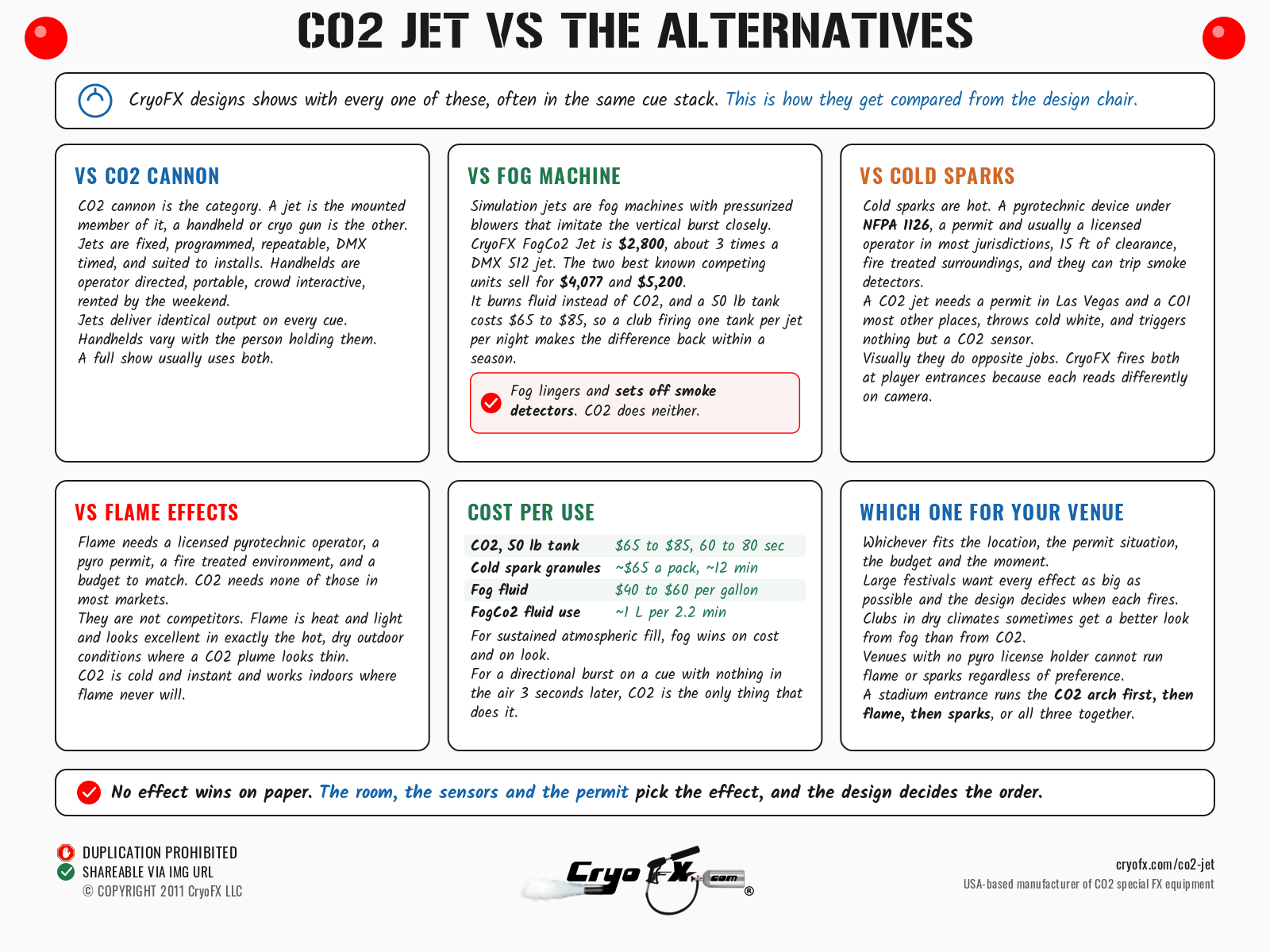
CryoFX designs shows with every one of these effects, often in the same cue stack, so this is how we compare them when designing a show.
CO2 jet vs CO2 cannon
A CO2 cannon is the category; a jet is the mounted member of it and a handheld or portable CO2 cannon (or cryo gun) is the other one. Jets are fixed, programmed, repeatable, DMX-timed, and suited to permanent installs. Handhelds are operator-directed, portable, crowd-interactive, and rented by the weekend. Jets deliver identical output on every cue. Handhelds vary with the person holding them. A full CO2 system for a show usually uses both, and a jet is a specialized device for the fixed half of that job. The complete CO2 cannon guide covers the handheld side in depth.
CO2 jet vs fog machine
This comparison has changed recently. There are now simulation CO2 jets: fog machines with pressurized blowers behind them that imitate a CO2 jet's vertical burst closely. They're different from high-output fog machines like the Sonic Boom units CryoFX carries and has installed in NFL and NHL arenas and in Las Vegas clubs including LIV at the Fontainebleau and Tao Beach, which push a lot of fog but don't shape it like a jet.
The economics: CryoFX's FogCo2 Jet simulation unit is $2,800, a little over 3 times the price of a standard DMX 512 CO2 jet, and the two best-known competing simulation units sell for $4,077 and $5,200. But it burns fluid instead of CO2. A 50 lb tank costs $65 to $85, and a club firing one tank per jet per night pays for the difference within a season and then fires as often as it likes.
The catch is that fog is fog. It lingers, it hangs, it doesn't dissipate in seconds, and it sets off smoke detectors. A CO2 jet doesn't. Broadcast and alarm-sensitive venues use CO2 for that reason alone. For sustained atmospheric fill, fog wins on cost and on look. For a directional burst on a cue with nothing left in the air 3 seconds later, CO2 is the only thing that does it. The CO2 jet vs fog machine page has the cost-per-use comparison.
CO2 jet vs cold sparks
Cold sparks are hot. They're a pyrotechnic device under NFPA 1126, they need a permit and usually a licensed operator in most jurisdictions nationwide, they need 15 feet of clearance from anything, they can set off smoke detectors, and they need fire-treated surroundings. A CO2 jet needs a permit in Las Vegas and a COI most other places, throws cold white, and triggers nothing but a CO2 sensor. Visually they do opposite jobs, gold sparkle versus white plume, and CryoFX fires both together at player entrances and on stages because each one reads differently on camera. Side by side on cost, permits, and safety: CO2 jet vs cold sparks.
CO2 jet vs flame effects
Flame needs a licensed pyrotechnic operator, a pyro permit, a fire-treated environment, and a budget to match. CO2 jets need none of those in most markets. From the design chair the two aren't competitors. Flame is heat and light and it looks excellent in exactly the hot, dry outdoor conditions where a CO2 plume looks thin. CO2 is cold and instant and works indoors where flame never will. A festival main stage wants both and uses them at different moments.
Which effect is best for my venue
Whichever one fits the location, the permit situation, the budget, and the moment. Large festivals want every effect as big as possible, and the design decides when each fires. Clubs in dry climates sometimes get a better look from fog than from CO2. Venues without a pyro license holder can't run flame or sparks regardless of what they'd like. CryoFX looks at all of it before recommending anything, which is what a design consultation is for.
How to choose the right CO2 jet
Like every piece of special effects stage equipment, CO2 jets are powerful tools that do one job. The right amount of special effects for a room is a design question, and so is the right size CO2 supply. Work through these in order.
Fixed install, touring, or event rental? A permanent install gets a designed system: individual valves, remote or DMX control, timers, safety interlocks, either installed by CryoFX or shipped as a kit the venue installs from our drawings. Touring gets road-cased production equipment: professional jets with spares and linkable hose. A one-off event gets a rental.
Venue type and size. Concert stages run portable jets along the front edge. Clubs mount them up top and at the booth. Corporate events put them around the reveal. Spacing, tank storage, what's flammable nearby, and whether a permit is needed all flow from the venue.
Indoor or outdoor. Outdoor jets that stay out get modified to survive sun and weather. Indoor jets need the monitoring conversation.
How many, and where. A nightclub size project is the most common one we quote. Small club: 4 to 6 standard jets, one tank each, DMX. Large club or dayclub: 8 to 12 jets, supply per jet or manifolded by design, patched into house show control. Mid-size festival stage: 12 to 20 jets, tank farm, pump. Stadium or arena: 20 to 50 or more, bulk supply, full show control. Touring: road-cased pro jets with redundancy. Theatrical and broadcast: precision timing, low-profile mounts, show-control compatible, prime valves. Theme park: custom fabrication, built into the prop or ride, built for heavy cycling.
DMX or simple on/off. If the venue already runs DMX, an off-the-shelf DMX 512 or LED jet patches straight in and we don't supply a controller. If it doesn't, a relay pack or a power-only jet with a switch does the job.
Moving head? If a lighting designer is involved and wants distinct looks from one position, yes. Otherwise standard.
Budget tier. Entry level is the CO2 Cannon brand line for DJs and small production companies. Professional is the CryoFX line. Custom is CryoFX Designs. CryoFX builds custom CO2 and special effects systems for nightlife, touring, theme parks, boats, vehicles, homes, and government clients, and the custom tier exists because each of those asks for something the catalogue doesn't have.
How often it will be used. Weekly use in a club or a rental fleet justifies the professional tier on valve life alone. A jet that fires twice a year can be an intro unit, with the understanding of what's inside it.
Frequently asked questions
Can CO2 jets be used indoors? Yes. CO2 doesn't trigger smoke detectors, and it dissipates in seconds. Indoor use needs CO2 monitoring mounted within 12 inches of the floor, ventilation or gas detection per IFC 5307, a 15 to 20 foot standoff from the audience, and a permit where the jurisdiction requires one.
Are CO2 jets loud? Yes. The discharge is a sharp, loud hiss, loud enough that operators warn people nearby before firing. CryoFX hasn't published a decibel figure, and the level varies with nozzle, orifice, and tank pressure.
Do CO2 jets produce moisture or wetness? The CO2 itself doesn't. Condensation forms on the jet, on the hose, and on surfaces the cold plume contacts, and a jet sweats after firing. Mount the electronics away from where that condensation collects and keep the plume off anything that can't get damp.
Are CO2 jets reusable? Indefinitely. A CryoFX jet is rated for 50,000 to 60,000 or more activations. Tanks are refilled or swapped; hoses and washers are the consumables.
Do CO2 jets work in cold weather? Better than in warm weather. Cool, humid air gives a longer, denser plume. The tank holds more liquid in the cold. Keep the hose insulated so the liquid doesn't sit in a frozen line between cues.
Do CO2 jets work in hot weather? Yes, with a shorter plume. Heat reduces the liquid in the tank and hot dry air dissolves the plume faster. Las Vegas at 90°F and 10% humidity gives the weakest look of any common venue condition; CryoFX has injected atomized water above jets to improve it. Keep tanks shaded.
How much does a CO2 jet weigh? 10 lb for a bare valve-and-nozzle unit up to 40 or 50 lb for a multi-valve, LED, or battery-equipped jet. Model-specific weights are on each product page.
How fast can a CO2 jet cycle between activations? Seconds or less. Fire too many times back to back without a pause and the valve can't thaw between cycles, condensation freezes, and the valve sticks open. Give it a beat between blasts.
Can CO2 jets operate continuously? CryoFX jets time out at about 6 seconds per activation and re-fire immediately. We've run jets 30 seconds to a minute continuously on request, with a cooldown afterward so the valve doesn't freeze open. Continuous operation is a tank question more than a jet question: a 50 lb tank is empty in 70 to 90 seconds.
How long does setup take? A 2- to 4-jet event setup with tanks staged is under an hour for an experienced crew: power and DMX, dry-fire, hoses, tanks, leak check, test. Add permit lead time before the date, and 5 to 7 minutes per tank change during the show.
Can CO2 jets be flown on truss upside down? Yes, and it's common at festivals, at Ultra, in clubs, and on tours. Clamp tight, add a safety cable, and orient the control board away from condensation.
How is a CO2 jet different from a cryo jet? Only the name. Cryo jet is the consumer and DJ term; CO2 jet (or cryo head) is the production term. It's the same device. The one caution: cryo means cold, so confirm whether the client means CO2 or liquid nitrogen.
Can CO2 jets be used with liquid nitrogen instead of CO2? No. CryoFX builds liquid nitrogen systems, and they use different valves, hoses, and pressure ratings. LN2 boils at -196°C against CO2's -78°C. Put LN2 through CO2 equipment and the hoses freeze and crack, the valves fail, and you have liquid nitrogen spraying where you don't want it.
How much does a CO2 jet cost? Most CryoFX jets are over $600. CO2 Cannon brand intro jets are under $600. LED jets run $1,350 to $1,600 and XY LED moving heads $3,000 to $4,000. Rental is $185 to $350 per jet per weekend plus $1 per foot of hose.
How many CO2 jets do I need? Two at minimum for any stage. Small clubs 2 to 4, large clubs 4 to 8 and up to 12, festival stages 10 to 12 with 8 as the floor and 20 on a main stage. One tank per jet is the default.
What size CO2 tank do I need for a CO2 jet? A 50 lb siphon cylinder is the standard single-jet tank, giving 70 to 90 seconds of output or 23 to 30 three-second blasts. A 20 lb tank gives about 40 seconds. Larger shows stack tanks or move to a pump.
Do CO2 jets need a permit? In Las Vegas, yes, every time. In most other US jurisdictions a certificate of insurance and venue approval are enough, but the AHJ decides, so ask in writing. Permanent installs need engineered drawings and building, fire, and electrical permits everywhere.
Why professional CO2 jets differ from DIY designs
The argument is the same one we make about handheld cannons, and it's short. The valve is the CO2 jet. Everything else is a box, a hose, and wiring. A valve that isn't rated for liquid CO2 at 850 to 900 psi and -78°C, with Viton or PTFE seals, will fail, usually within the first few shows.
Pressure ratings, temperature tolerance, CO2-compatible hose (non-rated hose permeates, stinks, forms bubbles, and pops with the sound of a 12-gauge shotgun), CGA 320 fittings, and orifice sizing are all things CryoFX has specified, built, and tested, internally and alongside fire prevention bureaus. A fixed installation adds structural mounting, long-run thermal behavior, prime and purge valves, and permit documentation. A homebuilt jet with unknown component ratings won't pass a permit review, and a cut sheet from an unidentifiable valve won't either.
Custom fabrication of special-effects devices exists because off-the-shelf special effects equipment doesn't cover speedboats, trumpets, wrist nozzles, and drop towers, and because CryoFX's engineers can modify a catalogue product or build from the valve up. We'll give surface-level guidance on the phone and point to the videos. When the conversation gets into why a system must be designed a certain way, that's a paid engagement under CryoFX Designs, which protects the client as much as it protects us, because professional liability insurance sits behind every design we produce.
CryoFX supplies the CO2 valves (multiple orifices, AC and DC coils), liquid nitrogen valves, CO2 hose, fittings, custom fabrication, and full installation and operation. Clients engage us as a partner on a revenue share, as a back-end consultant under NDA that their end client never sees, or across three contracts at once: equipment from CryoFX, design from CryoFX Designs, and installation and operation from CryoFX Services. For Spanish-language readers, the jet de CO2 page covers the essentials of this guide.
CO2 jet buyer checklist and next steps
This is the list we work through on a call. Having answers ready shortens the quote.
Intended use: permanent installation, touring, event rental, or custom fabrication.
Indoor or outdoor, and if outdoor, whether the jets stay out between events.
Venue type and size, with ceiling height at each jet position.
Number of jets and mounting positions, with 15 to 20 feet confirmed from nozzle to audience.
Control: DMX, moving head, show control or timecode, or simple on/off.
Power at each position: 12 V DC, 24 V DC, 110 V AC, or 220 V AC.
Tank supply: individual cylinders, micro bulk, or a pump system, and who sources the CO2.
Hose run lengths from tank position to each jet, and whether any run exceeds 100 feet or goes outdoors.
Permit: jurisdiction, AHJ, venue approval, and insurance limits required.
Delivery and installation timeline, working backward from the permit window.
Budget tier: entry level, professional, permanent installation, or custom build.
When you have those answers, you can view CO2 jet options and pricing on the CryoFX catalogue at view CO2 jet options and pricing, request a quote, schedule a design consultation, or check CO2 jet rental availability for your date. Related resources: CryoFX services, product knowledge, and the site-wide frequently asked questions. If you're unsure which direction to go, the consultation is the shorter path, because the venue usually decides the answer.
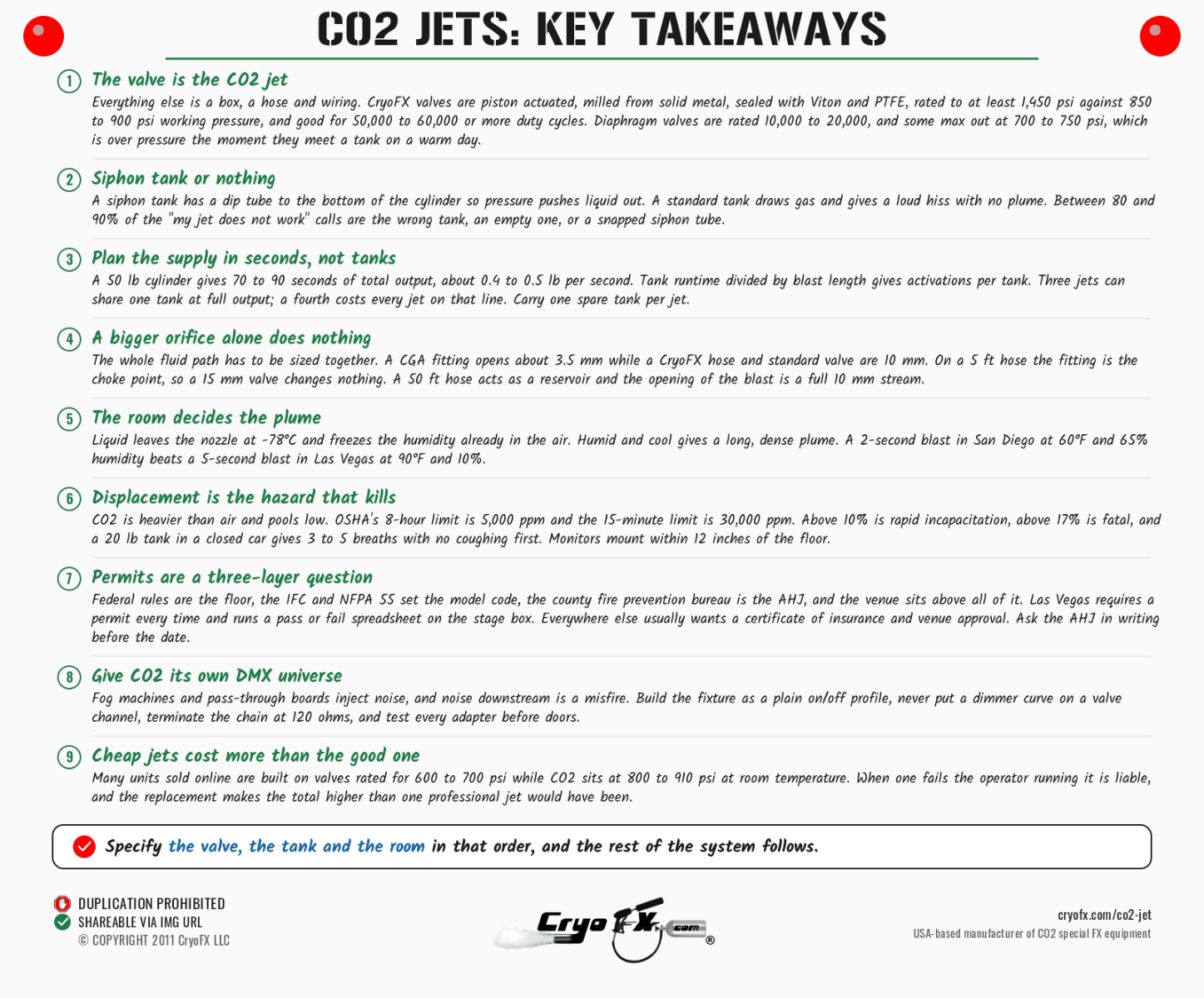
Updated - 08/27/2026.