
CO2 Jet Tank Setup: Sizes, Runtimes, And How The Supply Actually Works
CO2 Jet Tank Setup: Sizes, Runtimes, And How The Supply Actually Works
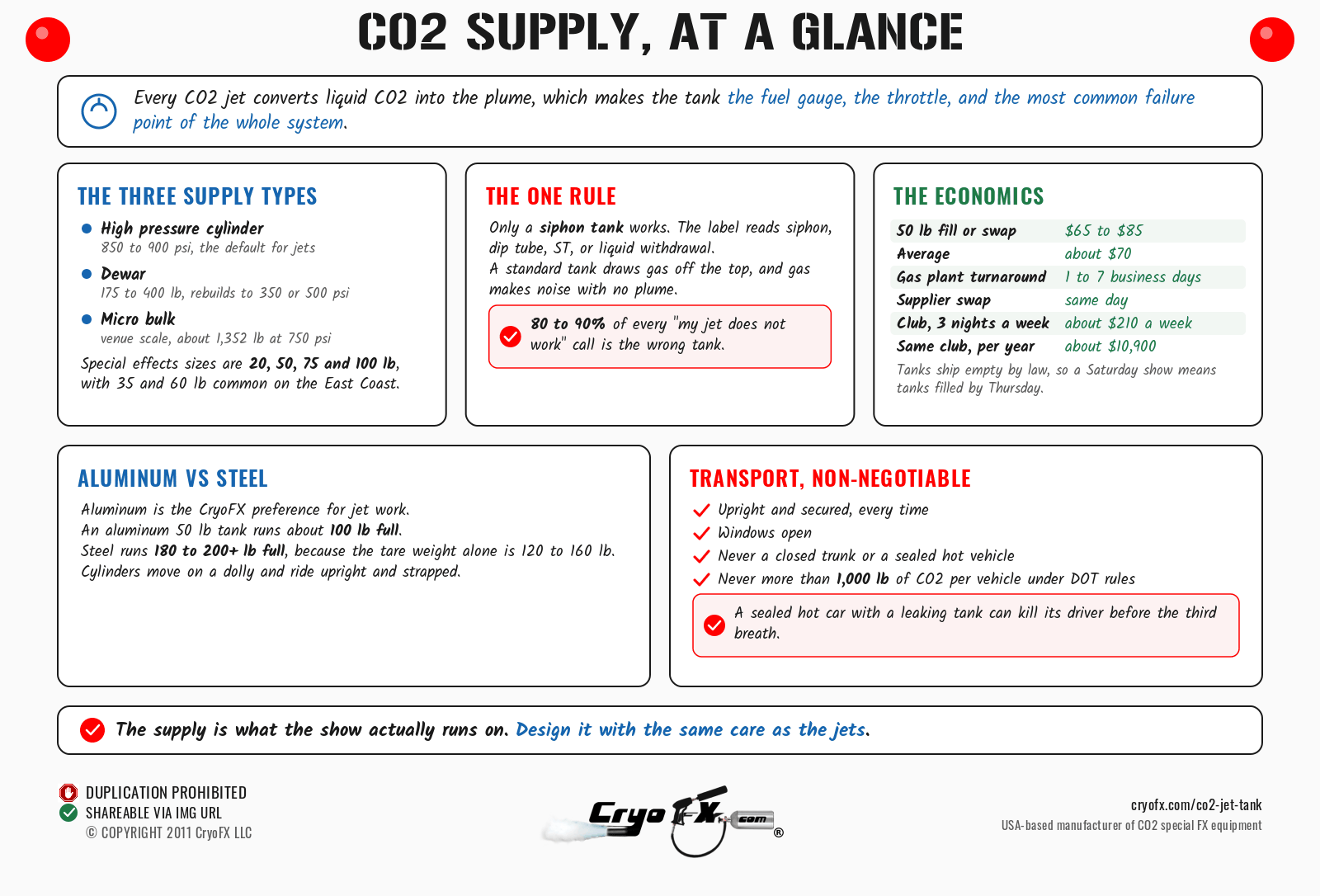
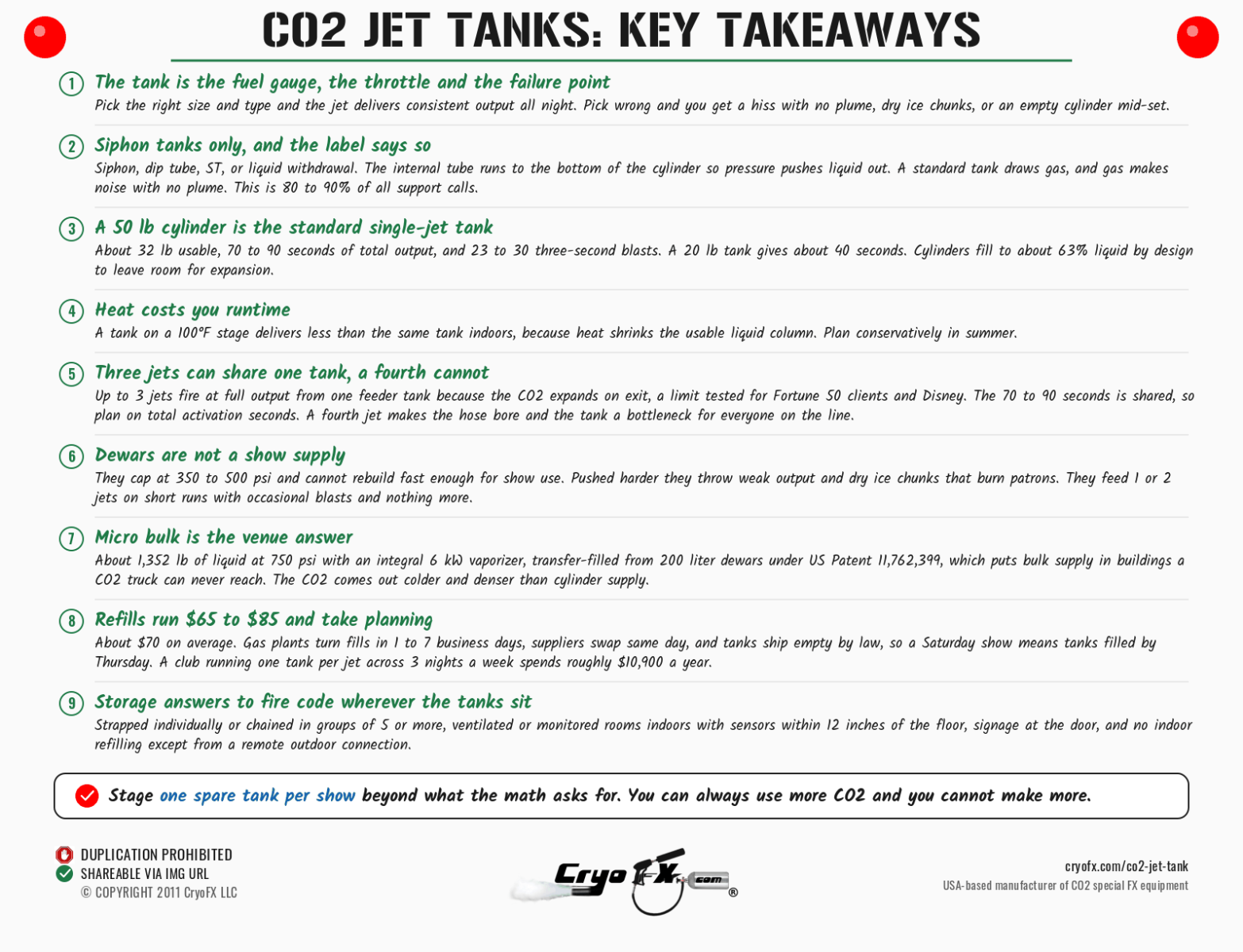
Every CO2 jet machine converts liquid CO2 into the plume, which makes the tank the fuel gauge, the throttle, and the most common failure point of the whole system. Pick the right size and type and the jet delivers consistent output all night; pick wrong and you get a hiss with no plume, dry ice chunks, or an empty cylinder mid-set. Below is the complete tank answer for jets, built to be used with the runtime calculator on this page.
Runtimes by tank size
The figures assume one jet drawing liquid from one tank at full output. Multiple tanks on one line add runtime; they never add pressure.
| Tank size | Usable liquid (approx.) | Total output through one jet |
|---|---|---|
| 5 lb | ~3 lb | ~10 seconds |
| 10 lb | ~6 lb | ~20 seconds |
| 15 lb | ~9 lb | ~30 seconds |
| 20 lb | ~13 lb | ~40 seconds |
| 35 lb | ~22 lb | ~60 seconds |
| 50 lb | ~32 lb | 70 to 90 seconds |
| 75 lb | ~47 lb | ~2 min 15 sec |
| 100 lb | ~63 lb | ~2 min 45 sec |
The special effects sizes are 20, 50, 75, and 100 lb, with 35 and 60 lb common on the East Coast. A high-pressure cylinder fills to about 63% liquid by design, leaving headspace for the liquid to expand with temperature, which is where the usable column comes from. Heat shrinks the liquid further: a tank on a 100°F stage delivers less than the same tank indoors, so plan conservatively in summer.
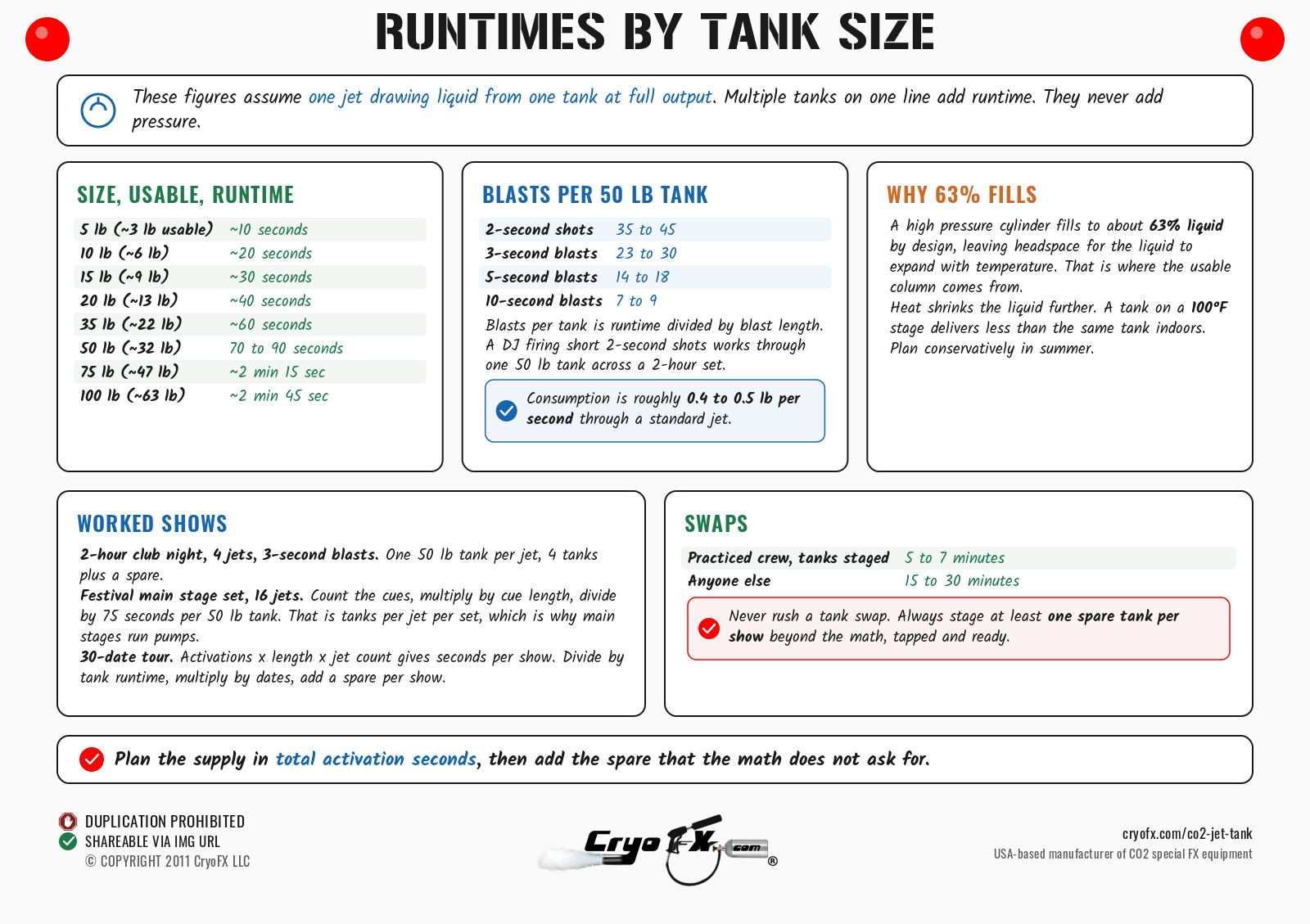
Blasts per tank is runtime divided by blast length. A 50 lb tank at 3-second blasts gives 23 to 30 blasts; at 5 seconds, 14 to 18; at 10 seconds, 7 to 9. A DJ firing short 2-second shots works through one 50 lb tank across a 2-hour set, roughly 35 to 45 activations.
Tanks per jet, and splitting
One tank, one hose, one jet is the CryoFX default, multiplied by the jet count so each jet is an isolated system; if one goes down, the rest of the stage keeps firing. Heavy activation schedules daisy chain 2 to 4 tanks per hose for runtime. Splitting runs the other direction: up to 3 jets can share one feeder tank with no measurable loss in per-jet output, a limit we've tested for Fortune 50 clients and Disney, because the CO2 expands on exit; the 70 to 90 seconds of liquid is shared between the three, so plan the tank around total activation seconds across all of them.
Add a fourth jet to the line and every jet loses output, because one hose bore and one tank become the bottleneck. Always stage at least one spare tank per show beyond the math, tapped and ready. Tank swaps take a practiced crew 5 to 7 minutes with tanks staged; give anyone else 15 to 30 and never rush one.
Siphon tanks, the non-negotiable
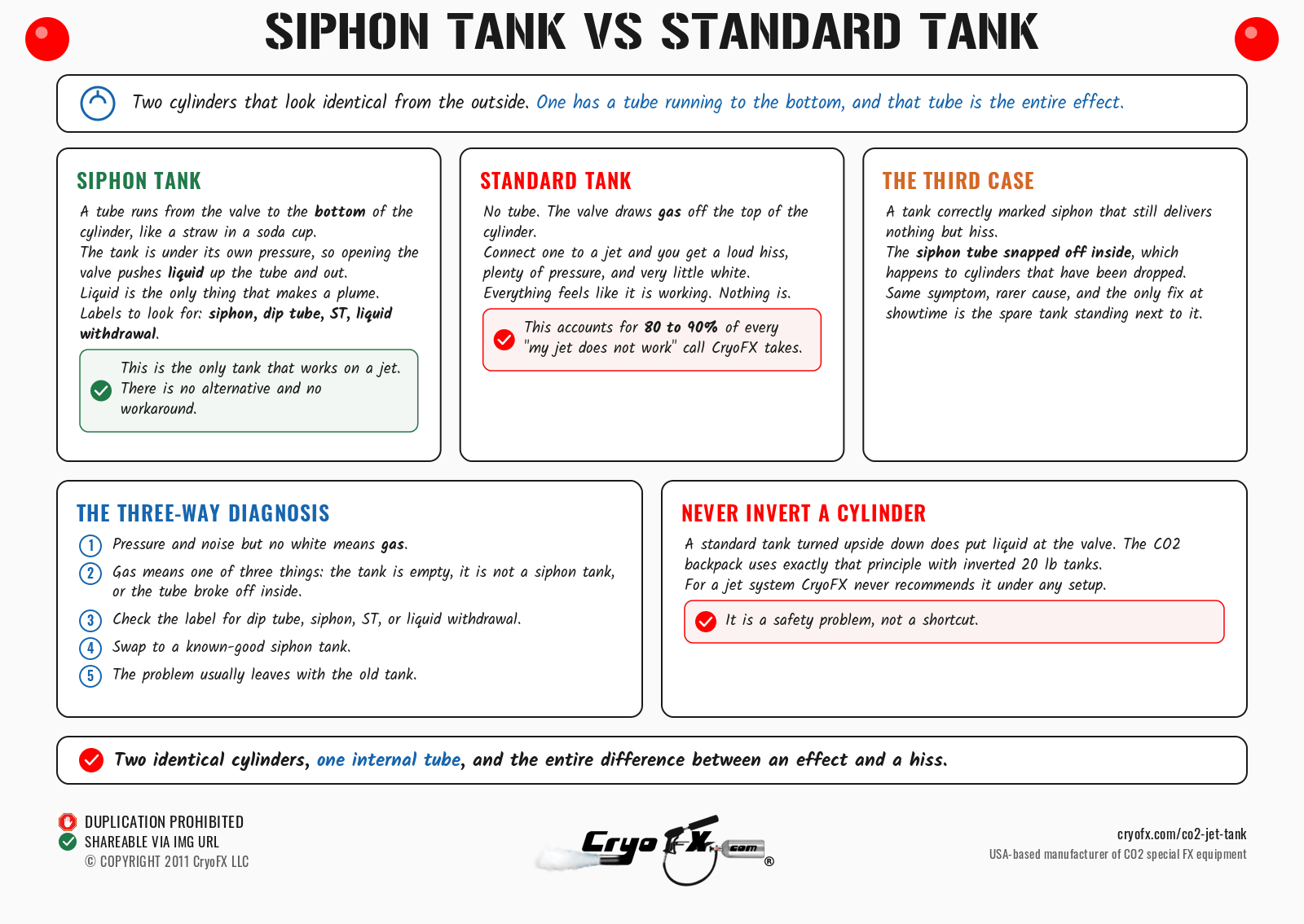
Only a siphon tank works. The label reads siphon, dip tube, ST, or liquid withdrawal, and inside runs a tube from the valve to the bottom of the cylinder, a straw in a soda cup, drawing liquid CO2 out under the tank's own pressure. A standard tank draws gas off the top, and gas makes noise with no plume, which is 80 to 90% of every "my jet doesn't work" call we take.
Siphon tubes can also snap off inside a dropped cylinder, the rarer version of the same symptom: a tank marked siphon that delivers nothing but hiss. Never invert a standard cylinder to fake a siphon feed on a jet system; it moves liquid to the valve and it's a safety problem we don't recommend under any setup.
Cylinders, dewar tanks, and micro bulk
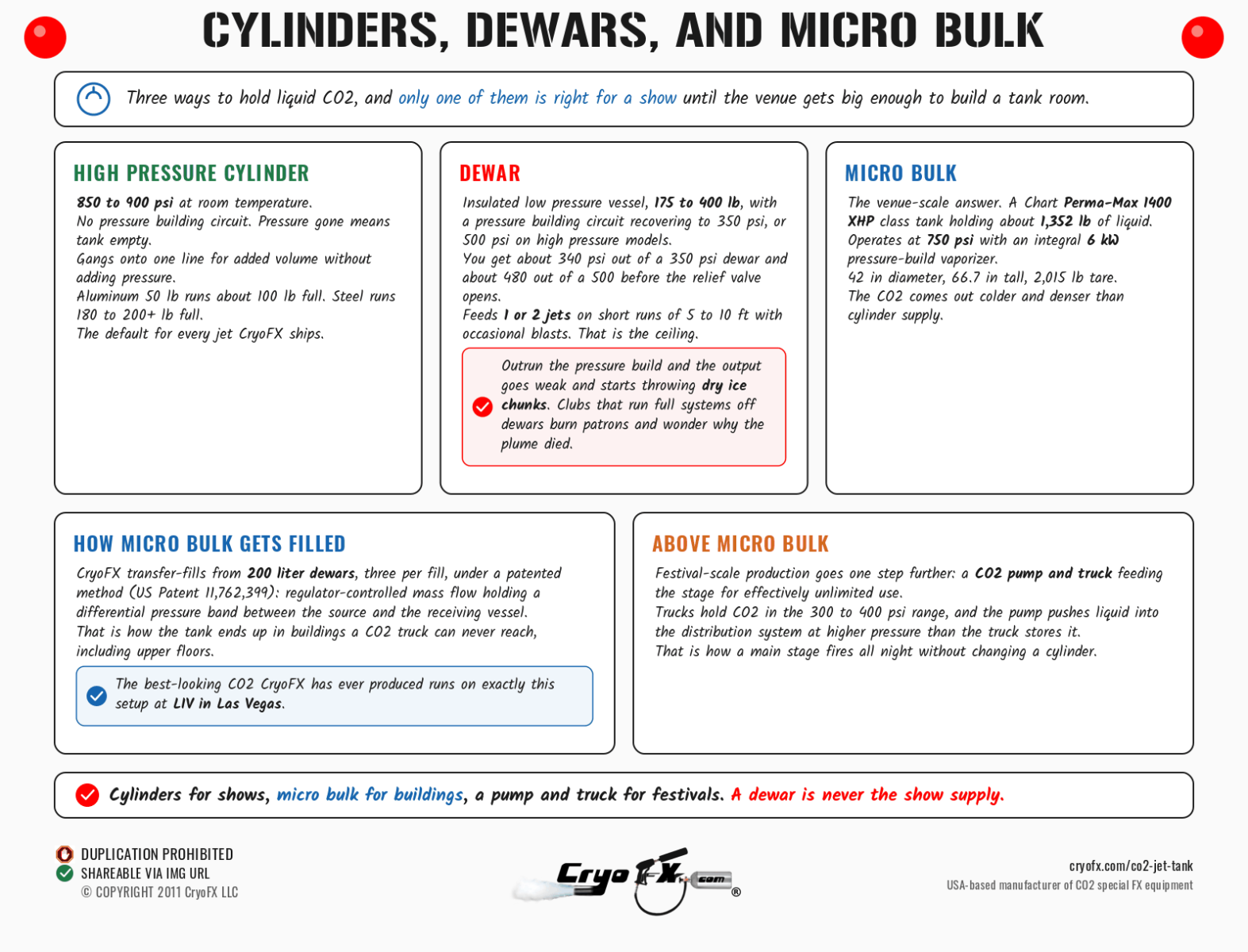
A high-pressure cylinder holds liquid CO2 at 850 to 900 psi at room temperature, has no pressure-building circuit (pressure gone means tank empty), and gangs onto one line for added volume. Aluminum is our preference for jet work: an aluminum 50 lb tank runs about 100 lb full, where steel runs 180 to 200+ lb full because the tare weight alone is 120 to 160 lb. Cylinders move on a dolly and ride in a truck, upright and strapped, never in a sealed hot vehicle, never more than 1,000 lb of CO2 per vehicle under DOT rules.
A dewar tank is an insulated low-pressure vessel of 175 to 400 lb with a pressure-building circuit that recovers to 350 psi (500 on high-pressure models). Dewars feed 1 or 2 jets on short runs with occasional blasts, and that's their ceiling: outrun the pressure build and the output goes weak and starts throwing dry ice chunks. Clubs that try to run full jet systems off liquid dewar tanks burn patrons and wonder why the plume died. It never makes sense to use a dewar as the show supply.
Micro bulk is the venue-scale answer. CryoFX installs an extra-high-pressure micro bulk tank (Chart's Perma-Max 1400 XHP class) holding about 1,352 lb of liquid, operating at 750 psi with an integral 6 kW pressure-build vaporizer, and transfer-fills it from 200-liter dewars on upper floors under CryoFX's patented method (US Patent 11,762,399), which is how the tank ends up in buildings a CO2 truck can never reach. The CO2 comes out colder and denser than cylinder supply, and the best-looking CO2 CryoFX has ever produced runs on exactly this setup at LIV in Las Vegas. Festival-scale production goes one step further: a CO2 pump and truck feeding the stage for effectively unlimited use.
Refills, swaps, and logistics
A 50 lb fill or swap runs $65 to $85, $70 on average. Gas plants turn fills in 1 to 7 business days; suppliers swap same-day; tanks ship empty by law, so a Saturday show means tanks filled by Thursday. A club running one 50 lb tank per jet per night across 3 nights a week spends about $210 a week, roughly $10,900 a year, and refills weekly. Orders over 100 lb of CO2 route through CryoFX services, and in Las Vegas CryoFX runs its own swap program: one price covering delivery, management, tanks, rental, and pickup, no gas-company invoice maze, no rent charges on misdeliveries. Some call it white glove service. We just call it simplicity.
[CALCULATOR BLOCK: CO2 CONVERSION CALCULATOR HERE, lb to cubic feet for permit paperwork and bulk planning]
The consumption math for real shows
[CALCULATOR BLOCK: TOURING CO2 CONSUMPTION, TANKS PER SHOW AND COST FOR THE RUN, tourcalc3_touring_co2_consumption_calculator_v3.html]
A 2-hour club night, 4 jets, 3-second blasts: one 50 lb tank per jet, 4 tanks plus a spare. A festival main stage set, 16 jets programmed cue by cue: count the cues, multiply by cue length, divide by 75 seconds per 50 lb tank, and that's tanks per jet per set, which is why main stages run pumps. A 30-date tour running the same show nightly: activations × length × jet count gives seconds per show; divide by tank runtime, multiply by dates, add a spare per show. Consumption per activation works out to roughly 0.4 to 0.5 lb of CO2 per second through a standard jet.
Fire codes govern the storage side (strapping, monitoring, ventilation), and the CO2 jet permit requirements guide covers how tank counts and total CO2 weight land on a permit application. The full supply engineering, prime valves and hose behavior included, is in the CO2 jet tank requirements guide on the pillar. Cylinders, siphon tanks, and dewar tanks are all stocked as CO2 jet tanks for sale on the CryoFX catalogue.
Storage, codes, and the stadium entrance
Tank storage answers to international fire code regulations wherever the tanks sit: strapped individually or chained in groups of 5 or more, ventilated or monitored rooms indoors with sensors within 12 inches of the floor, signage at the door, and no indoor refilling except from a remote outdoor connection. The show-control systems side ties in too: on permanent installs the tank room's monitors wire into the life safety panel, and electronic tank valves let the system close the supply automatically.
It scales from a single 50 lb cylinder behind a DJ booth to the stadium entrance pattern, where 8 jets and their tanks stage behind the tunnel for a 5-activation night and the whole supply strikes before the second quarter. Whatever the scale, the supply feeding the system is what the show runs on, so it gets designed with the same care as the jets.
Frequently asked questions
What size CO2 tank do I need for a CO2 jet? A 50 lb siphon cylinder is the standard single-jet tank: 70 to 90 seconds of output, 23 to 30 three-second blasts. Smaller shows run 20 lb tanks at about 40 seconds; bigger shows stack tanks or move to bulk supply.
How long does a 50 lb CO2 tank last on a CO2 jet? 70 to 90 seconds of total liquid output at full blast, less in hot conditions. As blasts: 23 to 30 at 3 seconds each.
How many blasts do I get per tank? Tank runtime divided by blast length. A 50 lb tank gives 23 to 30 three-second blasts, 14 to 18 five-second blasts, or 7 to 9 ten-second blasts.
Do CO2 jets need a siphon tank? Yes, always. Only a siphon (dip tube) tank draws liquid CO2, and only liquid makes the plume. A standard tank delivers gas: loud hiss, no effect. The wrong tank is 80 to 90% of all "jet not working" calls.
Can I use a dewar with a CO2 jet? Only for 1 or 2 jets on short runs with occasional blasts. Dewars max out at 350 to 500 psi and can't rebuild pressure fast enough for show use; pushed harder they throw weak output and dry ice chunks.
How many tanks do I need per jet? One per jet as the default, 2 to 4 chained per hose for heavy schedules, plus one spare tank per show staged and tapped.
Can I run 3 jets off one tank? Yes, with no measurable per-jet loss; the tank's runtime is shared across the three. A fourth jet on the same line drops everyone's output.
How much does a CO2 refill cost? $65 to $85 per 50 lb fill or swap, $70 average. Plants take 1 to 7 business days; suppliers swap same-day; tanks ship empty by law.
Can I transport CO2 tanks in my car? Upright, secured, windows open, never in a closed trunk or a hot vehicle, and never more than 1,000 lb of CO2 per vehicle under DOT rules. A sealed hot car with a leaking tank can kill its driver before the third breath.
Co2 Jet Tank | CryoFX®
Updated - 09/06/2026.