Updated - 07/24/2026.
USA Based Designer, Manufacturer, Installer of Special FX Equipment & Systems.
Renting CO2 cannons is the right call for some operators and the wrong call for others. The decision usually comes down to frequency of use, storage logistics, and whether maintaining equipment fits your operation.
This guide covers the full rental process from start to finish, what's in the rental agreement, what affects pricing, how to handle problems on event day, and what the return process looks like.
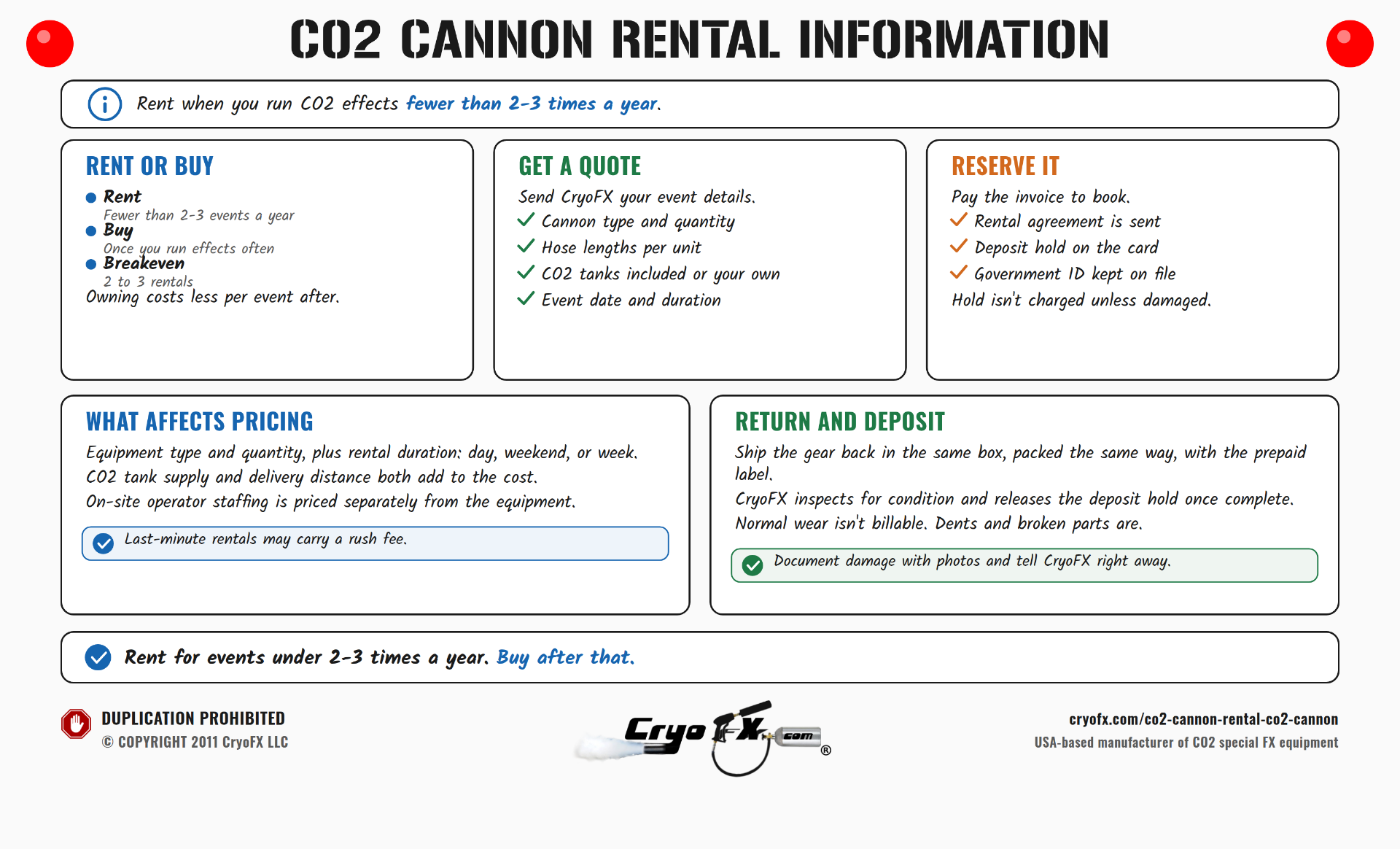
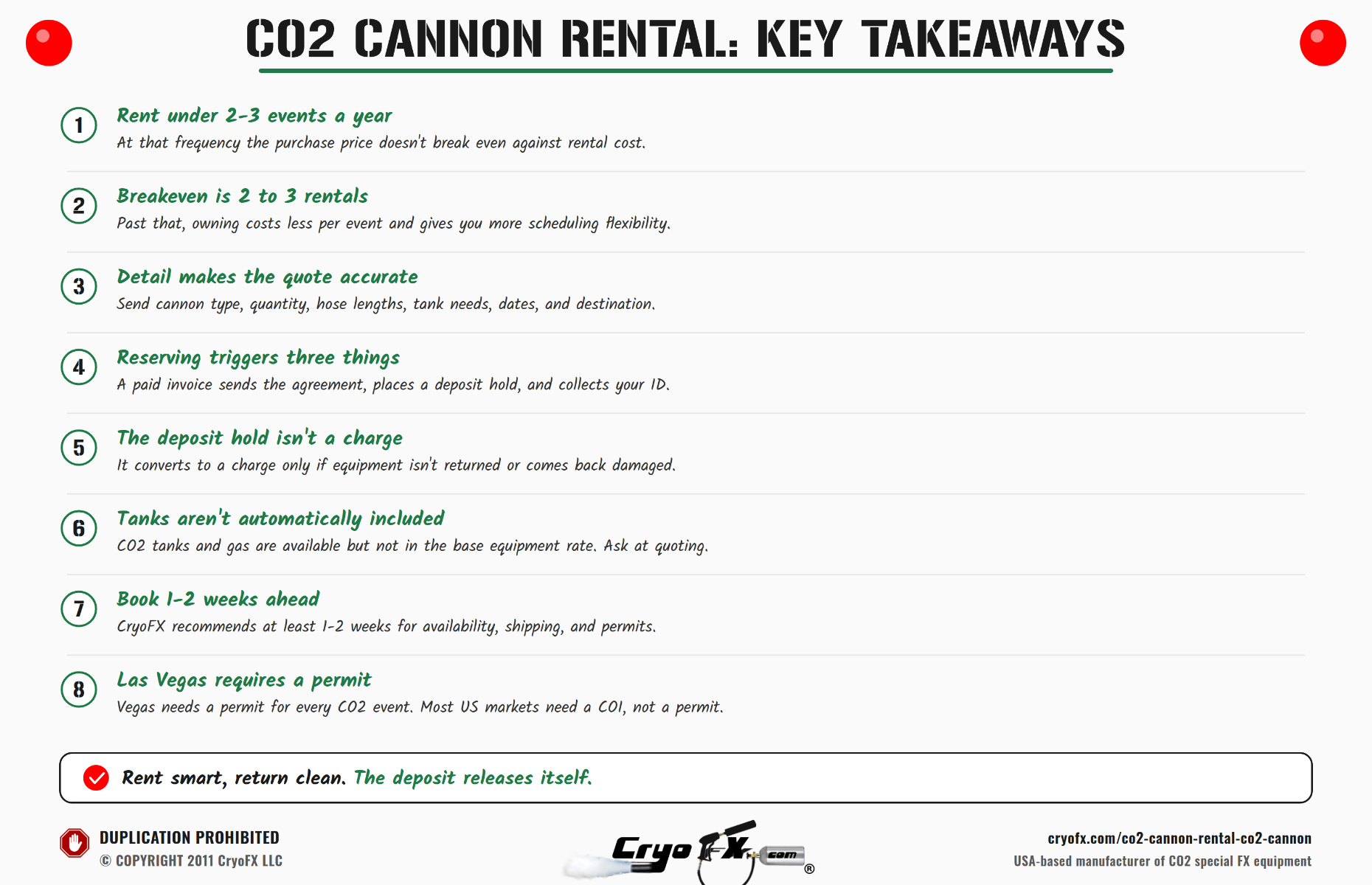
Renting makes sense if you're running CO2 effects at events fewer than 2-3 times per year. At that frequency, the purchase price of professional CO2 special effects equipment doesn't break even against rental costs. You also avoid the logistics of storing CO2 cannons and CO2 tanks between uses, managing valve maintenance, and dealing with hose inspection.
Renting also makes sense for production companies testing CO2 special effects for the first time, event planners adding a CO2 effect to a single high-visibility event, or anyone who needs equipment that isn't part of their regular kit.
Buying makes sense once you're running CO2 effects regularly. The typical breakeven is 2 to 3 rentals. Beyond that, owning your equipment costs less per event and gives you more scheduling flexibility.
Step 1: Get a quote
Contact CryoFX with the details of your event. To give you an accurate quote, CryoFX needs:
The more detail you provide upfront, the faster and more accurate the quote will be.
Step 2: Reserve the equipment
Once the quote is confirmed and you're ready to book, CryoFX invoices for the rental. When the invoice is paid, three things happen: the rental agreement is sent, a deposit hold is placed on the credit card on file (the hold is not charged unless equipment isn't returned or is damaged), and CryoFX collects a copy of the renter's government-issued ID. The ID is kept on file as part of the rental record.
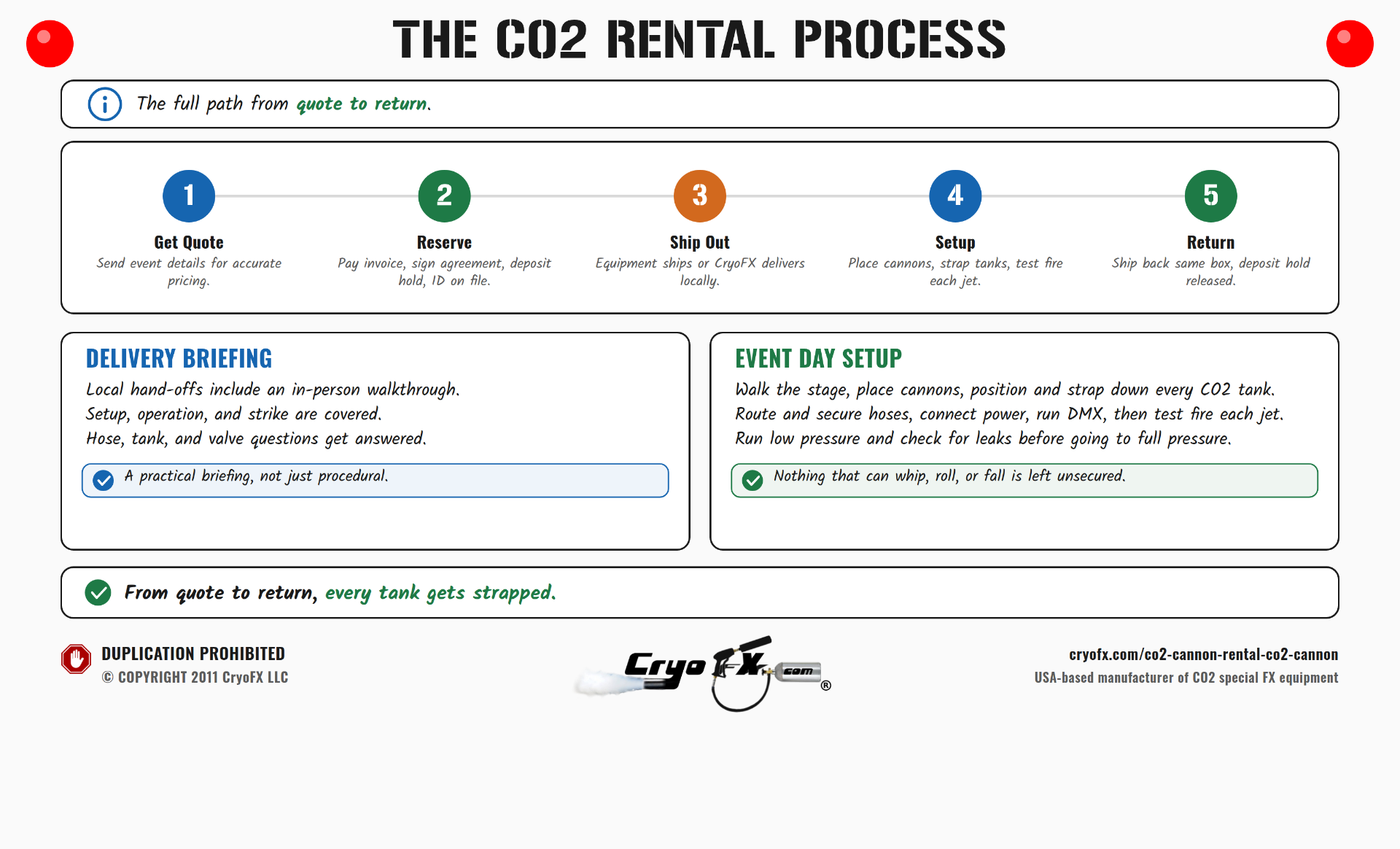
Step 3: Equipment ships or is delivered
CO2 cannon rental equipment ships to you in the appropriate packaging for safe transport. For local deliveries, CryoFX can deliver directly. Shipping logistics are confirmed as part of the booking process.
Step 4: Delivery briefing
For local deliveries where CryoFX hands off equipment in person, CryoFX walks through setup demonstration, covers any questions about the equipment, reviews safety procedures for CO2 cannon operation, including setup, operation, and strike, and covers expectations for the rental period. This briefing is practical, not just procedural. Any questions about hose connections, CO2 tank handling, valve operation, or control system setup get answered at this point.
Step 5: Event day setup
On events where CryoFX staff handle setup, the process goes like this: walk the stage to identify equipment positions and access points, place CO2 cannons in their designated locations, position CO2 tanks, route and secure CO2 hoses, strap down tanks, connect power and run DMX, test fire each jet for function, run pressure into hoses and check for leaks before full pressure, then complete a full system test. DMX is programmed and confirmed either before or after power setup.
Every hose gets secured. Every CO2 tank gets strapped. Nothing that can whip, roll, or fall is left unsecured before the show begins.
Step 6: Return
After the event, equipment ships back to CryoFX in the same box it arrived in, using the prepaid return label. The box is packed the same way it was received. CryoFX receives the equipment, inspects for cosmetic and operational condition, and releases the deposit hold once the inspection is complete.
The rental agreement is a binding contract. It covers:
Renters can provide their own insurance documentation covering loss, theft, or damage. If that's not in place, the deposit hold on the credit card serves as the security. The rental agreement also confirms that the renter is professionally trained and capable of operating the equipment safely.
The agreement is a straightforward document. Its purpose is to establish shared expectations, not to create surprises.
Several variables influence the final rental cost:
Equipment type and quantity, handheld CO2 cannons rent at a different rate than LED CO2 jets or XY DMX jets. More units cost more.
Rental duration, day rate, weekend rate, and week rate are different. A weekend event that requires equipment for 3 days is priced differently than a single show.
CO2 tank supply, if CryoFX supplies CO2 tanks, that adds to the rental cost. If you're sourcing your own CO2 and tanks, it doesn't.
Delivery distance, local pickup is typically less expensive than regional shipping. Distance affects both cost and lead time.
Operator staffing, if you need CryoFX staff on-site for the event to operate the equipment, that's priced separately from the equipment rental itself.
Lead time, last-minute rentals may carry a rush fee or may not be available depending on equipment inventory and shipping timelines.
Equipment problems during a live event require clear-headed troubleshooting, not panic. The first step is always isolation: is this problem happening on one CO2 cannon or all of them?
If it's one cannon and the others are working, the problem is in that mini-system (cannon + hose + tank). Start there.
If all cannons are affected, the issue is systemic, look at the control system, the DMX signal, or the CO2 supply.
Within a single mini-system, ask these questions in order:
These systems operate independently. Isolating which category the problem falls into tells you exactly where to look. The worst thing you can call CryoFX support with is "it doesn't work", there are too many variables for that to be useful. The best call comes with specifics: which jet, what it's doing (or not doing), what you've already checked.
CryoFX support is available during business hours for troubleshooting assistance.
Return equipment in the same box, packed the same way it was received, using the prepaid shipping label. Tank rentals have a separate process, tanks must be returned to their rental location or the customer must be present when tanks are picked up, per the tank rental agreement.
Damage policy:
Normal wear is expected and isn't billable. Normal wear means minor scuffs on the bottom of the unit's base, surface marks from stage contact, the kind of thing that happens to professional equipment in regular use.
Billable damage is anything beyond that: dents, broken components, cosmetic damage on the body of the unit, operational damage that affects function. If damage happens, document it immediately with photos and video, and notify CryoFX when it occurs rather than hoping it isn't noticed at inspection. Customers who are upfront about damage are treated differently than customers who return damaged equipment without disclosure.
What's the minimum lead time for a CO2 cannon rental?
CryoFX recommends at least 1-2 weeks for rental bookings to ensure equipment availability, shipping time, and any coordination on permits or CO2 tank supply. Rush situations can sometimes be accommodated, but earlier is always better.
Does the rental include CO2 tanks and gas?
CO2 tanks and CO2 gas are available as part of the rental but are not automatically included in the base equipment rate. Let CryoFX know during the quoting process whether you need CO2 tank supply included.
What happens if I don't return the equipment?
The deposit hold on the credit card on file converts to a charge for the value of the unreturned equipment. That value is stated in the rental agreement.
Can I rent CO2 cannons for a permanent nightclub installation trial?
Yes. Renting is a practical way to test CO2 special effects in your venue before committing to a permanent installation. The rental process is the same regardless of whether the end goal is a permanent install.
Do I need a permit to rent and use CO2 cannons?
That depends on your market. In Las Vegas, yes, a permit is required for every CO2 cannon event, including rentals. In most other US markets, a COI is typically required but a formal government permit is not. Confirm with your local fire department or contact CryoFX for guidance specific to your location.
When does buying CO2 cannon equipment make more sense than renting?
The typical breakeven is 2 to 3 rentals. If you run CO2 effects at events more than 2 to 3 times per year, purchasing is almost always the better economic decision. Below that frequency, renting keeps overhead low and eliminates the logistics of equipment storage, valve maintenance, hose inspection, and CO2 tank management between events.
What information does CryoFX need to provide a CO2 cannon rental quote?
To generate an accurate quote, CryoFX needs the type of equipment required, hose lengths for each piece, quantity of cannons, whether CO2 tanks should be included, event date and rental duration, shipping destination or delivery location, and whether you need a DMX controller, power cables, or DMX cables included in the rental.
What factors affect CO2 cannon rental pricing?
Rental cost depends on equipment type and quantity, rental duration (day rate, weekend rate, or week rate), whether CO2 tanks are included, delivery distance, whether CryoFX operator staffing is needed for the event, and lead time. Last-minute rentals may carry a rush fee or may not be available depending on equipment inventory and shipping timelines.
What should I do if a CO2 cannon stops working during a live event?
First, determine whether the problem affects one cannon or all of them. If it is one unit, troubleshoot that mini-system by checking CO2 supply, pneumatics, power, DMX signal, and mechanical condition in that order. If all cannons are affected, the issue is systemic, look at the control system, DMX signal, or the overall CO2 supply.
For everything you need to know about CO2 cannon operation and safety, the complete CO2 cannon information guide covers the full picture.
Ready to book or purchase? Explore CO2 cannon rental and purchase options at CryoFX.com.
Updated - 07/24/2026.