
CO2 Cannon vs Cold Sparks, Which Special Effect Is Right for Your Event?
CO2 Cannon vs Cold Sparks, Which Special Effect Is Right for Your Event? | CryoFX
CO2 cannon vs cold sparks: what's actually different and which one fits your event
They're both popular. They both look good in photos. And they're both regularly confused with each other by clients, venue managers, and even some production companies.
CO2 cannons and cold spark machines are not interchangeable. They produce completely different visual effects, carry different safety risks, require different permits, and fit different event contexts. Choosing the wrong one, or assuming either one is a plug-in substitute for the other, creates problems on show day.
Here's a direct comparison of both effects across the factors that matter most when you're deciding.
What each effect actually does
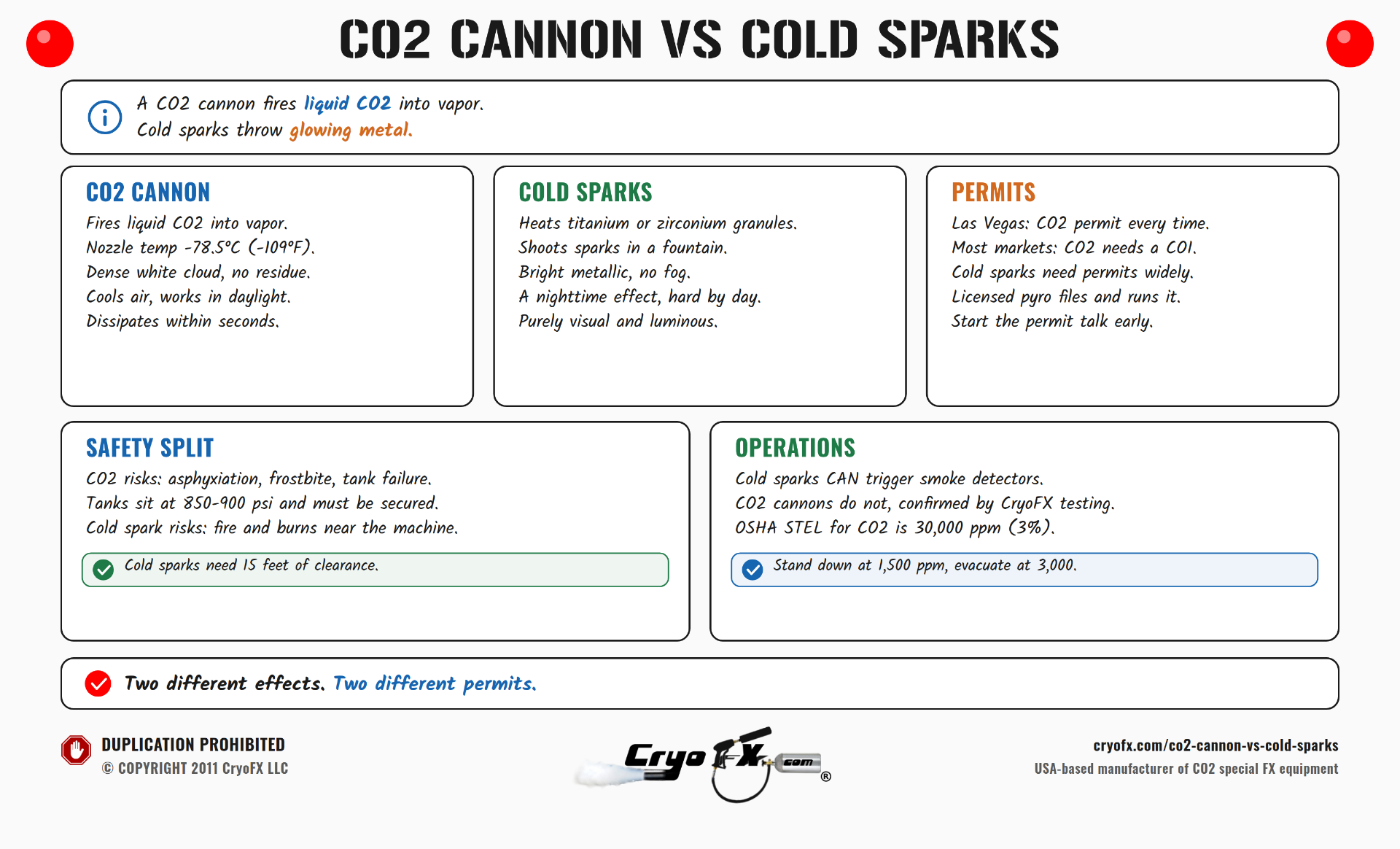
A CO2 cannon fires a burst of liquid CO2 that immediately expands into a dense white vapor cloud on exit. The plume is cold, visible, atmospheric, it looks like a wave of fog or a cloud blasting out of the cannon. The discharge temperature at the nozzle is -78.5°C (-109°F). The cloud dissipates within seconds, leaves no residue, produces no heat, and can cool the air near the stage.
A cold spark machine does something entirely different. It heats a titanium or zirconium-based metallic granule compound and propels the particles upward in a fountain pattern. What you see is a shower of glowing sparks, bright, metallic, resembling a grinder on metal. There's no vapor, no fog, nothing atmospheric. The effect is purely visual, purely luminous.
These are two distinct visuals. CO2 cannon effects work during the day if needed and read as atmospheric and immersive. Cold sparks are primarily a nighttime effect, they're hard to see in daylight, and they read as dramatic, climactic, and photography-forward. A wedding couple's first dance with cold spark fountains flanking them photographs completely differently than CO2 cannon blasts during the same moment.
Neither effect substitutes for the other. A client asking for "cold sparks" and getting CO2 cannons will be unhappy, and vice versa.
Safety profile: a direct comparison
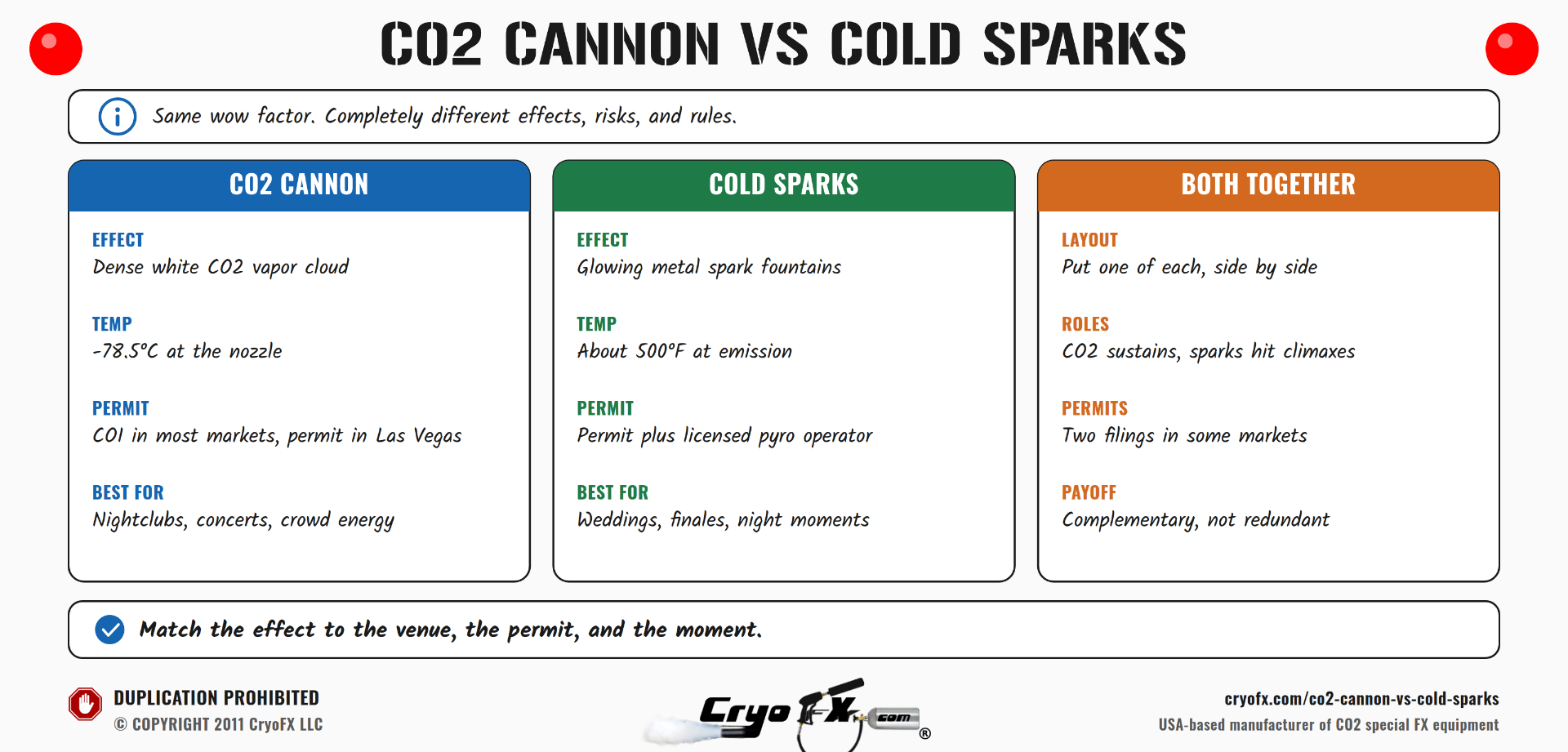
The safety profiles of these two effects are very different, and both have real risks that are sometimes underestimated.
CO2 cannons:
The primary risks with CO2 cannon operation are asphyxiation, frostbite, and pressurized vessel failure. CO2 is a colorless, odorless gas that accumulates at floor level. In a small enclosed space with significant CO2 discharge, oxygen displacement is a genuine danger. CO2 does NOT trigger smoke detectors, confirmed through CryoFX testing, which means there's no automatic alarm system watching for CO2 buildup the way there is for smoke. Monitoring equipment and situational awareness are the real safeguards.
Frostbite risk applies to anyone who gets close to the discharge nozzle or is hit by dry ice chunks that can form in the plume. Tanks at 850-900 psi are also pressurized vessels that must be properly secured. A tank that falls and loses its valve becomes a projectile. OSHA's short-term exposure limit (STEL) for CO2 is 30,000 ppm (3%). CryoFX operators stand down from firing at 1,500 ppm and initiate evacuation at 3,000 ppm.
Cold spark machines:
Cold spark machines are hot. The sparks emit at approximately 500°F at the point of emission. They cool as they travel through the air, but anything the sparks contact near the machine, before that cooling happens, can ignite.
The term "cold spark" is a misnomer that causes real safety problems. The name implies the sparks are safe to the touch or safe around flammable materials. They are not. CryoFX released a video specifically demonstrating this: sparks fired into foam caused the foam to disintegrate, and sparks fired into a paper towel treated with lacquer thinner produced an immediate fire. Clothes can melt. Hair can catch fire. Anything flammable within the spray path and close to the machine is at risk.
Cold sparks CAN trigger smoke detectors. CO2 cannons cannot. This is a meaningful operational difference, especially in venues where a triggered smoke detector shuts down the entire event.
Cold spark machines cannot explode the way a pressurized CO2 tank can, but a fire started by a spark machine can escalate quickly. More event-related injuries have occurred with cold spark machines than CO2 cannons, largely because people use them without permits and without understanding the actual heat involved.
The 15-foot clearance rule applies to cold sparks, no audience members, no props, no furniture, no ceiling within 15 feet of the machine in all directions.
Permit comparison
This is one of the biggest practical differences between the two effects.
CO2 cannons:
In Las Vegas, a government permit is required 100% of the time. In most other US markets, CO2 cannon events require a COI but no formal government permit. The authority having jurisdiction is the local fire department, and many jurisdictions simply don't have a specific permit requirement for compressed gas in a temporary event context.
Cold spark machines:
Cold sparks are classified as pyrotechnic-adjacent in most US jurisdictions, and permits are required in the majority of professional event markets nationwide. A licensed pyrotechnic operator is required to both file the cold spark permit and operate the machines during the event in most states.
This is not a technicality. It's a meaningful operational cost and logistical requirement. You cannot hand a cold spark machine to a DJ or a venue stagehand and call it a day. The person running the machine must be a licensed pyro operator, and the permit must name that operator.
A real example: CryoFX was hired for a Las Vegas event where the client had booked cold spark machines. The client's venue contact told them the on-site fire marshal had approved the effect and that a permit wasn't needed. CryoFX explained that this was incorrect, Clark County Fire Prevention still required a separate permit filing regardless of what the venue's fire marshal said. The client disagreed, did their own investigation by going back to the hotel, and confirmed that CryoFX was right.
At that point, the client said they'd prefer to use CO2 cannons instead. CryoFX explained that CO2 cannons in Las Vegas also require a permit, a different permit, filed with Clark County, but still mandatory. The client was surprised again and pushed back. After confirming that as well, they ultimately decided to use fog machines to approximate the look they wanted and skip the permit process entirely.
This story is more common than it sounds. Clients often receive incomplete information from venues, then discover mid-planning that both effects require paperwork. Starting that conversation early, with accurate information, saves a significant amount of time and money.
Event type fit
CO2 cannons and cold spark machines each have contexts where they perform best.
Nightclubs: CO2 cannons are the primary effect here. The atmospheric plume works in tight spaces, cools the crowd, and creates energy that reads well in the dark. Cold sparks need clearance that most clubs can't provide, and the permit + licensed operator requirement adds friction.
Concerts and festivals: CO2 cannons excel at sustained energy. A row of CO2 jets firing during a high-energy song section creates the kind of moment that defines a show. Cold sparks work well for specific climactic moments, a drop, a finale, a dramatic reveal, but the permit and operator requirements make them a more deliberate addition rather than a general-purpose effect.
Weddings: Cold sparks dominate in the wedding market. The visual is exactly what wedding photographers want, bright fountains, a cinematic grand entrance, a first dance with a lit backdrop. CO2 cannons can work, but the visual is quite different. Both effects are popular, and the right choice depends on the look the client wants and the venue's ceiling height and clearance.
Corporate events: Both work well depending on stage setup. Cold sparks tend to hold their effect longer per activation, which is appealing for corporate events where the stage moment needs to carry across a large room. CO2 cannons work well for crowd activation and high-energy brand moments.
Using both together
CO2 cannons and cold spark machines are often combined in the same show, and the combination works well because they're complementary rather than redundant.
A common stage layout is to pod the effects together: one cold spark machine and one CO2 cannon placed side by side across the stage. The CO2 cannons provide sustained atmospheric energy throughout the show. The cold spark machines fire at specific climactic moments. Different visual languages, used for different purposes.
CryoFX has executed shows with both effects running in alternating patterns, 2 cold sparks flanking a row of CO2 jets, or CO2 cannons for the bulk of the show with cold sparks reserved for the finale. The combination requires coordinating two different permit applications in some markets and ensuring the licensed pyro operator covers the cold spark activation, but the visual payoff is significant.
If you're considering combining both effects, start the permit conversation early. Cold spark machine permits, particularly in states requiring a pyro operator, can take longer to process than CO2 cannon permits.
FAQs
Can cold sparks replace CO2 cannons at a nightclub that doesn't have ceiling clearance?
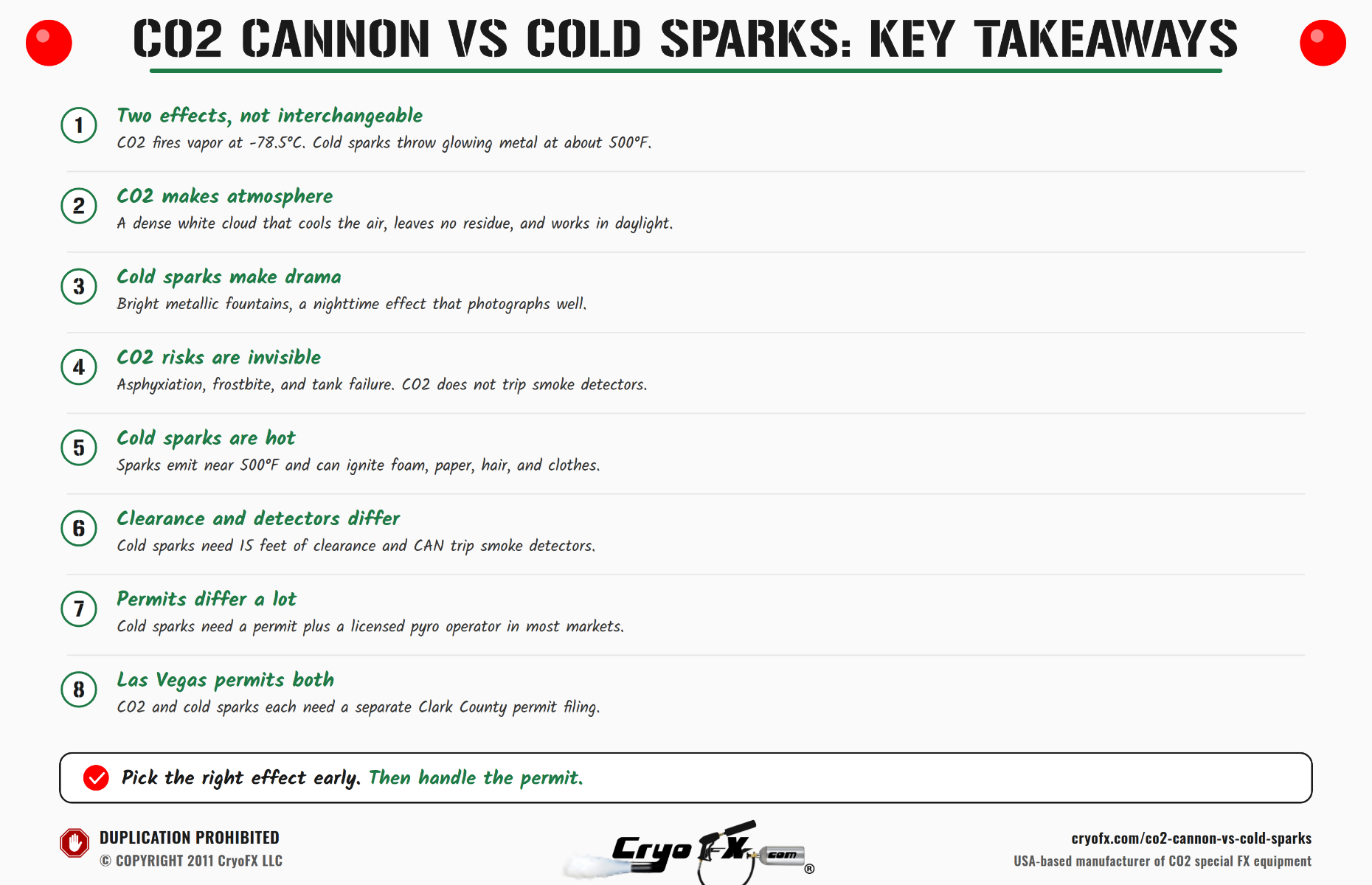
No. If you don't have the ceiling clearance for cold sparks (15 feet minimum from the machine in all directions), the effect can't be used safely. CO2 cannons are the better choice in low-ceiling venues, and they don't require the clearance that cold sparks do.
Do cold sparks trigger fire alarms?
Yes, cold sparks can trigger smoke detectors. CO2 cannons do not, this has been confirmed through CryoFX testing. This is an important operational distinction, particularly in venues where a triggered alarm stops the event entirely.
Is a licensed pyrotechnic operator required to run cold spark machines?
In most US jurisdictions, yes. The permit for cold sparks typically requires a licensed pyro operator to file the permit and operate the machines during the event. Requirements vary by state and city, so confirm with the local AHJ.
Which effect photographs better at a wedding?
Cold sparks are generally preferred for wedding photography because of the bright, luminous fountain visual. CO2 cannons produce a softer, atmospheric cloud effect that also reads well on camera but has a very different aesthetic. The right choice depends on the couple's vision and the venue's capabilities.
Can cold sparks be used outdoors?
Yes, but wind is a variable that needs to be managed. If sparks are blown sideways by wind toward flammable materials or the audience, the safety risk increases. Cold spark machines used outdoors require the same clearance as indoor use, and the spark direction needs to be monitored throughout the activation.
What is the discharge temperature of a CO2 cannon?
A CO2 cannon fires liquid CO2 that exits the nozzle at -78.5 degrees Celsius, which is -109 degrees Fahrenheit. At that temperature, the liquid CO2 immediately expands into a dense white vapor cloud. The plume dissipates within seconds, leaves no residue, produces no heat, and can slightly cool the air near the stage.
Do CO2 cannons trigger smoke detectors?
No. CO2 cannons do not trigger smoke detectors of any type, including photoelectric, ionization, and laser detectors. CryoFX has confirmed this through direct testing. Cold spark machines can trigger smoke detectors, which is an important operational difference in venues where a triggered alarm would stop the event entirely.
Do CO2 cannons require a government permit?
In Las Vegas, CO2 cannon events require a government permit filed with Clark County Fire Prevention. In most other US markets, a certificate of insurance is required but no formal government permit. Cold sparks require pyrotechnic permits in most US jurisdictions. Confirm with the local authority having jurisdiction for your specific market and event.
Can CO2 cannons and cold spark machines be used together in the same show?
Yes. The two effects are complementary rather than redundant and are often combined. A common stage setup positions one cold spark machine and one CO2 cannon side by side. CO2 cannons provide sustained atmospheric energy throughout the show, while cold spark machines fire at specific climactic moments. The combination requires separate permit applications in some markets.
For a full breakdown of CO2 cannon operation and specifications, see the CO2 cannon complete guide on CryoFX.com.
Interested in adding CO2 cannons to your next event? Browse CO2 cannons for sale and contact CryoFX to discuss what fits your stage.
___
CryoFX® is the leading manufacturer, designer, and global supplier of CO2 special effects equipment and custom special effects systems
for Theme Parks, Sporting Arenas, Mega Nightclubs & Day Clubs , TV/FILM & large scale events & installs in any industry requiring Co2 Systems.
CryoFX LLC Global Headquarters • 3859 S Valley View Blvd, Suite 2, Las Vegas, NV 89103 • 1.855.527.9639
Updated - 07/26/2026.