Cold Fireworks Price: What Machines Cost To Buy, To Rent, And To Run For One Event
Cold Fireworks Price: What Machines Cost To Buy, To Rent, And To Run For One Event
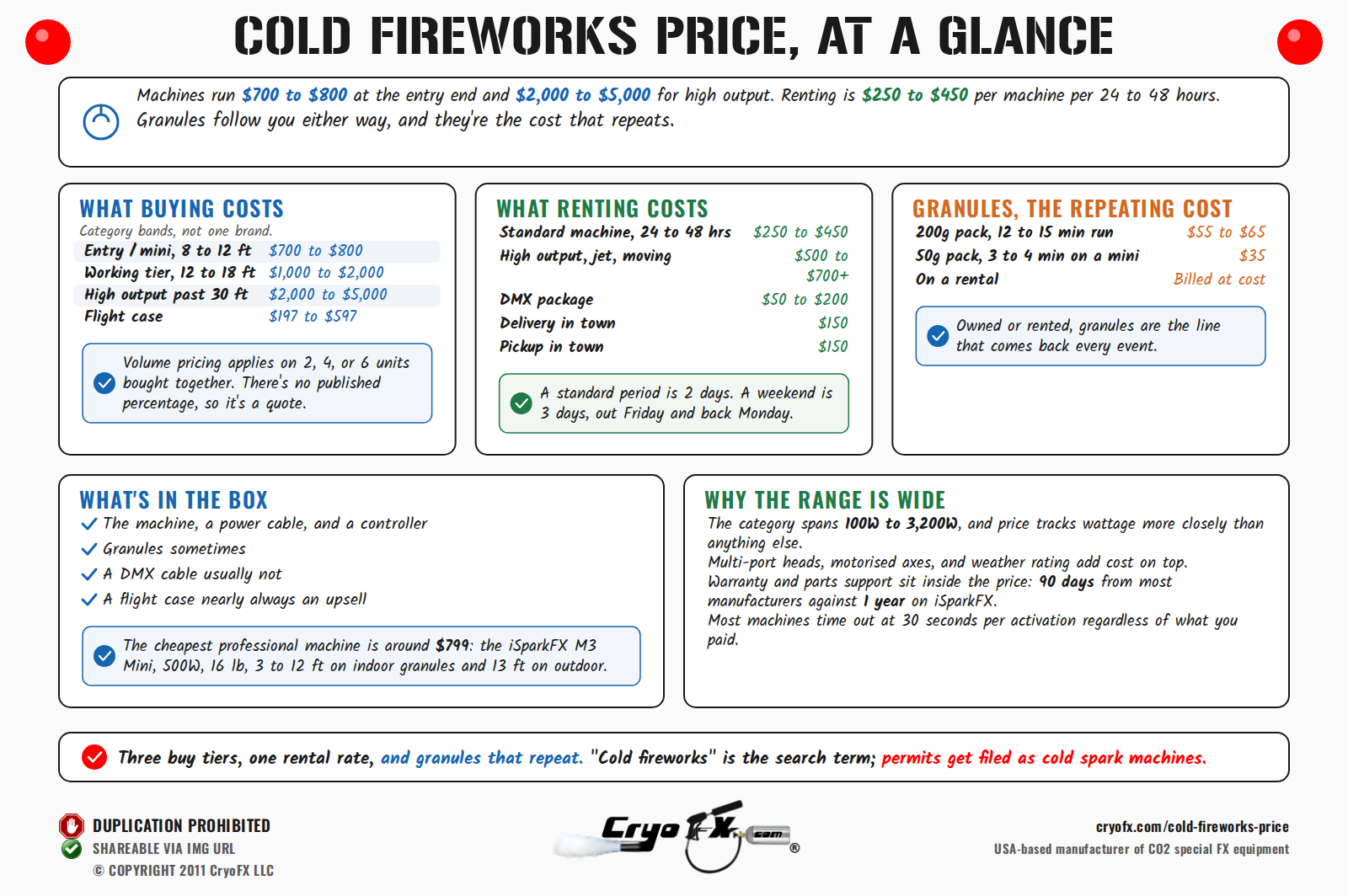
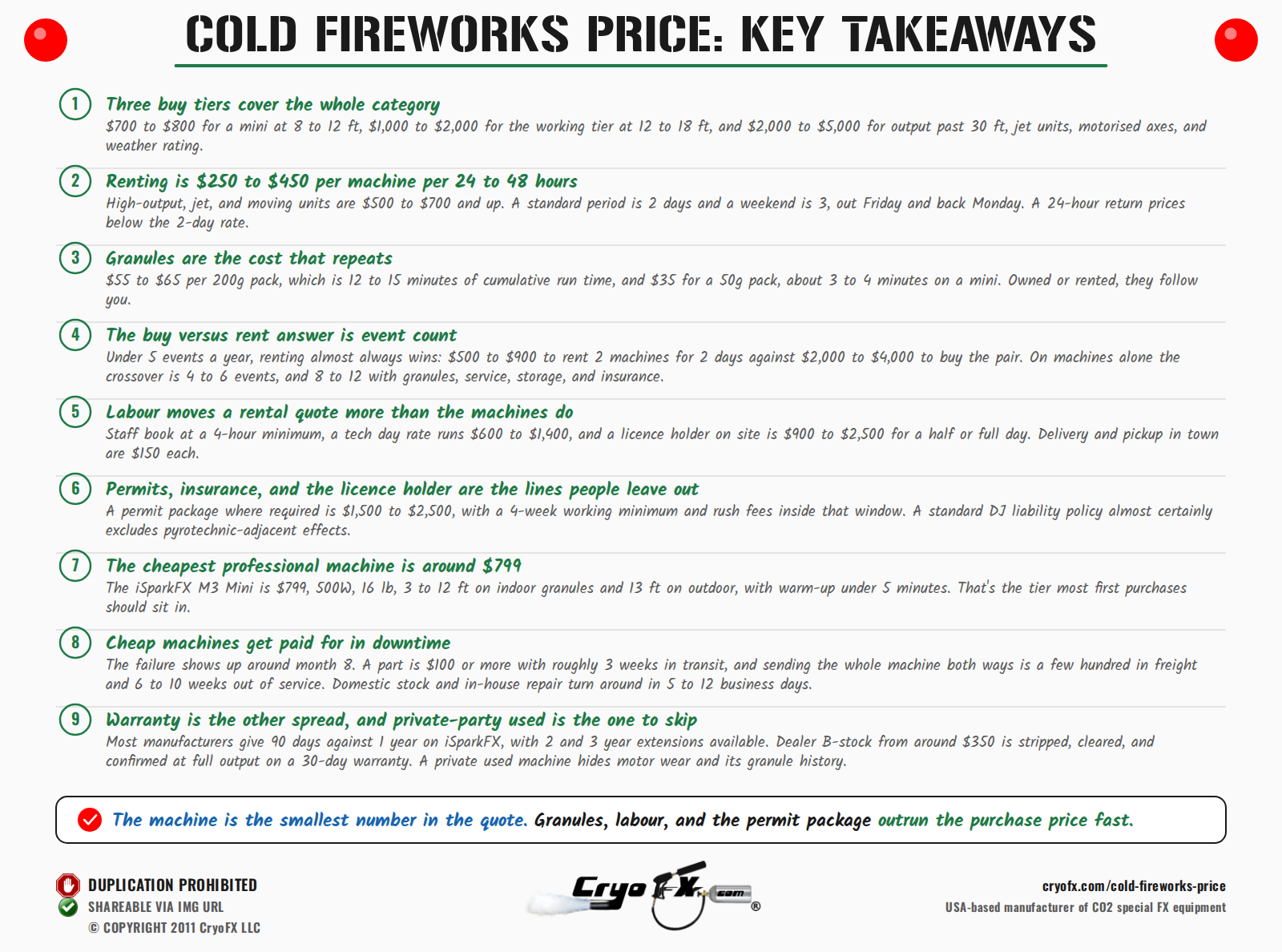
Cold fireworks machines cost $700 to $800 at the entry end, $1,000 to $2,000 for the main working tier, and $2,000 to $5,000 for high-output, multi-axis, and weather-rated units. Renting is $250 to $450 per machine per 24 to 48 hours. Granules follow you either way at $53 to $69 per 200g pack, and they're the cost that repeats.
One note on the term before the numbers. "Cold fireworks" is what buyers type, so it stays on this page, and it's the wrong phrase to put on a permit application. The house standard on filings is "cold spark machines," and the distinction gets made explicitly with fire marshals on every application.
Cold fireworks price at a glance
| Buy | Rent (24 to 48 hrs) | |
|---|---|---|
| Entry / mini, 8 to 12 ft | $700 to $800 | $250 to $450 |
| Working tier, 12 to 18 ft | $1,000 to $2,000 | $250 to $450 |
| High output past 30 ft, jet, moving, weather-rated | $2,000 to $5,000 | $500 to $700+ |
| Granules, 200g pack (12 to 15 min run time) | $53 to $69 | at cost |
| Granules, 50g pack (3 to 4 min on a mini) | $35 to $45 | at cost |
| DMX package | cable usually not included | $50 to $200+ |
| Flight case | $197 to $597 | separate line |
Those bands hold across the category because most machines come out of a small group of factories building to similar architectures. Model-by-model prices for one brand, from $559 for B-stock up to $4,697, sit on the Sparkular machine price page, and the equipment classes behind the tiers are explained in the cold spark machine pricing and information guide.
[INSERT BUY VERSUS RENT COST CURVE INFOGRAPHIC HERE, 1 TO 20 EVENTS PER YEAR, CROSSOVER BAND SHADED]
What buying costs across the category
$700 to $800 buys a mini. Around 500W, 16 lb, 8 to 12 feet of output, under 5 minutes of warm-up. The iSparkFX M3 Mini is $799 and does 3 to 12 feet on indoor granules and 13 feet on outdoor. That's a working machine for wedding entrances, low ceilings, and small club rooms, and it's the tier most first purchases should sit in.
$1,000 to $2,000 is the main working tier: 12 to 18 feet of output, a heavier auger assembly and blower, and a longer run before thermal protection cuts the activation. Most machines time out at 30 seconds per activation regardless of what you paid.
$2,000 to $5,000 buys output past 30 feet, jet units throwing a ball of sparks 25 to 30 feet, multi-nozzle heads, motorised axes, and weather rating. The category spans 100W to 3,200W and price tracks wattage more closely than it tracks anything else.
What arrives in the box is the machine, a power cable, and a controller. Granules sometimes. A DMX cable usually not. A flight case nearly always an upsell.
Volume pricing applies on 2, 4, or 6 units bought together. There's no published percentage, so it's a quote. Buying in pairs matches how the effect gets deployed, since almost every layout is symmetrical.
What renting costs across the category
Standard machines rent at $250 to $450 each per 24 to 48 hours. High-output, jet, and moving units are $500 to $700 and up.
A standard period is 2 days. A weekend is 3 days, out Friday and back Monday. A 24-hour return prices below the 2-day rate, which is the right structure for a single club night.
Labour is a separate line and it's the one that moves a rental quote most. Staff book at a 4-hour minimum, a regular tech day rate is $900 to $1,200, and a pyro licence holder on site is $900 to $2,500 for a half or full day. Delivery is $150 in town and pickup is $150 in town. Deposits, cancellation terms, and the underwriting for self-operated hires are set out on the cold spark machine rental page.
Buy versus rent, at a glance
The question is event count.
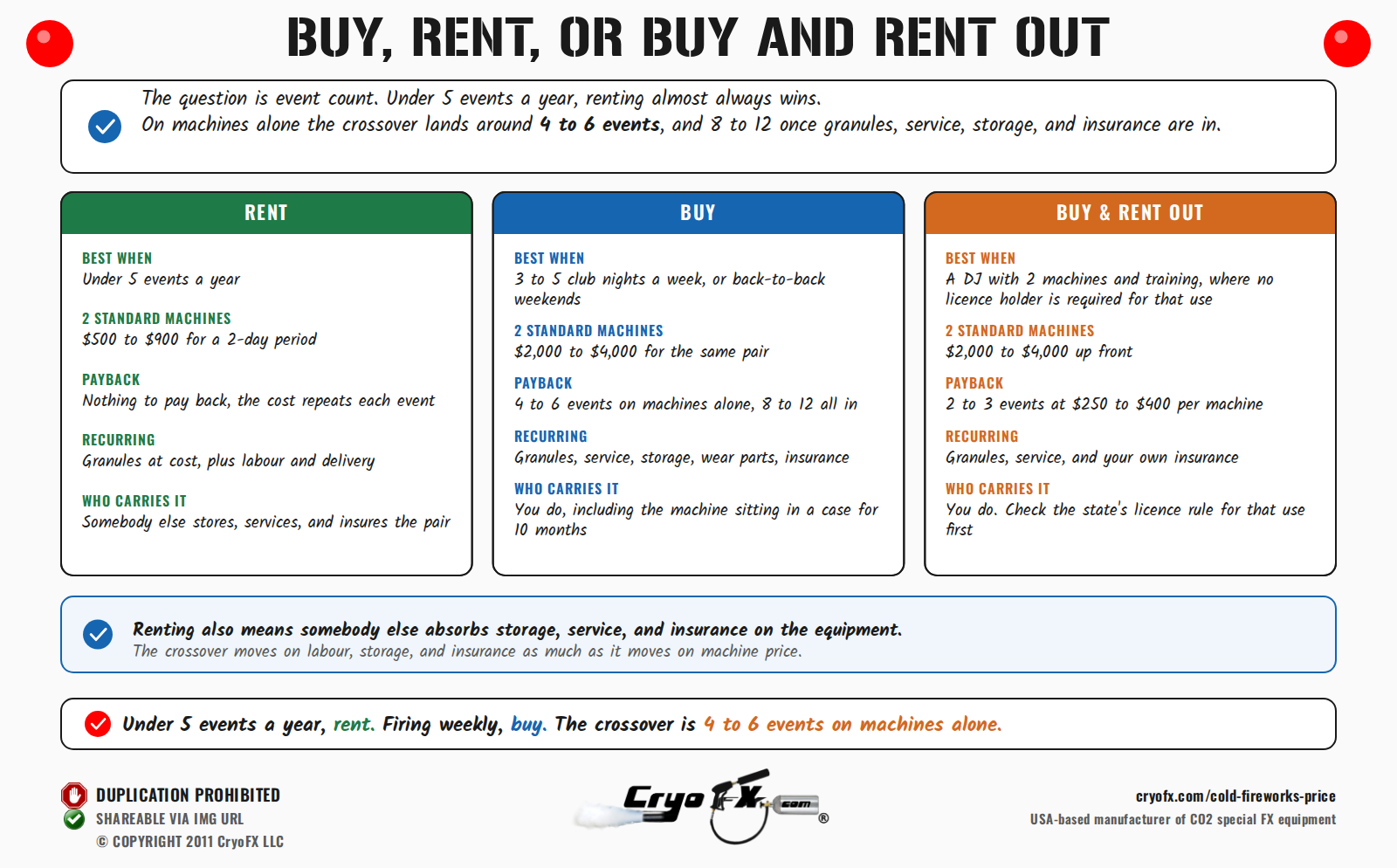
Under 5 events a year, renting almost always wins. Two standard machines rent at roughly $500 to $900 for a 2-day period before granules and labour, against $2,000 to $4,000 to buy the same pair. Renting also means somebody else absorbs storage, service, insurance on the equipment, and the machine sitting in a case for 10 months.
Buying wins on frequency. A club firing 3 to 5 nights a week, a DJ with weekly bookings, or a production company doing back-to-back weekends crosses over quickly. On machines alone the crossover lands around 4 to 6 events. Add granules, service, storage, and an insurance policy that actually covers spark effects and it stretches to 8 to 12. The full model, including the weekly club arithmetic and the annual DJ arithmetic, is built out on the cold spark machine cost page.
One case sits outside the arithmetic. A DJ who buys 2 machines plus training, in a state that doesn't require a licensed pyrotechnician for that use, can rent them out at $250 to $400 per machine per event and pay the purchase back in 2 to 3 events. That turns the machines from a cost line into a revenue line.
The cost per event
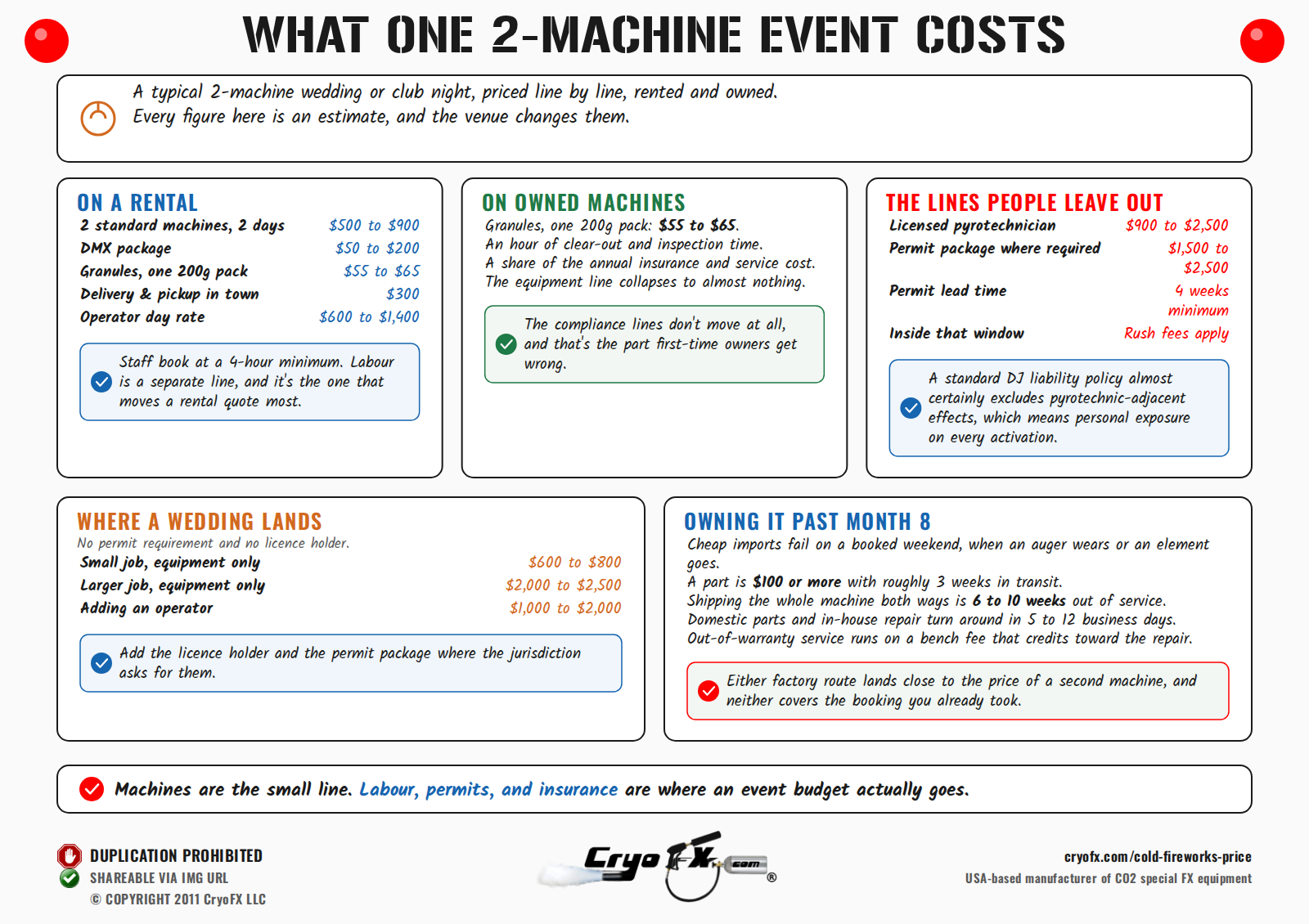
A 2-machine wedding on a rental:
- 2 standard machines, 2-day period: $500 to $900
- DMX package: $50 to $200
- Granules, one 200g pack: $53 to $69
- Delivery and pickup in town: $300
- Operator, 4-hour minimum against a $900 to $1,200 day rate
- Licensed pyrotechnician where the jurisdiction requires one: $900 to $2,500
- Permit package where required: $1,500 to $2,500
A wedding without a permit requirement and without a licence holder lands in the $600 to $800 range on equipment for a small job and $2,000 to $2,500 for a larger one. An operator adds roughly $1,000 to $2,000. Every figure here is an estimate and the venue changes them.
The same wedding on owned machines: granules at $53 to $69, an hour of clear-out and inspection time, and a share of the annual insurance and service cost. The equipment line collapses to almost nothing. The compliance lines do not move at all, and that's the part first-time owners get wrong.
The lines people leave out are permits, insurance, and the licensed operator. A permit filing has a 4-week working minimum with rush fees inside that, and a standard DJ liability policy almost certainly excludes pyrotechnic-adjacent effects, which means personal exposure on every activation even when someone else filed the paperwork.
Why cheap machines cost more
The failure shows up around month 8, on a booked weekend, when an auger wears or a heating element goes.
A cheap import sends you back to the factory. A part is $100 or more with roughly 3 weeks in transit. If the whole machine has to go both ways, it's a few hundred dollars in freight and 6 to 10 weeks out of service. Either route lands close to the price of a second machine, and neither one covers the booking you already took.
The counterweight is domestic stock. CryoFX holds heating elements, hoppers, blowers, DMX boards, and electronics boards across brands, mostly shipping same day, and does repairs in house rather than forwarding them. Out-of-warranty service runs on a bench fee paid up front that covers the first hour of diagnosis and credits toward the repair. Turnaround is 5 to 12 business days from receipt depending on parts.
Warranty is the other spread. Most manufacturers give 90 days. iSparkFX gives 1 year, with 2 and 3 year extensions available on both iSparkFX and Showven, and B-stock and C-stock carry 30 days. Warranty covers manufacturer defect and excludes clogs, jams, wrong power, moisture, contaminated granules, and a machine that was never cleaned, which is worth reading before assuming a long warranty means a long safety net.
Private-party used machines are the one purchase to avoid outright. Motor and impeller wear is invisible from outside, granule history is unknown, and the wrong granules damage a chamber permanently. Dealer B-stock and C-stock from around $350 has been stripped, chamber cleared, hoppers emptied, blown through, augers verified, and confirmed at full output before resale, which is a different product entirely. Buying domestically, with parts on a shelf behind the purchase, is what the price gap between an import and a supported machine is actually paying for, and current stock is listed with the cold spark machines for sale.
Frequently asked questions
How much do cold fireworks cost?
Machines run $700 to $800 at the entry end, $1,000 to $2,000 for the main working tier, and $2,000 to $5,000 for high-output, multi-axis, and weather-rated units. Renting is $250 to $450 per machine per 24 to 48 hours. Granules add $35 to $45 for a 50g pack and $53 to $69 for 200g, which is the recurring cost.
Is it cheaper to buy or rent cold fireworks?
Renting wins for a handful of events a year. Two standard machines rent at roughly $500 to $900 for a 2-day period before granules and labour, against $2,000 to $4,000 to buy the same pair. Buying wins once you're firing regularly. The crossover depends on labour, storage, and insurance as much as the machine price.
How much do cold fireworks cost per event?
For a typical 2-machine wedding or club night on a rental: $500 to $900 for the machines over 2 days, $50 to $200 for a DMX package, $300 for delivery and pickup in town, granules at cost, and staff booked at a 4-hour minimum. Add a licensed pyrotechnician at $900 to $2,500 where the jurisdiction requires one.
What is the cheapest professional cold fireworks machine?
Around $799, which is where the mini tier sits. The iSparkFX M3 Mini is $799, 500W, 16 lb, 3 to 12 ft on indoor granules and 13 ft on outdoor, warm-up under 5 minutes. It's a working machine for small rooms and wedding entrances. Dealer B-stock starts lower, from around $350 to $559, on a 30-day warranty.
Why is there such a wide price range?
Power and output. The category spans 100W to 3,200W, and price tracks the heating element, blower, and chassis needed to push sparks higher. Multi-port heads, motorised axes, and weather rating add cost on top. Warranty and parts support sit inside the price too: 90 days from most manufacturers against 1 year on iSparkFX.
Do cold fireworks have ongoing costs?
Yes. Granules are the recurring one, at $53 to $69 per 200g pack for 12 to 15 minutes of cumulative run time. Beyond that: permits, insurance, labour, storage, and periodic service, plus wear parts like heating elements, augers, and blowers. The full annual model is broken out on the cold spark machine cost page.
Cold Fireworks Price | CryoFX®
Updated - 08/12/2025.