Cold Spark Machines in Nightclubs, and What it Takes to Run Them Every Weekend
Cold Spark Machine for Nightclubs: VIP Bottle Service & Club Events | CryoFX
Cold Spark Machines in Nightclubs, and What it Takes to Run Them Every Weekend
A nightclub runs cold spark machines from fixed positions a fire marshal has already approved, fired by someone whose licence covers that machine type, under a permit that covers a period rather than a single date, with granules as a recurring line in the monthly budget. Clubs that treat it as an event booking every weekend pay several times what clubs that treat it as an installation pay.
The machines heat a zirconium-titanium granule until it glows and blow the particles out of a nozzle, with no combustion and nothing pressurised, which is set out in the complete guide to cold spark machines. What follows is the operating side: staffing, permitting, positions, and what a year of nightly use actually costs.
CryoFX has done nightclub installs in Phoenix, Arizona and several across the Midwest, plus Las Vegas properties that can't be disclosed.
Rent per booking or install permanently
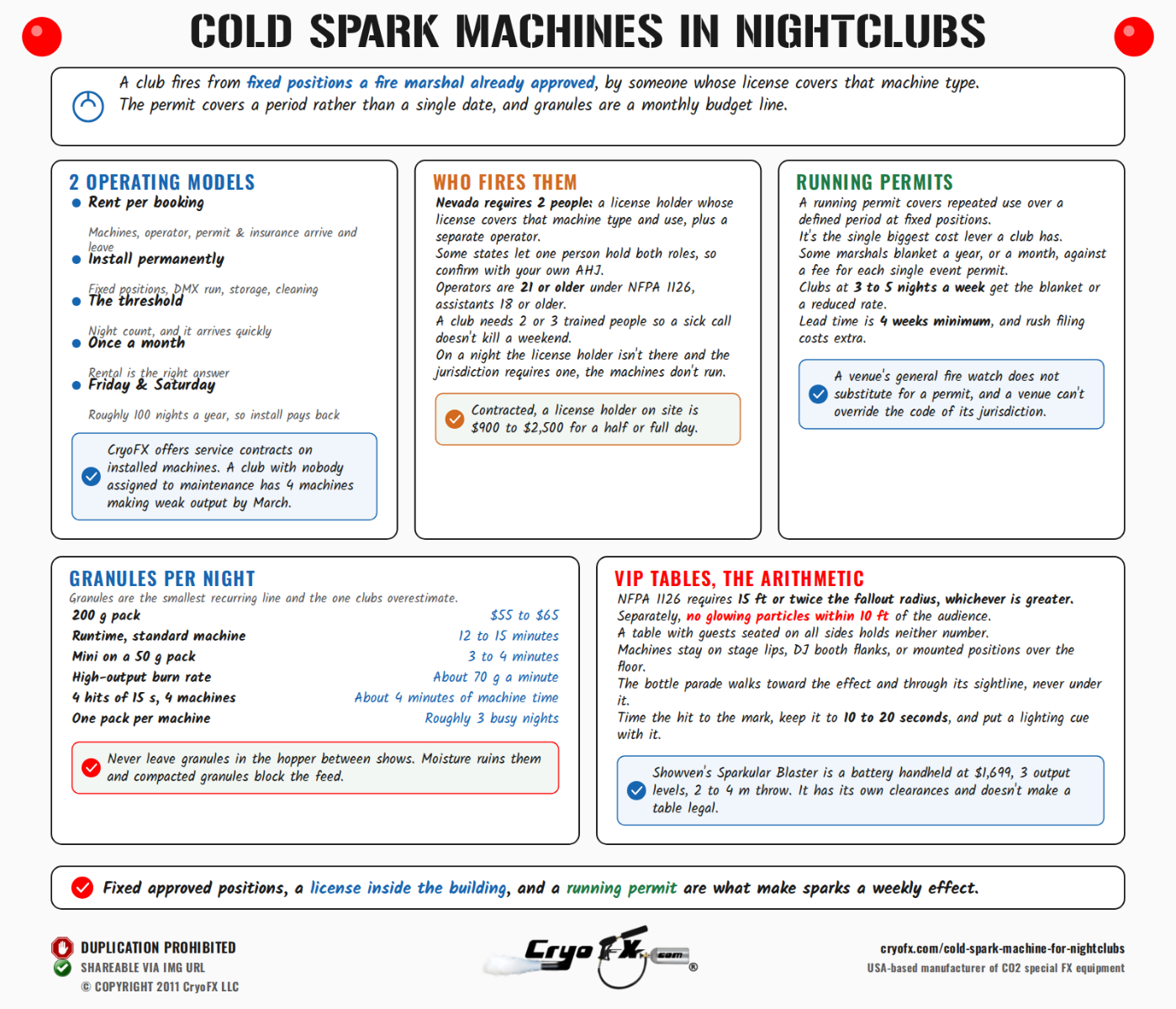
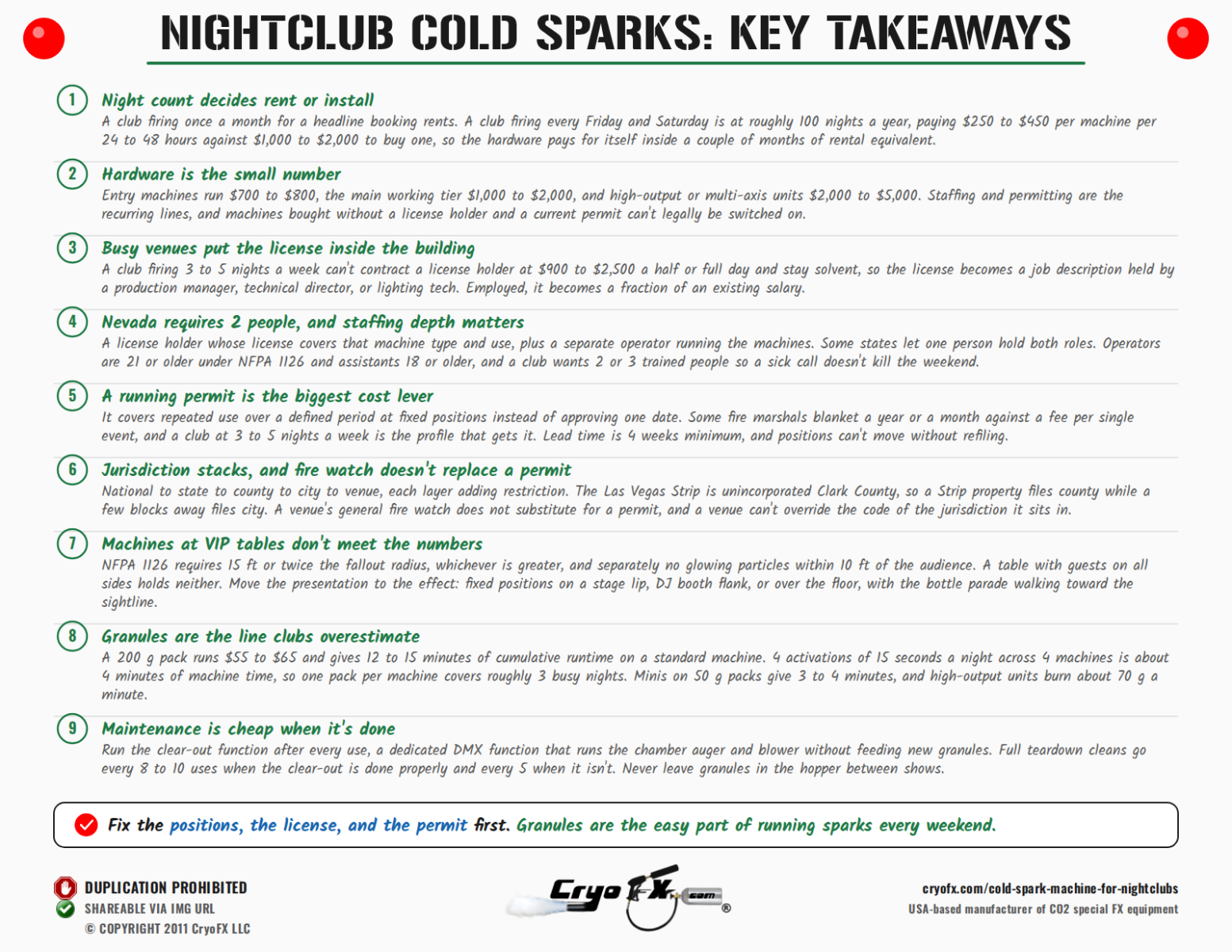
A rental night is a complete package delivered and taken away. An effects company brings the machines, brings a licensed operator, carries the permit for that date, and carries the insurance. The club supplies power, positions, and access. Nothing about the building changes and nothing stays behind, which is the right answer for a club firing sparks once a month for a headline booking.
An install is a commitment to a set of things the club then owns. Fixed positions get built and mounted, a dedicated DMX run gets pulled during the install rather than after the first inspection, machines need dry secure storage, and somebody has to clean them. CryoFX offers service contracts on installed machines, which is what keeps the second year running as well as the first, because a club with nobody assigned to maintenance is a club with 4 machines producing weak output by March.
The threshold is night count, and it arrives quickly. A club firing every Friday and Saturday is looking at roughly 100 nights a year. Rental sits at $250 to $450 per machine per 24 to 48 hours. The main working tier of cold spark machines for sale runs $1,000 to $2,000 each, with entry units at $700 to $800 and high-output or multi-axis units from $2,000 to $5,000. On a 2-night-a-week programme the hardware pays for itself inside a couple of months of rental equivalent.
Purchase tiers and the ownership model in full sit on the cold spark machine cost page. The point for a club is that hardware is the small number. Staffing and permitting are the recurring ones, and buying machines without solving those buys nothing you can legally switch on.
The employed licence holder model
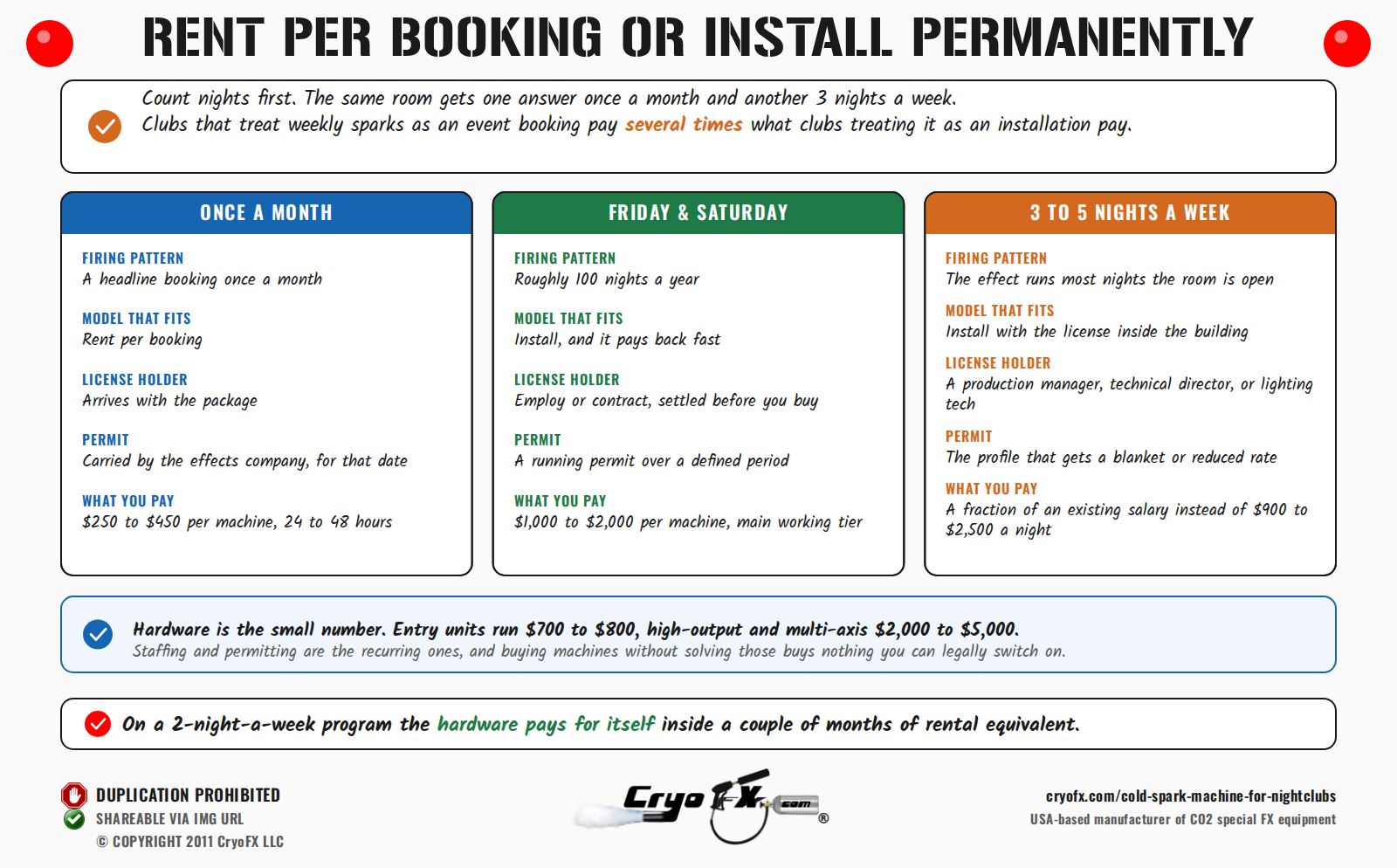
Busy venues put the licence inside the building. A club firing 3 to 5 nights a week can't contract a licence holder per night at $900 to $2,500 for a half or full day and stay solvent, so the licence becomes a job description held by a production manager, a technical director, or a lighting tech who went and got licensed.
Nevada requires 2 people: a licence holder whose licence covers that machine type and that use, plus a separate operator running the machines. Some states let one person hold both roles. That distinction changes the staffing plan completely, so establish it with your own AHJ before you write a job posting.
Operators are 21 or older under NFPA 1126 and assistants 18 or older, which rules out handing the remote to a barback. In practice the club needs 2 or 3 trained people so a shift change or a sick call doesn't kill the effect for a weekend.
On a night the licence holder isn't there and the jurisdiction requires one, the machines don't run. There's no version of this where a manager fires them because the room is busy and the DJ asked. CryoFX offers training covering use, fire code compliance, rental operations and machine care, and issues a certificate that several fire departments have accepted as recognised professional training, which is often what gets a club's own staff onto the permit.
Running permits and fixed positions
A running permit covers repeated use over a defined period at fixed positions instead of approving one date. It's the single biggest cost lever a club has.
The economics are worth understanding before you file. Some fire marshals blanket it at a couple of hundred dollars for a year, or a couple of hundred for a month, against a couple of hundred for each single event permit. A club running 3 to 5 nights a week is the profile that gets the blanket or a reduced rate rather than per-night pricing, because no bureau wants to process 200 identical applications for the same room.
The package itself is the same package any event files: equipment cut sheets, granule MSDS, insurance naming the jurisdiction, licence holder and operator identity, and a plot diagram with fixed positions, room dimensions, ceiling height, and marked distances to the stage, the audience, and any set pieces or furniture. The fire permit process page has the full contents and the filing sequence. Lead time is 4 weeks minimum, and rush filing inside that costs extra and is usually impossible inside a week.
Jurisdiction stacks from national to state to county to city to venue, and each layer adds restriction rather than removing it. The Las Vegas Strip is unincorporated Clark County, so a Strip property files county. A few blocks away it's city. Clubs that assume "Vegas" is one permitting authority get that wrong at their own expense.
The misconception that costs clubs the most is fire watch. A venue's general fire watch does not substitute for a permit, and a venue cannot override the code of the jurisdiction it sits in. Hotels and clubs tell operators otherwise regularly, sometimes in good faith because somebody in the building believes it. Get the permit.
VIP bottle service, what actually happens
Clubs ask for machines at the table. The answer is no, and the reason is arithmetic rather than caution. NFPA 1126 requires 15 feet or twice the fallout radius, whichever is greater, and separately requires that no glowing or flaming particles come within 10 feet of the audience. A table with guests seated around all sides of it can't satisfy either number, and the cold spark safety guide covers how those distances are derived.
What works is moving the presentation to the effect. Machines sit on fixed approved positions, usually a stage lip, a DJ booth flank, or a mounted position over the floor, and the bottle parade walks toward and through the sightline of the effect rather than under it. The guest still gets the photograph, the room still turns to look, and nobody is standing inside a fallout radius.
Handheld and tabletop substitutes come up constantly. Showven's Sparkular Blaster is a battery handheld at $1,699 with 3 output levels and a 2 to 4 metre throw, which is a real product with real clearance requirements of its own. It doesn't turn a crowded table into a legal position. Treat it as a different tool for a different shot.
Choreograph the walk so the moment lands. Time the activation to the point where the parade hits its mark, keep it to 10 to 20 seconds, and put the room lighting cue with it, because contrast is what makes the sparks read on a phone camera.
[INSERT INFOGRAPHIC: CLUB FLOOR PLAN WITH APPROVED FIXED POSITIONS, CLEARANCE RINGS, AND THE BOTTLE PRESENTATION WALK PATH]
The annual operating cost
Granules are the smallest of the recurring lines and the one clubs overestimate. A 200g pack runs $53 to $69 depending on brand and whether an RFID card is included, and gives 12 to 15 minutes of cumulative runtime on a standard machine. A club firing 4 activations of 15 seconds a night across 4 machines is using about 4 minutes of machine time, so a single pack per machine covers roughly 3 busy nights. Minis on 50g packs give 3 to 4 minutes, and high-output units burn about 70 grams a minute, which changes the maths sharply if the install specced for height.
Licensed staff is the real number. Contracted, a licence holder on site is $900 to $2,500 for a half or full day, always separate from any permit package fee. Employed, it becomes a fraction of an existing salary, which is the entire argument for the in-house model.
Permit fees are small once you have a running permit and painful when positions change, because moving a machine means refiling. Budget one refiling a year for the renovation or the DJ booth rebuild that's coming.
Maintenance is cheap if it's done and expensive if it isn't. Run the clear-out function after every use, a dedicated DMX function that runs the chamber auger and the blower without feeding new granules. CryoFX goes further and tips the machine to empty the hopper, then runs a full activation cycle so nothing is left in the feed path. Full teardown cleans go every 8 to 10 uses when the clear-out is done properly and every 5 when it isn't, and the maintenance and cleaning page has the sequence. Never leave granules in the hopper between shows, because moisture ruins them and compacted granules block the feed.
[EMBED youtu.be/de9_5Tjn6QE CLEANING HERE]
Install decisions that are hard to reverse
Fixed positions are a permit condition rather than a preference, so the position you choose is the position you have until you refile. Ask what the club will want to change in a year. A new DJ booth, a new stage lip, a new LED wall, or a VIP section moved 10 feet all invalidate a plot.
Ceiling clearance is the first disqualifier. CryoFX recommends 20 to 25 feet from the top of the machine, and club ceilings are frequently lower than that, with truss, lighting pods, and soft goods filling what height there is. Nothing combustible overhead is a hard rule: fabric, paper, wood, and stretched fabric ceilings are out, and metal, concrete, drywall and plaster are acceptable. A low grid means minis at 8 to 12 feet, and it's better to know that before the machines are ordered.
Fire alarm disclosure has to happen before the first night. CryoFX has tested CO2 against photoelectric, ionisation and laser detectors and confirmed it doesn't trigger them. Cold spark output has set off alarms, and sensitivity varies enormously between buildings and even between zones in the same building. Tell the venue's fire safety team and test during a closed period rather than at 1am with a full room.
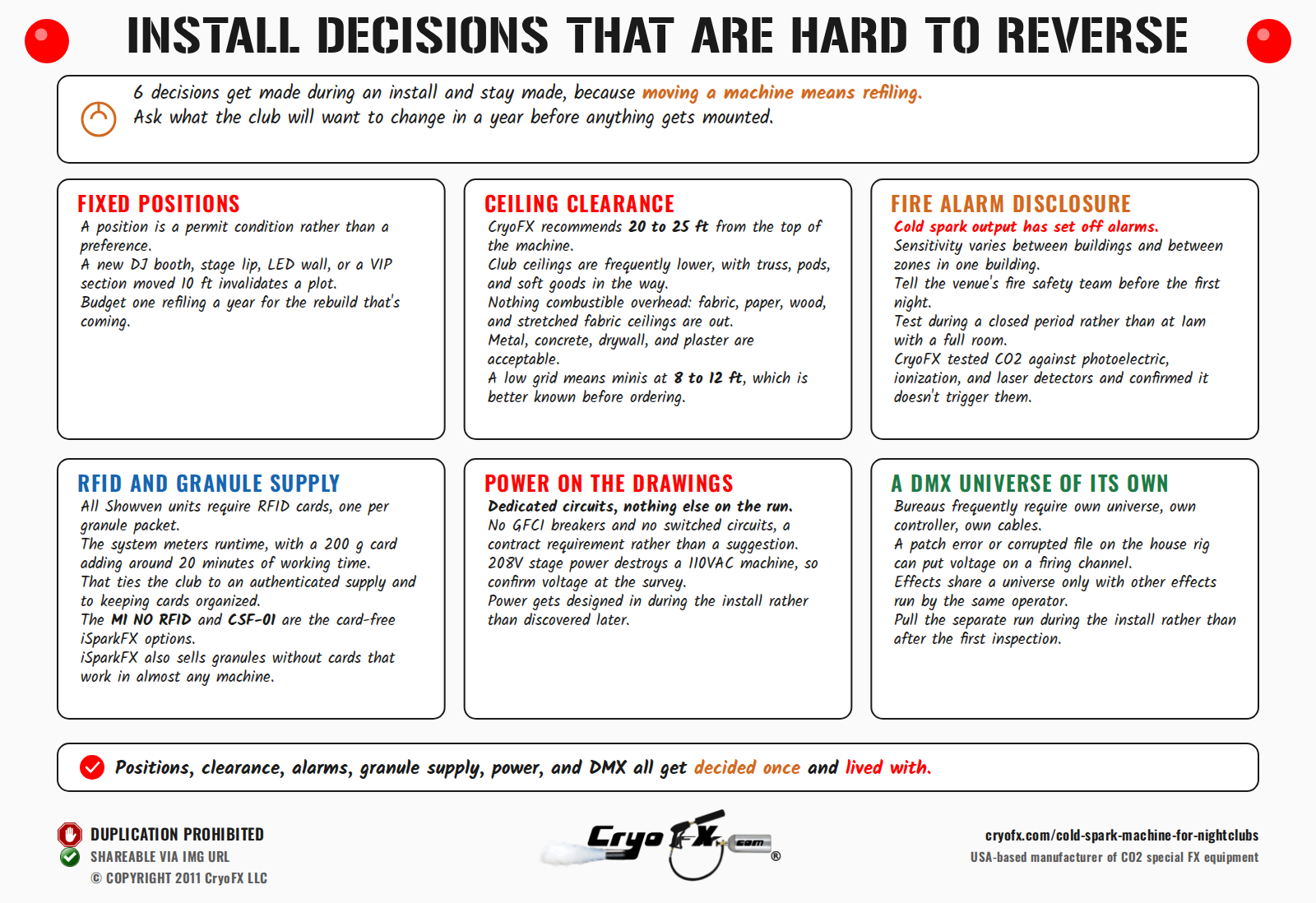
RFID is a supply decision made at install. All Showven units require RFID cards, cards ship one per granule packet, and the system meters runtime, with a 200g card adding around 20 minutes of machine working time. That ties the club to an authenticated granule supply and to keeping cards organised. Several iSparkFX models skip it entirely, with the M1 NO RFID and the CSF-01 as the card-free options, and iSparkFX also sells granules without cards that work in almost any machine.
Power gets designed in during the install, not discovered later. Dedicated circuits, nothing else on the run, no GFCI breakers, no switched circuits, which is a CryoFX contract requirement rather than a suggestion. The power requirements page has the amp math per model.
Frequently asked questions
How do nightclubs use cold spark machines?
2 models. Rent per booking, where an effects company brings machines, a licensed operator, and the permit for a single night. Or install permanently, where the club owns fixed machines, employs or contracts a licence holder, and runs under a permit that covers a period rather than one date. Volume decides which one is cheaper.
Are cold spark machines at VIP tables?
No. The machines sit on fixed approved positions, usually a stage lip, DJ booth flank, or a mounted position over the floor, and the bottle presentation walks toward the effect. NFPA 1126 requires 15 feet or twice the fallout radius, whichever is greater, and no glowing particles within 10 feet of people. A table surrounded by guests can't hold either.
Does a nightclub need a licensed pyrotechnician on staff?
If the club fires these regularly, it needs reliable access to one, and employing a licence holder is how busy venues get there. In Nevada that's 2 roles: a licence holder whose licence covers the machine type and use, plus a separate operator running the machines. Some states allow one person to hold both. Hiring per night works, and it costs more per night.
What is a running permit and how does a club get one?
A permit covering repeated use over a defined period at fixed positions, rather than a one-night approval. The club files the same package as any event: cut sheets, granule MSDS, insurance naming the jurisdiction, licence holder and operator identity, and a plot diagram with fixed positions, room dimensions, and marked distances. Positions can't move afterwards without refiling. Lead time is 4 weeks minimum.
Should a club rent or install permanently?
Count nights. A club firing once a month rents. A club firing every Friday and Saturday is paying rental rates 100 times a year on machines that cost $1,000 to $2,000 each to buy, so install pays back fast. The real decision is staffing and permitting, because owning machines without a licence holder and a current permit buys nothing.
What does it cost a club to run cold spark machines nightly?
3 recurring lines: granules, licensed staff, and permits. Granules run $53 to $69 for a 200g pack giving 12 to 15 minutes of cumulative runtime on a standard machine, so short nightly hits go a long way. A licence holder on site is $900 to $2,500 for a half or full day when contracted. Employing one changes that number.
How do clubs buy granules in bulk?
Through the manufacturer or supplier, matched to machine and grain size, and stored sealed and dry because moisture ruins them. Machines with an RFID reader tie the club to one authenticated granule supply and meter runtime, which is a purchasing constraint worth checking before install. Several iSparkFX models have no RFID requirement.
Can a club put cold spark machines on the house lighting DMX?
Fire prevention bureaus frequently require these on their own universe, own controller, own cables, because a patch error or corrupted file on the house rig can put voltage on a firing channel. Special effects share a universe only with other effects run by the same operator. Plan the separate run during install rather than after the first inspection.
___
CryoFX® is the leading manufacturer, designer, and global supplier of CO2 special effects equipment and custom special effects systems
for Theme Parks, Sporting Arenas, Mega Nightclubs & Day Clubs , TV/FILM & large scale events & installs in any industry requiring Co2 Systems.
CryoFX LLC Global Headquarters • 3859 S Valley View Blvd, Suite 2, Las Vegas, NV 89103 • 1.855.527.9639
Updated - 08/12/2026.