
What is a CO2 cannon? Uses, benefits, how it works
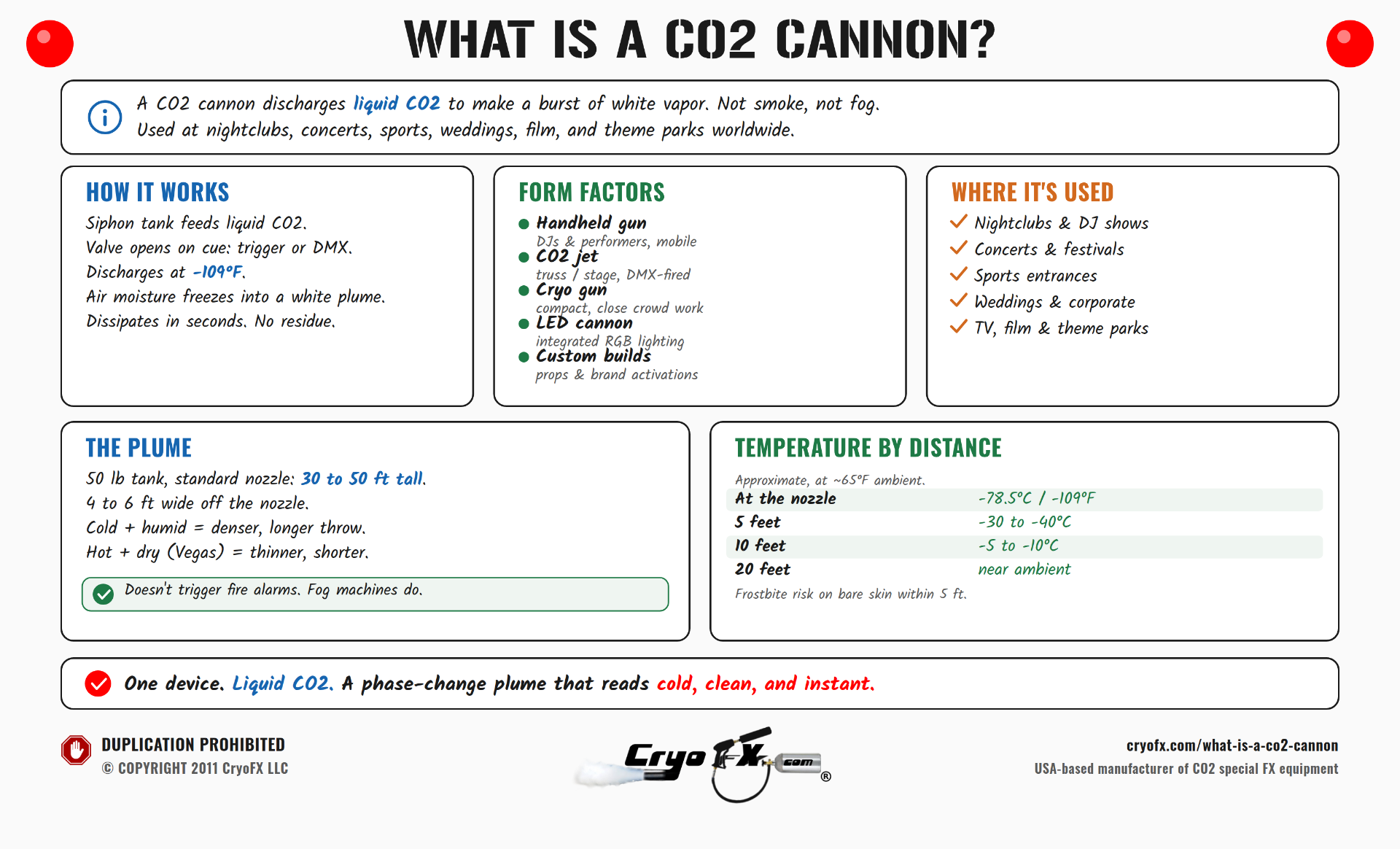
A CO2 cannon is a device that discharges pressurized liquid carbon dioxide to create dramatic bursts of white vapor cloud, one of the most recognized visual effects in live entertainment worldwide.
That's the short answer. The full picture is a bit more nuanced, and understanding it will help you choose the right equipment, set it up correctly, and get the effect you're actually after.
What it is and why it's called a cannon
The name breaks down simply. CO2 stands for carbon dioxide. Cannon refers to the way the device projects material out of a nozzle, the same mechanical concept behind old-school artillery, minus any ignition, gunpowder, or pyrotechnic material. Nothing burns. Nothing explodes. A CO2 cannon is entirely cold-effect equipment.
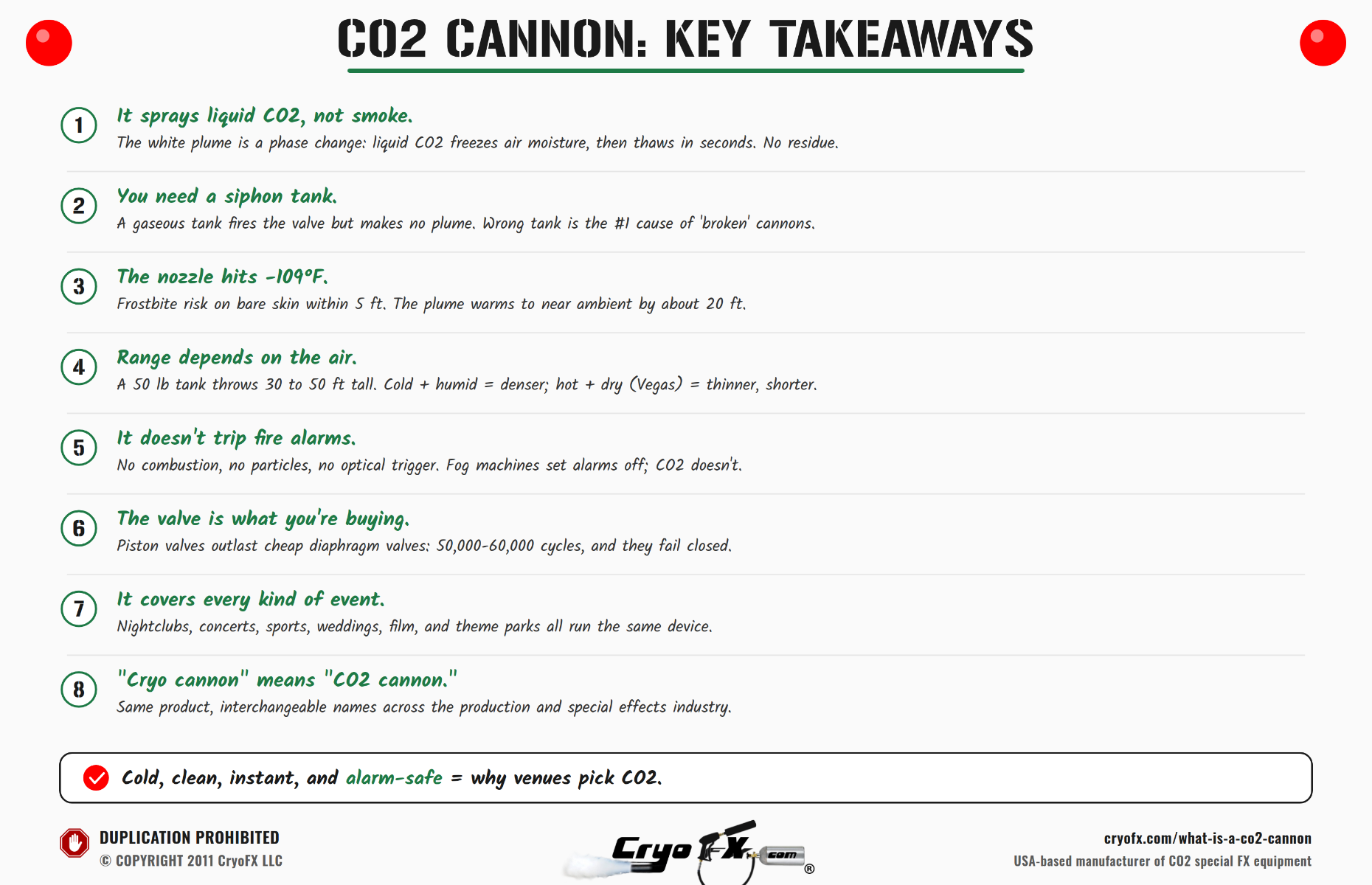
You'll hear the term "cryo cannon" used interchangeably with CO2 cannon, especially in the production and special effects industry. They refer to the same device. "Cryo" means extremely cold, and liquid CO2 discharging at -78.5°C (-109°F) absolutely qualifies. If you see either name on a website or in a spec sheet, you're looking at the same product category.
One clarification worth making: some industries outside entertainment use the term "CO2 cannon" to refer to devices that spray gas-phase CO2, not liquid. In stage production, special events, and entertainment, a CO2 cannon or cryo cannon means a device running on liquid CO2 from a siphon tank. That distinction matters operationally, and we'll get into why below.
The CO2 cannon umbrella covers several form factors: handheld cannon guns, stage-mounted CO2 jets, cryo guns, LED CO2 cannons, and custom builds. They all run on the same liquid CO2 mechanism. The differences are in form factor and deployment, not in the underlying technology. For a complete CO2 cannon guide covering every product type and use case, see cryofx.com/co2-cannon.
How a CO2 cannon works
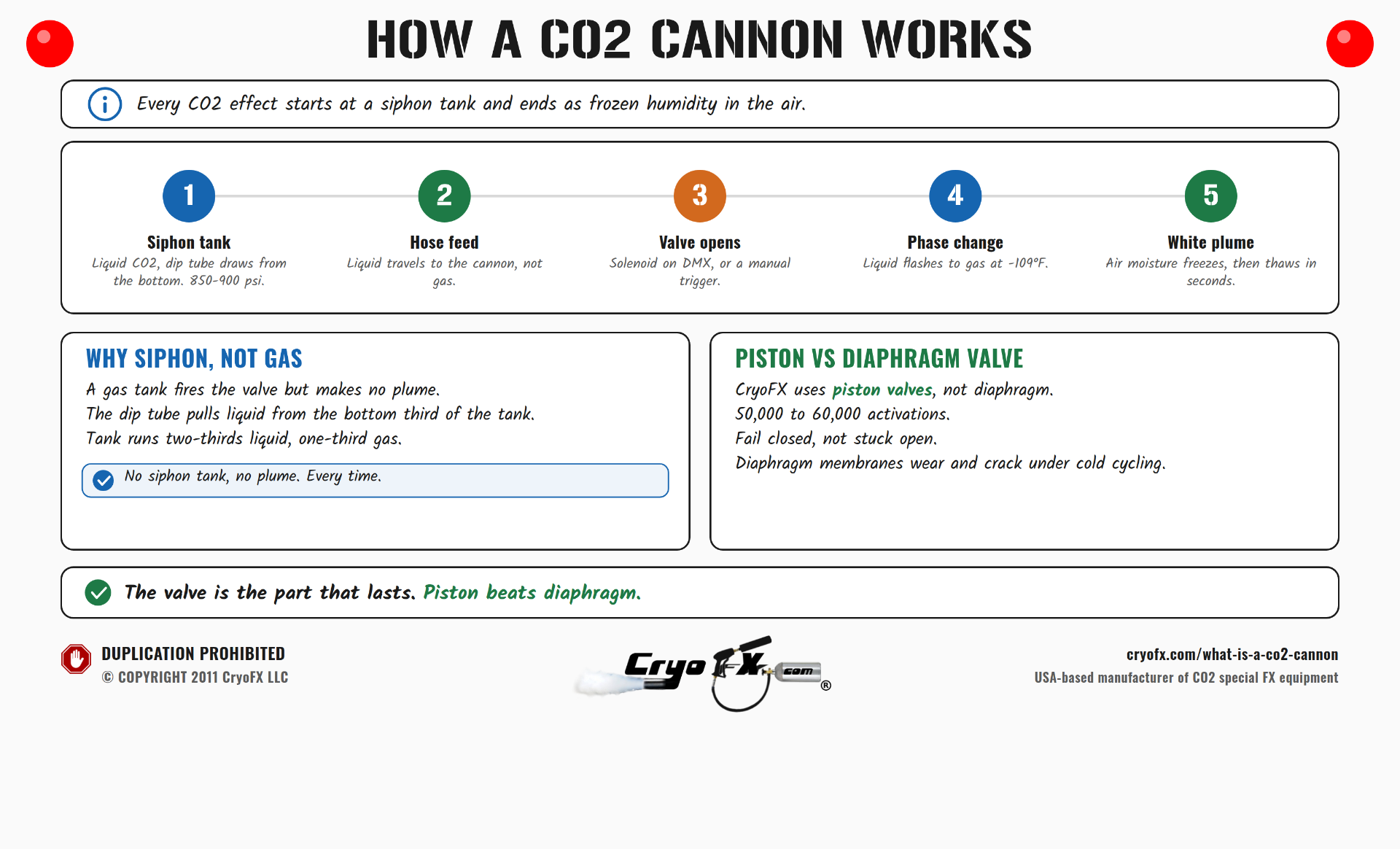
Every CO2 special effects device starts at the same place: a siphon CO2 tank.
A standard CO2 tank that stores gas won't work for this application. You need a siphon tank, also called a liquid CO2 tank or siphon tube tank. Inside, a dip tube (essentially a long internal straw) reaches down to where the liquid CO2 sits at the bottom of the tank. The tank is typically two-thirds full of liquid and one-third gas. When the valve opens, the dip tube draws liquid CO2 up from the bottom and sends it through the hose to the cannon. These tanks operate at 850 to 900 psi, high-pressure cylinders that require proper handling, secure mounting, and correct fittings at every connection point.
Once liquid CO2 exits the nozzle, a phase change happens instantly. Liquid CO2 becomes gas, the temperature at the point of discharge drops to approximately -78.5°C (-109°F), and the moisture molecules in the surrounding air freeze temporarily. That frozen humidity is what creates the white plume. It's not smoke, not fog, not a chemical reaction, it's frozen ambient humidity reflecting light, and it dissipates in seconds as the temperature normalizes.
The on/off mechanism is a solenoid valve. In plain terms, a solenoid valve is a standard valve that opens and closes via an electric signal. These valves come in multiple voltage configurations: 12V DC, 24V DC, 110/120V AC, 220/240V AC, and other custom applications depending on the equipment. For handheld CO2 cannons, the operator's trigger takes the place of an electronic solenoid. For stage-mounted jets and DMX-controlled CO2 jets, the solenoid valve fires on command from a lighting or DMX control desk.
CryoFX uses piston solenoid valves, not diaphragm valves. Piston valves handle higher duty cycles (50,000 to 60,000 activations), operate reliably at CO2 pressures, and have a safer failure mode, they tend to fail closed rather than stuck open. Diaphragm valves use a thin flexible membrane that wears out faster, especially under repeated cold cycling.
What the effect looks like at an event
From 50 feet away, a well-placed CO2 cannon blast looks like several fog machines firing simultaneously in perfect unison, except it moves faster, hits harder, and disappears completely within seconds. There's no residue, no lingering haze, no cleanup.
A single cannon with a 50 lb siphon tank and a standard nozzle will produce blasts roughly 30 to 50 feet tall, 4 to 6 feet wide (sometimes wider depending on the nozzle), and the throw distance after the initial blast depends heavily on the environment.
Two variables matter more than any equipment spec: temperature and humidity.
In Las Vegas at 90°F and 10% humidity, a CO2 cannon blast is noticeably thinner and shorter. The hot, dry air contains very little moisture for the CO2 to freeze. The plume forms, but it's less dense, dissipates faster, and doesn't roll out as far from the nozzle. The throw distance drops significantly. You still get an impressive effect, but it requires more CO2 and ideal positioning to compensate.
In San Diego at 60°F and 60 to 70% humidity, the same cannon produces a completely different-looking blast. The cooler temperature and higher ambient moisture mean more humidity molecules available to freeze. The plume is thicker, taller, denser, and rolls further from the nozzle before dissipating. A 2-second blast at these conditions looks dramatically better than a 5-second blast in the Las Vegas example.
As an approximate reference: right at the nozzle, the CO2 is -78.5°C. At 5 feet, in a 65°F environment, you're looking at temperatures somewhere around -30°C to -40°C, still cold enough for immediate frostbite on bare skin with sustained contact. At 10 feet, the CO2 has warmed considerably, somewhere around -5°C to -10°C depending on the ambient conditions. At 20 feet, you're approaching near-ambient temperatures, and the visible effect is mostly dissipated except in high-humidity environments. These are estimates, not laboratory measurements, but they illustrate why minimum distance rules matter operationally.
The blast is also loud. The initial discharge from a CO2 cannon at high pressure produces a sharp crack that will startle anyone nearby who isn't expecting it. Giving bystanders advance warning isn't optional etiquette, it's a basic operating practice.
One additional note: CO2 causes a sensation of cold on skin as the plume passes, because the gas is warming up as it expands away from the nozzle. Guests will feel it. They generally love it. But it's the warming phase they're feeling, at the nozzle itself, contact with liquid CO2 would cause frostbite immediately.
Where CO2 cannons are used
The range of applications is wider than most people realize when they first encounter the equipment.
Nightclubs, DJ shows, and concerts represent the most common context. CO2 cannons at DJ booths, either handheld or stage-mounted as CO2 jets, are a standard installation in major venues. Las Vegas mega-clubs, stadium-scale festival stages, and touring DJ productions all use them routinely.
Sporting events and sports entrance sequences use CO2 cannons for grand entrance effects, player introductions, and highlight moments during games. The immediate dissipation means no visibility obstruction for athletes, cameras, or crowd sightlines.
Theme parks, Hollywood productions, and TV/film sets use CO2 effects to create fast-appearing, fast-disappearing atmospheric effects that would be impossible with conventional fog or smoke. CryoFX has tested and installed CO2 cannon systems at multiple major theme park and attraction properties.
Weddings and corporate events use handheld CO2 cannons for grand entrance moments and first-dance effects. Brand activations and private parties use them for high-impact visual moments that photograph well.
One of the most important operational advantages for all of these venues: CO2 does not trigger fire alarms. CryoFX has tested CO2 against photoelectric, ionization, and laser-based fire detection systems. CO2 does not produce combustion products, doesn't contain particles that register in ionization chambers, and the optical properties of the plume don't trigger photoelectric sensors. Fog machines set off fire alarms; CO2 cannons don't. For any event in a venue with an active detection system, that's a fundamental difference.
CryoFX has placed CO2 cannons in some remarkable contexts: 50 cannons fired simultaneously for a controlled demonstration at the Meadowlands Mall Drop Tower in New Jersey, designed to be visible from New York with an immediate mushroom cloud effect that disappeared within seconds. A separate test involved 10 cannons at the top of Disneyland's Matterhorn, requiring hundreds of feet of CO2 hose and multiple large tanks just to supply liquid CO2 to the nozzles at elevation.
CO2 cannon vs. similar devices
Several terms get confused regularly. Here's the precise distinction between each category.
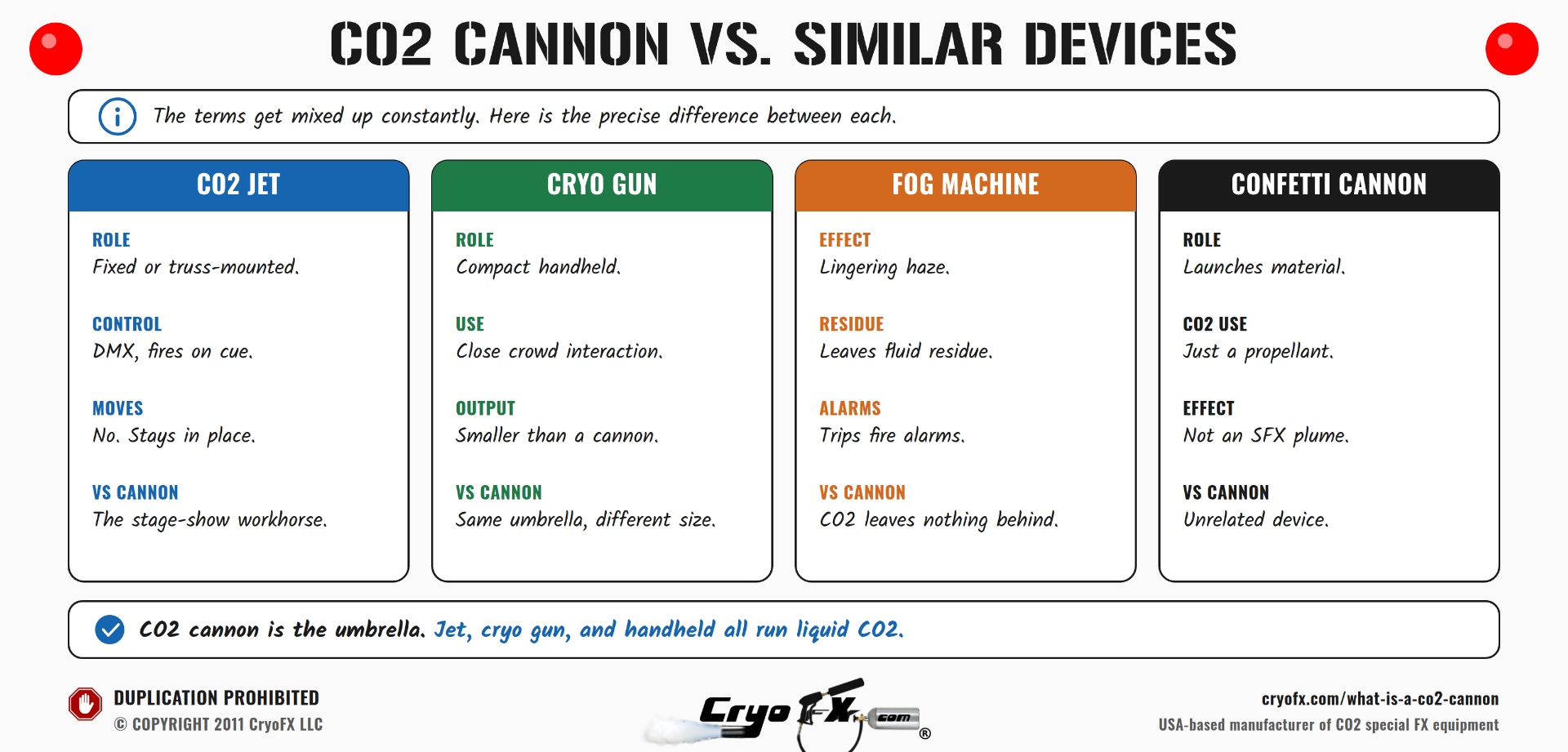
CO2 cannon vs. CO2 jet: A CO2 cannon is the umbrella term covering all CO2 special effects devices that discharge liquid CO2. A CO2 jet is a specific category within that umbrella, fixed or truss-mounted, DMX-controlled via DMX control, and not meant to be moved during operation. Jet cannons are the stage production workhorse. They're not handheld and they're not repositioned mid-show.
CO2 cannon vs. cryo gun: A cryo gun is a smaller handheld device designed for close crowd interaction. It's more compact than a handheld cannon, used for direct engagement with audience members, and has its own form factor and output characteristics. The cryo gun falls under the CO2 cannon umbrella but is a distinct product type. A handheld cannon is larger, outputs more CO2, and is what you see DJs using on stage.
CO2 cannon vs. fog machine: CO2 doesn't linger, doesn't leave residue, doesn't require fog fluid, doesn't require a heating element, and doesn't trigger smoke alarms. A fog machine or smoke machine produces a different effect entirely. Some specialty fog machines on the market, including products CryoFX carries, use high-velocity blowers to mimic the look of CO2 jets reasonably well, with quick-dissipating fog formulas. But they are still fog machines, they will set off fire alarms, and they don't require CO2 tanks or high-pressure hoses.
CO2 cannon vs. confetti cannon: Not related. A confetti cannon can use CO2 as a propellant to fire confetti, but it is not a special effects CO2 device. The confetti cannon's purpose is to launch material; the CO2 is just the mechanism to do it. CO2 cannons used in stage productions don't fire material, just liquid carbon dioxide and the resulting vapor plume.
Common name confusion: clients will sometimes call and ask for a "fog gun," a "party cannon," or a "DJ fogger." If someone has seen a DJ holding a device that shoots what looks like fog, they're describing a CO2 cannon or handheld cannon. It takes a siphon CO2 tank and a CO2 hose, and what comes out looks like fog but is not.
Who makes CO2 cannons and what to look for
CryoFX is a manufacturer of CO2 cannons and a US-based global manufacturer with operations out of Las Vegas. The distinction between manufacturer and reseller matters when you're evaluating equipment quality, warranty support, and long-term reliability.
Most CO2 cannons look similar from the outside. The housing, the grip, the nozzle, many products share similar form factors because the basic design has been copied repeatedly across the industry. What differentiates quality equipment from cheap imports is almost entirely internal: the valve.
CryoFX uses piston-activated solenoid valves. Competing products, including some that are marketed as US-made, frequently use diaphragm valves with components sourced overseas. A diaphragm valve has a thin flexible membrane that handles lower pressure tolerances and has a much shorter duty cycle. When CryoFX receives competitor valves for inspection after failures, the root cause is almost always the same: a worn or cracked diaphragm, cheap seats and seals, or undersized internal components that couldn't handle sustained CO2 cycling.
"Made in America" claims in this space need scrutiny. If the valve comes from overseas, the device isn't meaningfully domestically manufactured regardless of where it's assembled. The valve is the functional core of the product.
The housing construction matters too, but it's secondary. Two cannons with identical chrome exteriors can perform completely differently in operation based on what's running inside. Professional CO2 special effects equipment for stage performances, live performances, or permanent installations needs to cycle reliably under temperature extremes and high-pressure CO2 conditions show after show.
CryoFX backs their products with a limited lifetime warranty on manufacturer defects, publishes more technical content on CO2 special effects equipment than any other company in the space, and has equipment certified for permanent installation in major venues, theme parks, and stadiums across the United States.
If you're ready to buy, browse the full line of CO2 cannons for sale at cryofx.com/products/co2-cannon-products.
FAQ
What is a CO2 cannon used for? CO2 cannons are used in nightclubs, DJ shows, concerts, festivals, sporting events, weddings, corporate events, theme parks, and TV/film productions to create dramatic bursts of white vapor. The effect is fast-appearing, instantly dissipating, and produces no residue or cleanup.
Does a CO2 cannon set off fire alarms? No. CO2 does not trigger photoelectric, ionization, or laser fire detection systems. CryoFX has tested CO2 against all common fire alarm types and confirmed no activation. This is one of the primary reasons venues choose CO2 over fog machines for special effects.
What's the difference between a CO2 cannon and a cryo gun? A CO2 cannon is the broader category covering all devices that discharge liquid CO2 for special effects, including handheld cannons, stage-mounted jets, and LED models. A cryo gun is a smaller, more compact handheld device specifically designed for crowd interaction at close range. Both fall under the CO2 cannon umbrella.
Do you need a special tank for a CO2 cannon? Yes. You must use a siphon CO2 tank (also called a liquid CO2 tank or dip tube tank). A standard gas CO2 tank won't deliver the liquid CO2 required to create the effect. The siphon tube inside draws liquid from the bottom of the tank up through the hose to the cannon.
Why does the CO2 blast look different at different events? Temperature and humidity are the controlling variables. Higher humidity and lower temperatures produce a denser, taller, more visible plume that rolls further from the nozzle. Hot, dry conditions (like an outdoor summer show) produce a thinner, shorter-lived effect. The equipment is the same, the atmosphere changes the output.
What is a CO2 cannon? A CO2 cannon is a device that discharges pressurized liquid carbon dioxide to produce dramatic bursts of white vapor cloud. The term covers multiple form factors including handheld cannon guns, stage-mounted CO2 jets, cryo guns, and LED CO2 cannons. All run on the same liquid CO2 mechanism and require a siphon tank.
What is the difference between a CO2 cannon and a CO2 jet? A CO2 cannon is the umbrella term covering all liquid CO2 special effects devices. A CO2 jet is a specific category within that group: fixed or truss-mounted, DMX-controlled, and designed for permanent or semi-permanent stage installation. CO2 jets fire on command from a lighting or DMX control desk and are not repositioned during a show.
What temperature does a CO2 cannon discharge at? Liquid CO2 exits the cannon at approximately -78.5 degrees Celsius (-109 degrees Fahrenheit) at the nozzle. At 5 feet out, temperatures are still around -30 to -40 degrees Celsius depending on conditions. At 10 feet, the gas has warmed to roughly -5 to -10 degrees Celsius. The visible plume is near-ambient temperature by 20 feet in most environments.
What type of valve does CryoFX use in their CO2 cannons? CryoFX uses piston-activated solenoid valves. Piston valves handle 50,000 to 60,000 activation cycles, operate reliably under CO2 pressure conditions, and fail closed rather than stuck open. Competing products frequently use diaphragm valves, which have a shorter duty cycle and degrade faster under repeated cold CO2 cycling.
What is the difference between a CO2 cannon and a fog machine? CO2 cannons discharge liquid carbon dioxide that converts instantly to white vapor through phase change, requiring no heating element or fluid. Fog machines heat a water-based fluid to create a haze that lingers. CO2 effects dissipate within seconds, leave no residue, and do not trigger fire alarms. Fog machines can trigger fire alarms and produce lingering haze that requires ventilation to clear.
What is a Co2 Cannon |CryoFX®
Updated - 06/30/2026.