
CO2 Cryo Jet: What It Is & How It Differs from a Standard CO2 Jet
CO2 Cryo Jet: The Cryogenic Special Effects Machine, Explained By Its Cold
Every CO2 jet is a cryo jet; the naming pages of this cluster settle that. What this page owns is the "cryo" itself: what the cold actually measures, why the same jet throws a fat plume in one room and a thin one in another, why supply pressure decides how the effect looks, and how CryoFX engineers the coldest, densest output in the industry when a client wants the version the naming implies. If the standard jet pages answer "which machine," this one answers "why does mine look like that."
Cold, measured
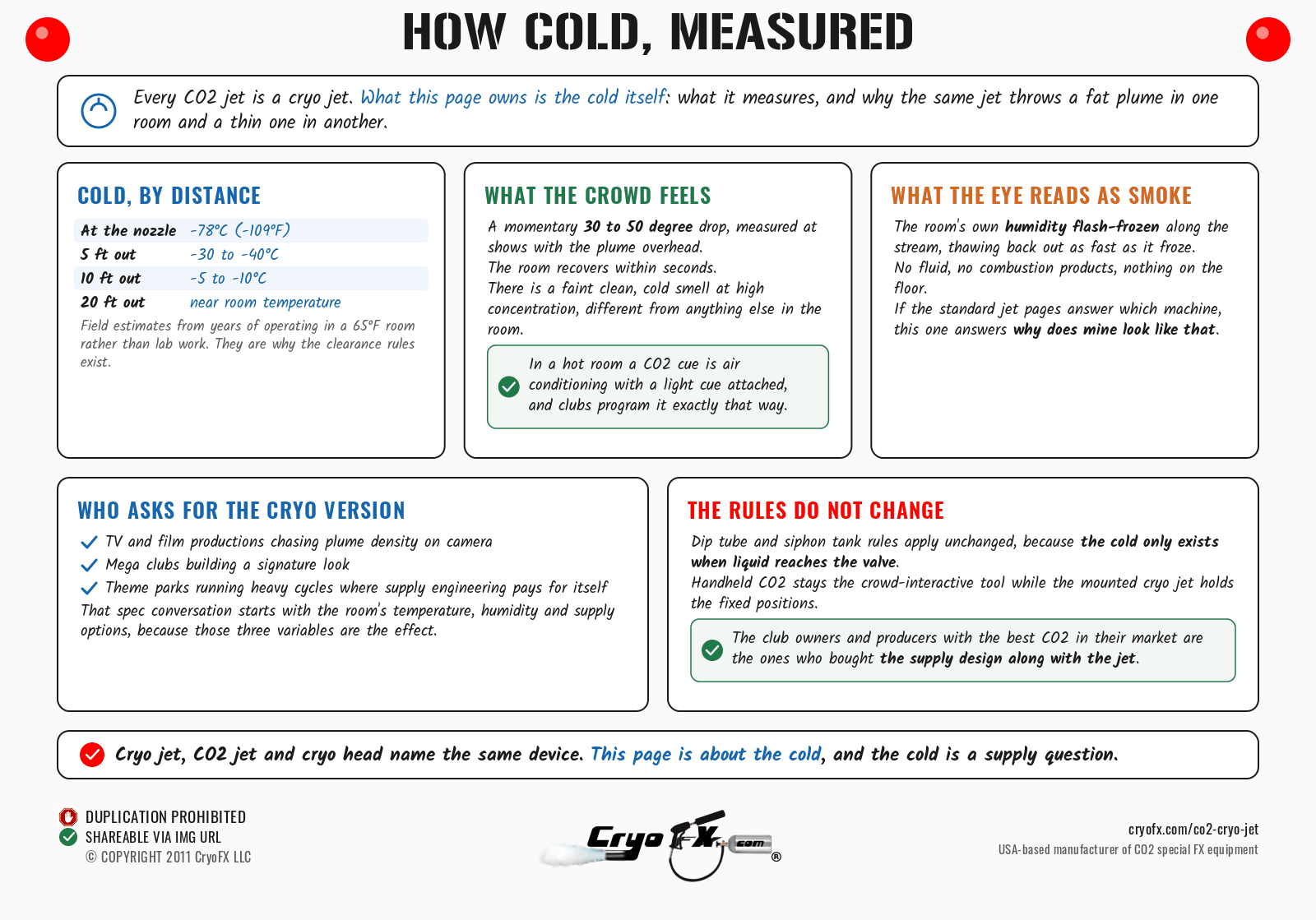
High pressure liquid CO2 leaves the nozzle at about -78°C (-109°F). Five feet out in a 65°F room the stream sits around -30 to -40°C, by 10 feet it's -5 to -10°C, and by 20 feet it approaches room temperature; those are field estimates from years of operating rather than lab work, and they're why the clearance rules exist.
The crowd under a firing jet feels the cooling effect as a momentary 30 to 50 degree drop, measured at shows with the plume overhead, and the room recovers within seconds. What the eye reads as smoke is the room's own humidity flash-frozen along the stream, thawing back out as fast as it froze.
Humidity and temperature run the show
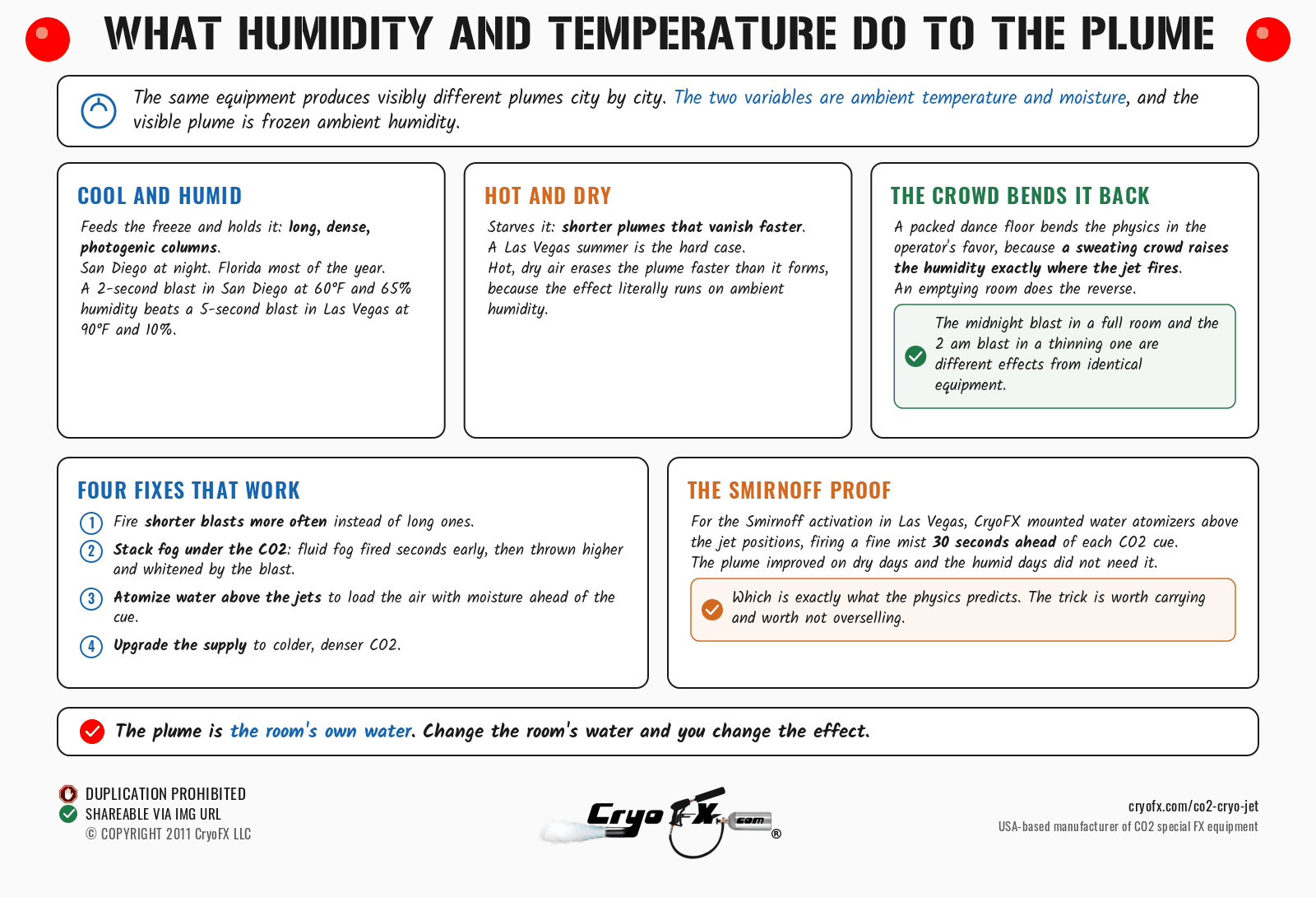
The same equipment produces visibly different plumes of CO2 city by city, and the two variables are ambient temperature and moisture. Cool, humid air (San Diego at night, Florida most of the year) feeds the freeze and holds it: long, dense, photogenic columns. Hot, dry air (a Las Vegas summer) starves it: shorter plumes that vanish faster. A packed dance floor bends the physics back in the operator's favor, because a sweating crowd raises the humidity exactly where the jet fires.
Where the room won't cooperate, CryoFX has engineered around it. For the Smirnoff activation in Las Vegas we mounted water atomizers above the jet positions, firing a fine mist 30 seconds ahead of each CO2 cue to load the air with moisture; the plume improved on dry days and the humid days didn't need it, which is exactly what the physics predicts. The stacking trick from our dayclub designs does the same job with fog: fluid fog fired seconds early, then thrown higher and whitened by the CO2 blast.
Supply pressure decides the look
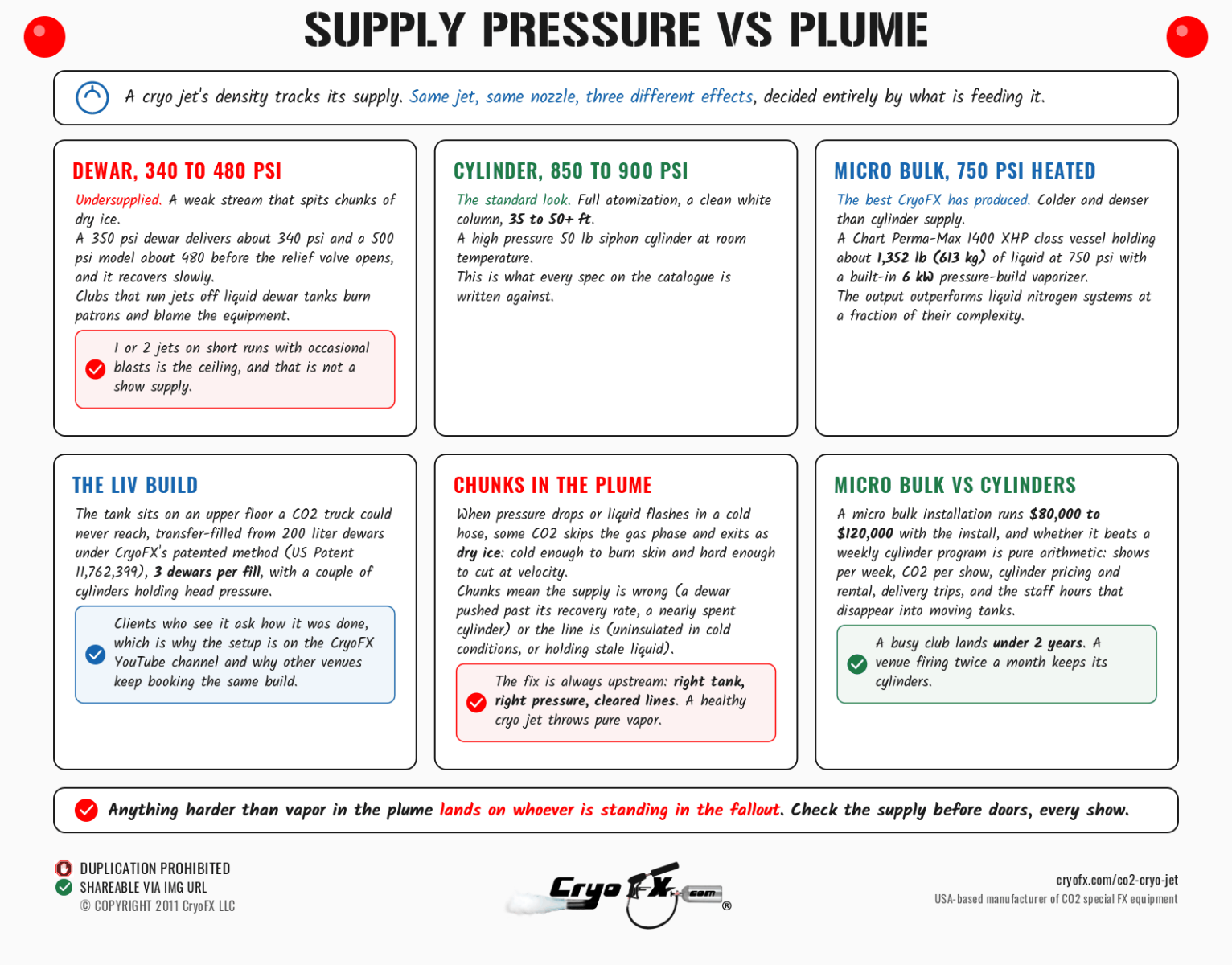
A cryo jet's density tracks its supply. A high pressure 50 lb siphon cylinder at 850 to 900 psi delivers the standard look: full atomization, a clean white column, 35 to 50+ ft. A dewar tank at 340 to 480 psi undersupplies the same jet, and the result is a weak stream that spits chunks of dry ice; clubs that run jets off liquid dewar tanks burn patrons and blame the equipment. Between the two sits the reason this page carries a calculator.
The best-looking CO2 CryoFX has ever produced runs at LIV in Las Vegas on a micro bulk tank: a Chart Perma-Max 1400 XHP class vessel holding about 1,352 lb (613 kg) of liquid, operating at 750 psi with a built-in 6 kW pressure-build vaporizer that heats the CO2 to working pressure. The tank sits on an upper floor a CO2 truck could never reach, transfer-filled from 200-liter dewars under CryoFX's patented method (US Patent 11,762,399), 3 dewars per fill, with a couple of cylinders holding head pressure.
The CO2 comes out colder and denser than cylinder supply, the output outperforms liquid nitrogen systems at a fraction of their complexity, and clients who see it ask how it was done, which is why the setup is on our YouTube channel and why other venues keep booking the same build.
Micro bulk vs cylinders: run your own numbers
A micro bulk installation runs $80,000 to $120,000 with the install, and whether it beats a weekly cylinder program is pure arithmetic: shows per week, CO2 per show, cylinder pricing and rental, delivery trips, and the staff hours that disappear into moving tanks. The calculator below runs the comparison the way CryoFX quotes it, including the cumulative cost curve out to 10 years, resale value on the vessel, and the break-even month for your actual demand. A busy club lands under 2 years; a venue firing twice a month keeps its cylinders, and the tool is honest about both.
[CALCULATOR BLOCK: MICRO BULK TANK BREAK-EVEN VS CYLINDERS, mbcalc3_micro_bulk_break_even_calculator_v3.html]
Dry ice, and what chunks in the plume mean
When pressure drops or liquid flashes in a cold hose, some CO2 skips the gas phase and exits as dry ice: solid carbon dioxide, cold enough to burn skin on contact and hard enough to cut at velocity. Chunks in the plume mean the supply is wrong (a dewar pushed past its recovery rate, a nearly spent cylinder) or the line is (uninsulated in cold conditions, or holding stale liquid).
The fix is always upstream: right tank, right pressure, cleared lines. A healthy cryo jet throws pure vapor, and anything harder than vapor in the plume lands on whoever's standing in the fallout, so the upstream check happens before doors, every show, as part of the standard pre-show sequence this cluster's safety guide lays out.
Where the cryo configuration gets specified
Deployment matches any jet in this cluster: clubs, theme parks, stage production, corporate reveals, and special events of every size. Handheld CO2 stays the crowd-interactive tool while the mounted cryo jet holds the fixed positions, and dip tank and siphon tube rules apply unchanged, because the cold this page describes only exists when liquid reaches the valve. The clients who specifically want the "cryo" version, the coldest and densest output available, are TV and film productions chasing plume density on camera, mega clubs building a signature look, and theme parks running heavy cycles where supply engineering pays for itself.
That spec conversation runs through the same intake as every CryoFX system, and it starts with the room's temperature, humidity, and supply options, because this page's whole argument is that those three variables are the effect. Wide variety of products aside, the club owners and event producers who get the best CO2 in their market are the ones who bought the supply design along with the jet, and the LIV build is the standing proof.
The full engineering context, from valves and tanks through installation and permits, is the CO2 jet and cryo jet guide on the pillar. Current equipment, from standard jets to the models behind the builds above, is on the CryoFX catalogue under CO2 cryo jets for sale.
Frequently asked questions
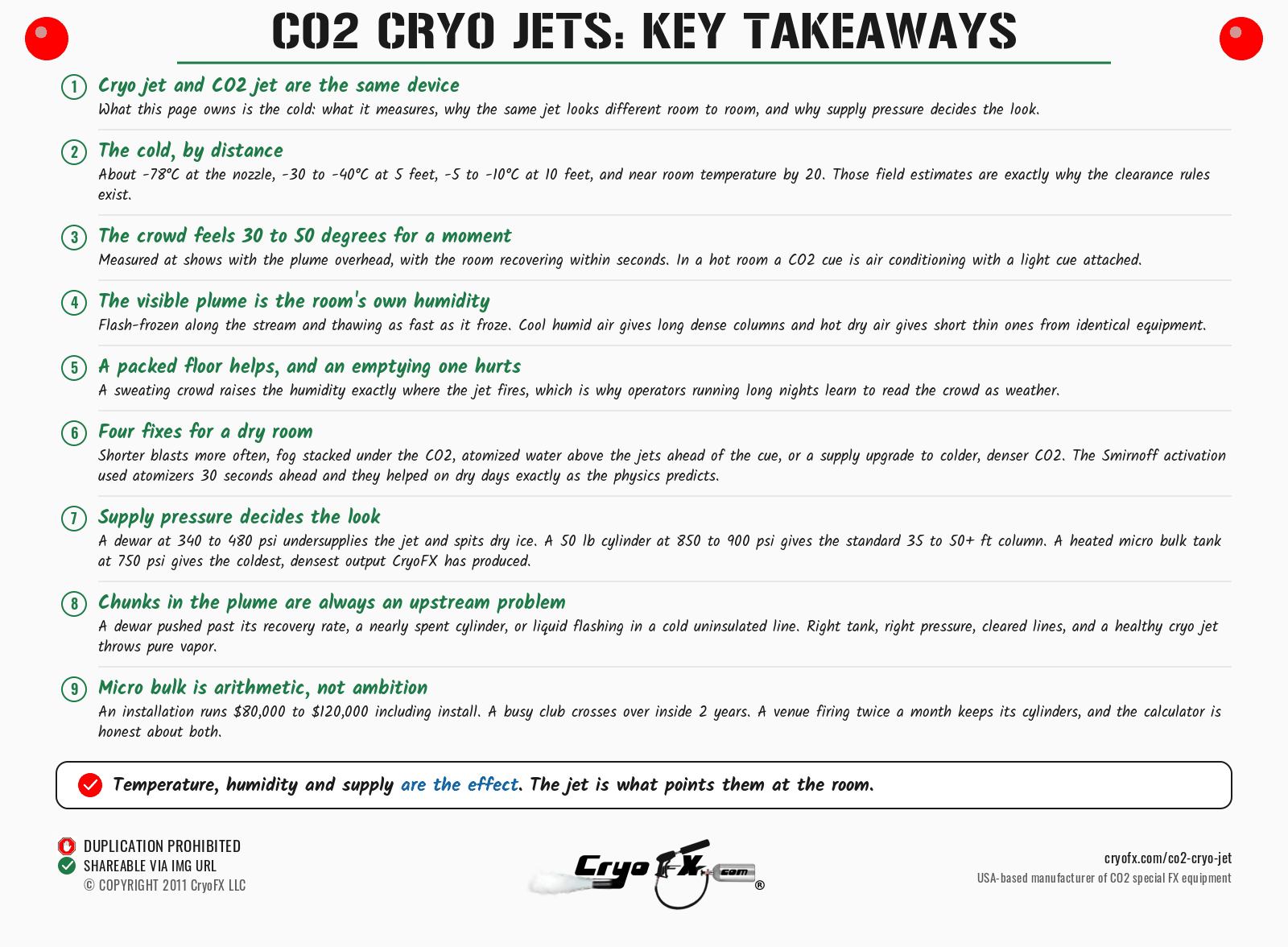
What is a CO2 cryo jet? A CO2 jet described by its output: a cryogenic special effects device firing liquid CO2 at about -78°C, producing a cold white vapor column 35 to 50+ ft tall. The name is interchangeable with CO2 jet; this page covers the cold-output physics behind it.
How cold is a CO2 cryo jet? About -78°C (-109°F) at the nozzle, roughly -30 to -40°C at 5 feet, and near room temperature by 20 feet. The crowd feels a momentary 30 to 50 degree drop when a jet fires overhead.
Why does my CO2 jet look weak in Las Vegas? Hot, dry air erases the plume faster than it forms; the effect literally runs on ambient humidity. Fixes that work: fire shorter blasts more often, stack fog under the CO2, add atomized water above the jets, or upgrade the supply to colder, denser CO2.
Does humidity affect a CO2 jet? More than any other variable. The visible plume is frozen ambient moisture, so humid rooms produce long dense columns and dry rooms produce short thin ones from identical equipment.
Why is my CO2 jet throwing ice? Dry ice chunks mean the supply pressure is wrong: a dewar that can't rebuild pressure fast enough, a nearly empty cylinder, or liquid flashing in a cold, uninsulated line. Fix the supply and the chunks stop.
Can a dewar run a CO2 cryo jet? Only 1 or 2 jets on short runs with occasional blasts. Dewars max out at 350 to 500 psi and recover slowly; pushed harder they deliver weak output and dry ice. Venues that want bulk supply run the heated micro bulk setup instead.
Is a CO2 cryo jet different from a cryo jet? No. CO2 cryo jet, cryo jet, and CO2 jet all name the same device. The cluster's naming pages cover the terms; this page covers the cold.
Co2 Cryo Jet | CryoFX®
Updated - 09/06/2026.