
CO2 Jet Cannon: Cold Gas Stage Effects with DMX 512, Specified Right
CO2 Jet Cannon: Cold Gas Stage Effects with DMX 512, Specified Right
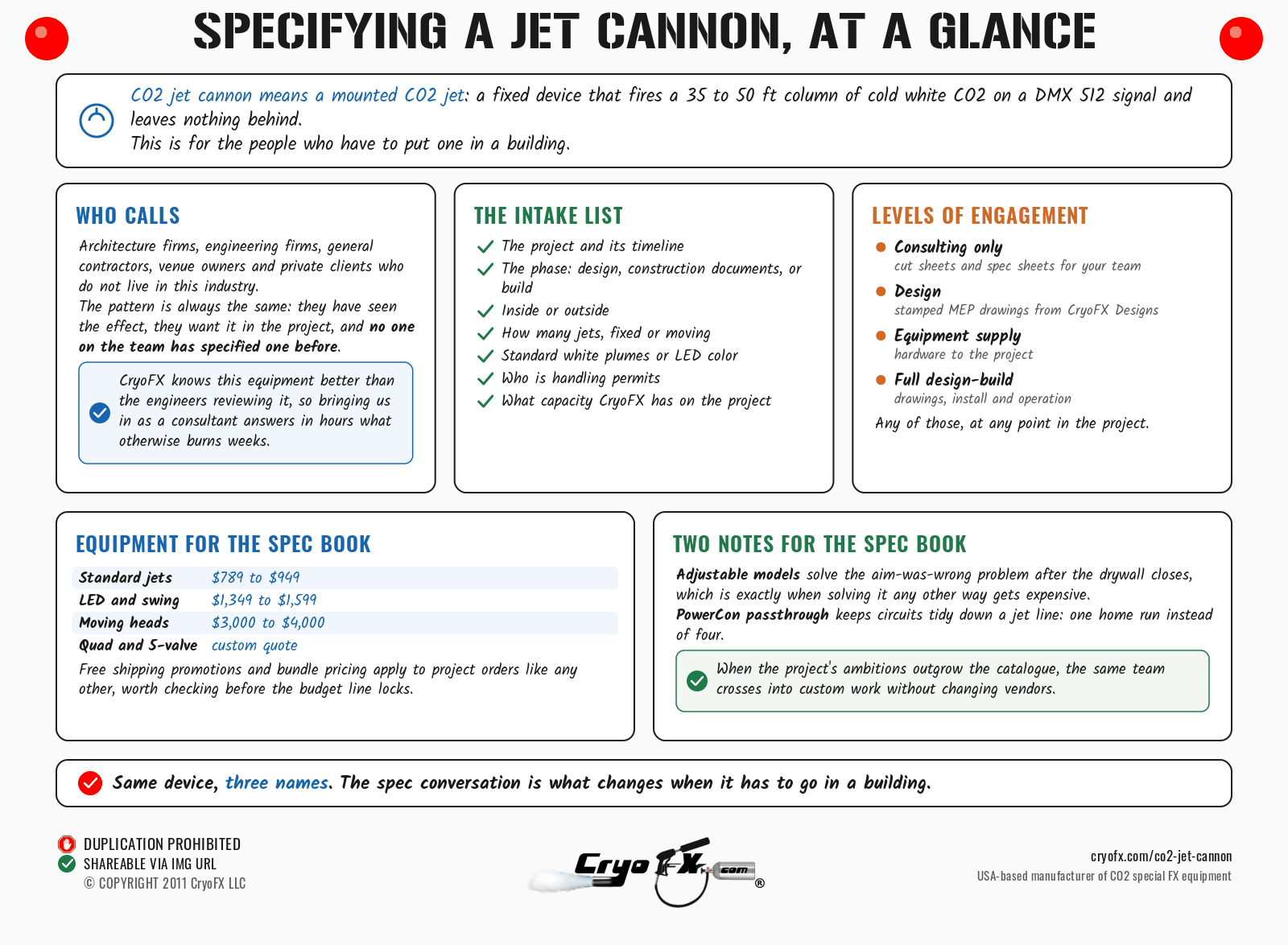
If you've landed here from a design meeting, a rider, or a client's mood board, "CO2 jet cannon" means a mounted CO2 jet: a fixed device that fires a 35 to 50 ft column of cold white CO2 on a DMX 512 signal and leaves nothing behind. The cluster's definition page covers the device itself; what follows is for the people who have to put one in a building.
CryoFX works with architecture firms, engineering firms, general contractors, venue owners, and private clients who don't live in this industry, and the pattern is always the same: they've seen the effect, they want it in the project, and no one on the team has specified one before. Here's how that conversation goes when it goes well.
The questions we'll ask you
Our intake for a GC or architect runs down a list, and having answers ready saves a design cycle. What's the project and its timeline? What phase are you in: design, construction documents, or build? Inside or outside? How many jets, and fixed or moving? Standard white plumes or LED color? Who's handling permits? And what's our capacity on the project: consulting only, design, equipment supply, or running the whole thing?
CryoFX engages at any of those levels, from handing over cut sheets and spec sheets for your team to study, to full design-build with stamped drawings. The honest pitch we make is that we know this equipment better than anyone including the engineers reviewing it, so bringing us in as a consultant answers questions in hours that otherwise burn weeks.
What the building has to provide
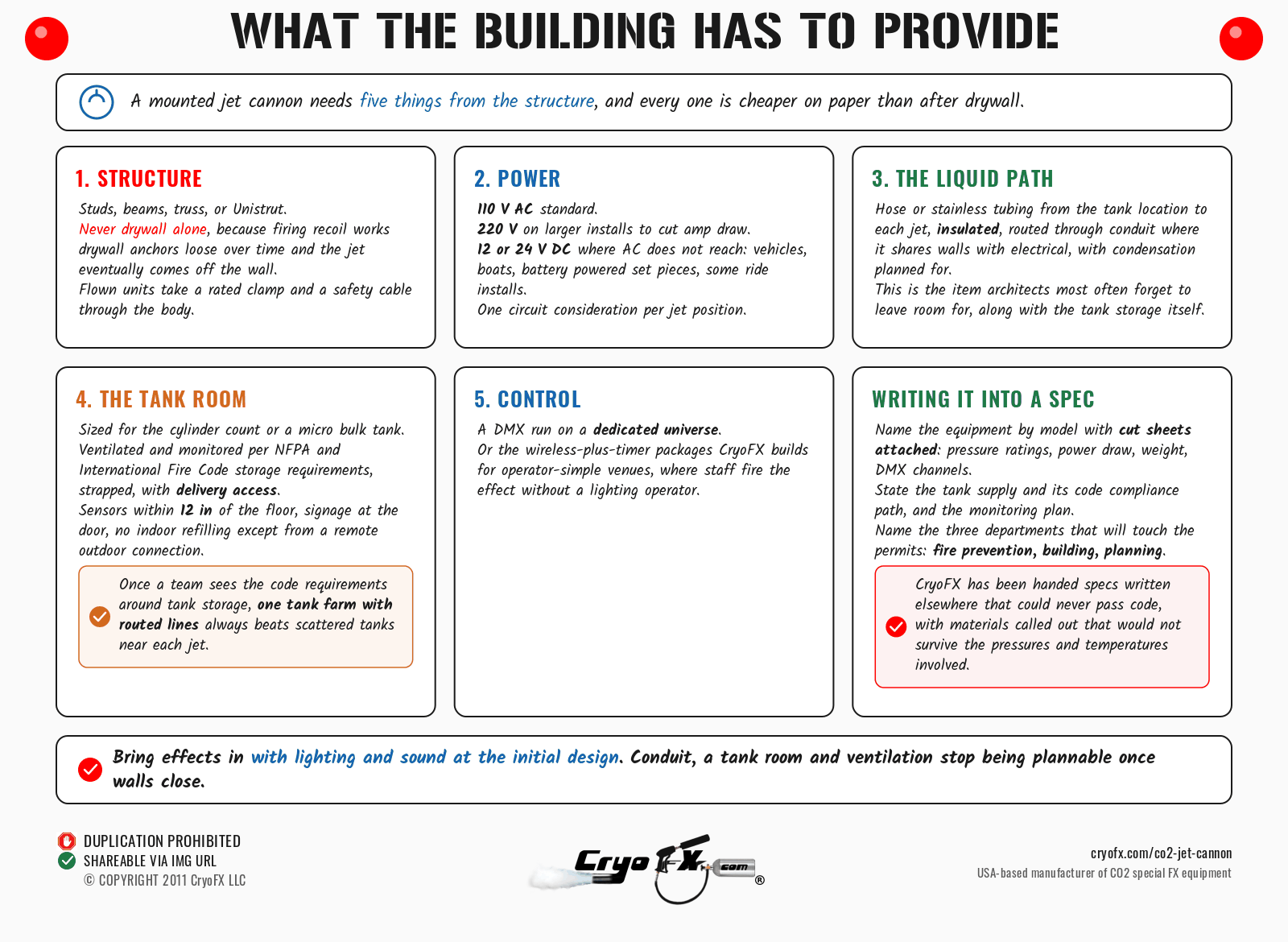
A mounted jet cannon needs five things from the structure, and every one is cheaper on paper than after drywall.
Structure: the jet mounts to studs, beams, truss, or Unistrut, never to drywall alone, because firing recoil works drywall anchors loose over time. Flown units take a rated clamp and a safety cable.
Power: 110 V AC standard, 220 V on larger installs to cut amp draw, or 12/24 V DC where AC doesn't reach. One circuit consideration per jet position.
The liquid path: hose or stainless tubing from the tank location to each jet, insulated, routed through conduit where it shares walls with electrical, with condensation planned for. This is the item architects most often forget to leave room for, along with the tank storage itself.
The tank room: sized for the cylinder count or a micro bulk tank, ventilated and monitored per NFPA and International Fire Code storage requirements, strapped, with delivery access. Once an architecture team sees the code requirements around tank storage, the single tank farm with routed lines always beats scattered tanks near each jet.
Control: a DMX run on a dedicated universe, or the wireless-plus-timer packages we build for operator-simple venues.
Writing it into a spec
A buildable spec names the equipment by model with cut sheets attached (pressure ratings, power draw, weight, DMX channels), the tank supply and its code compliance path, the monitoring plan, and the three departments that will touch the permits: fire prevention, building, and planning.
CryoFX Designs produces stamped mechanical, electrical, and plumbing drawings for exactly this use. We have been handed specs written elsewhere for jet cannon systems that could never pass code, with materials called out that would not survive the pressures and temperatures involved, and the fix was a redesign with our engineering brought in; cheaper to start there.
Timeline and budget
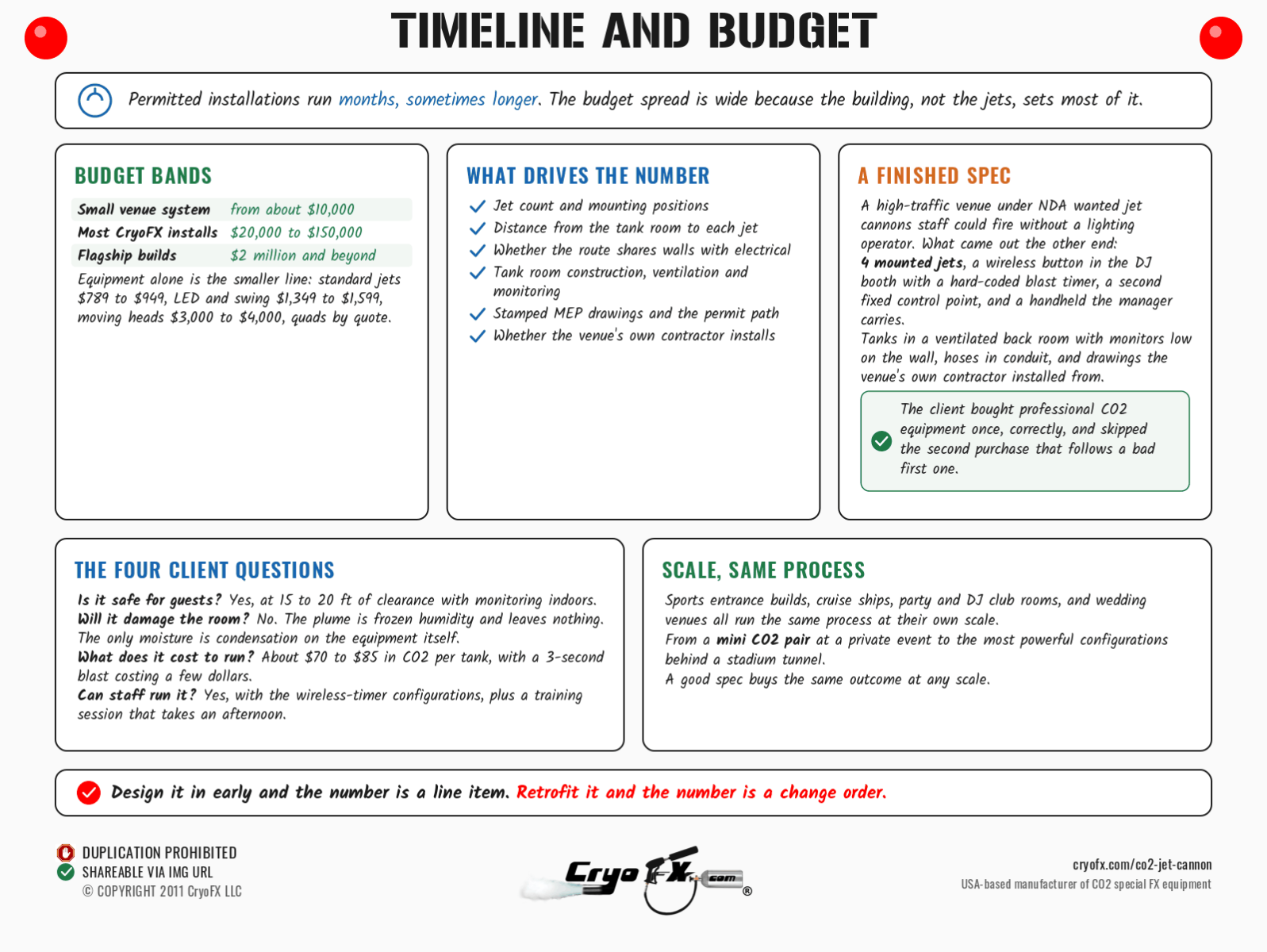
Bring special effects in with lighting and sound at the initial design, never as a finishing touch, because the conduit, tank room, and ventilation stop being plannable once walls close. Permitted installations run months, sometimes longer. Budget-wise, most CryoFX installations land between $20,000 and $150,000, with small venue systems starting around $10,000 and flagship builds running to $2 million and beyond. Equipment alone: standard jets $789 to $949, LED and swing $1,349 to $1,599, moving heads $3,000 to $4,000, quads by quote.
The complete technical background sits in the CO2 jet cannon complete guide, and the deeper installation walkthrough, purge valves and tank rooms included, is on the cluster's CO2 jet installation guide. Equipment for the spec book: CO2 jet cannon for sale on the CryoFX catalogue.
What the finished spec looks like
A recent conversation shows the shape. A high-traffic venue (under NDA) came in wanting jet cannons the staff could fire without a lighting operator: the spec that came out the other end was 4 mounted jets, a wireless button in the DJ booth with a hard-coded blast timer, a second fixed control point, and a handheld controller the manager carries, tanks in a ventilated back room with monitors low on the wall, hoses in conduit, and drawings the venue's own contractor installed from.
The client bought professional CO2 equipment once, correctly, and skipped the second purchase that follows a bad first one. A good spec buys the same outcome at any scale: sports entrance builds, cruise ships, party and DJ club rooms, and wedding venues all run the same process at their own scale, from a mini CO2 pair at a private event to the most powerful CO2 configurations behind a stadium tunnel.
Two last notes for the spec book. Free shipping promotions and bundle pricing on the catalogue apply to project orders like any other, worth checking before the budget line locks. And easy angle adjustment models (the Adjustable line) solve the aim-was-wrong problem after the drywall closes, which is exactly when solving it any other way gets expensive. Power passthrough on PowerCon keeps circuits tidy down a jet line, one home run instead of four.
Questions your client will ask you
Speccing for someone else means fielding their questions, so here are the answers to the four that always come. Is it safe for guests? Yes, at 15 to 20 ft of clearance with monitoring indoors, and the safety guide in this cluster is written to hand over. Will it damage the room? No; the plume is frozen humidity, leaves nothing, and the only moisture is condensation on the equipment itself. What does it cost to run? About $70 to $85 in CO2 per tank, with a 3-second blast costing a few dollars; the tank math page prices any show schedule. And can staff run it? Yes, with the wireless-timer configurations built exactly for venues without production crews, plus a training session that takes an afternoon.
And when the project's ambitions outgrow the catalogue, the same team crosses into custom work without changing vendors: hidden installs, moving heads, vehicle integration, and effects built into the architecture itself all run through the process on the custom fabrication page of this cluster. The spec conversation stays the same; only the drawings get more interesting.
Frequently asked questions
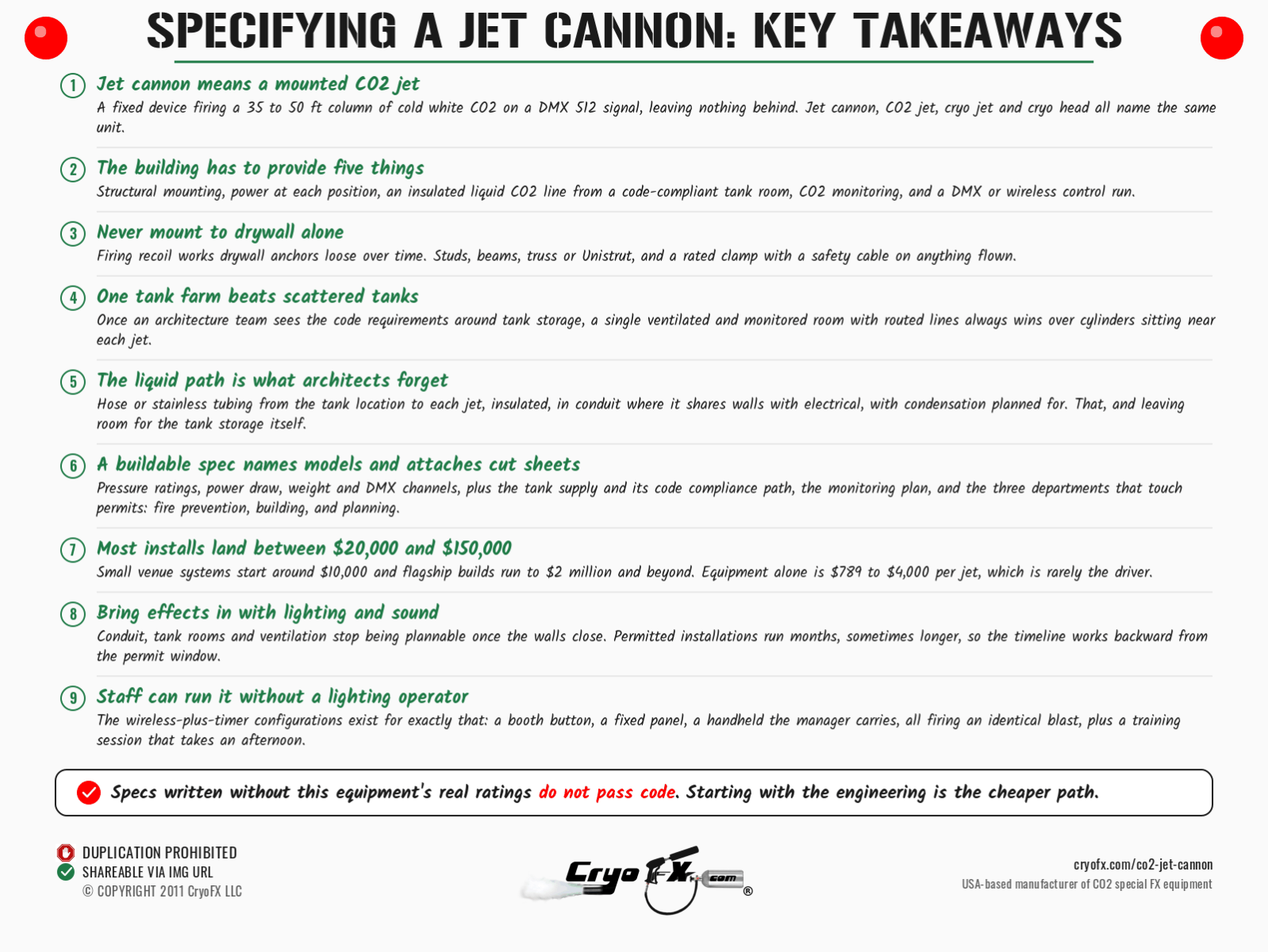
What is a CO2 jet cannon? A mounted CO2 effect device, a CO2 jet under another name, that fires a 35 to 50 ft column of cold CO2 on a DMX or power signal. The phrase is common among architects, contractors, and buyers outside the production industry.
Is a CO2 jet cannon the same as a CO2 jet? Yes. Jet cannon, CO2 jet, cryo jet, and cryo head all name the same mounted unit.
Can a CO2 jet cannon be built into a new venue? Yes, and new construction is the best time: the tank room, hose routing, power, and monitoring all get designed in with lighting and sound instead of retrofitted.
What does a building need for a CO2 jet cannon? Structural mounting (never drywall alone), power at each position, an insulated liquid CO2 line from a code-compliant tank room, CO2 monitoring, and a DMX or wireless control run.
How much does a CO2 jet cannon installation cost? Most CryoFX installs run $20,000 to $150,000, small systems from about $10,000, flagship builds to $2 million and up. Equipment alone runs $789 to $4,000 per jet.
Who installs CO2 jet cannons? CryoFX designs, builds, and installs complete systems through CryoFX Designs (stamped MEP drawings) and CryoFX Services, or supplies equipment and drawings for the project's own contractors, at whatever level of involvement the project needs.
Do CO2 jet cannons need a permit? In Las Vegas, yes, every time. Elsewhere, event use typically needs venue approval and insurance while permanent installations need building, fire, and electrical permits everywhere. The permit page covers the full map.
Co2 Jet Cannon | CryoFX®
Updated - 09/06/2026.