
CO2 Jet Permit Requirements: The Permits, The Paperwork, And The Process
CO2 Jet Permit Requirements: What You Need Before Installing or Operating | CryoFX
CO2 Jet Permit Requirements: The Permits, The Paperwork, And The Process
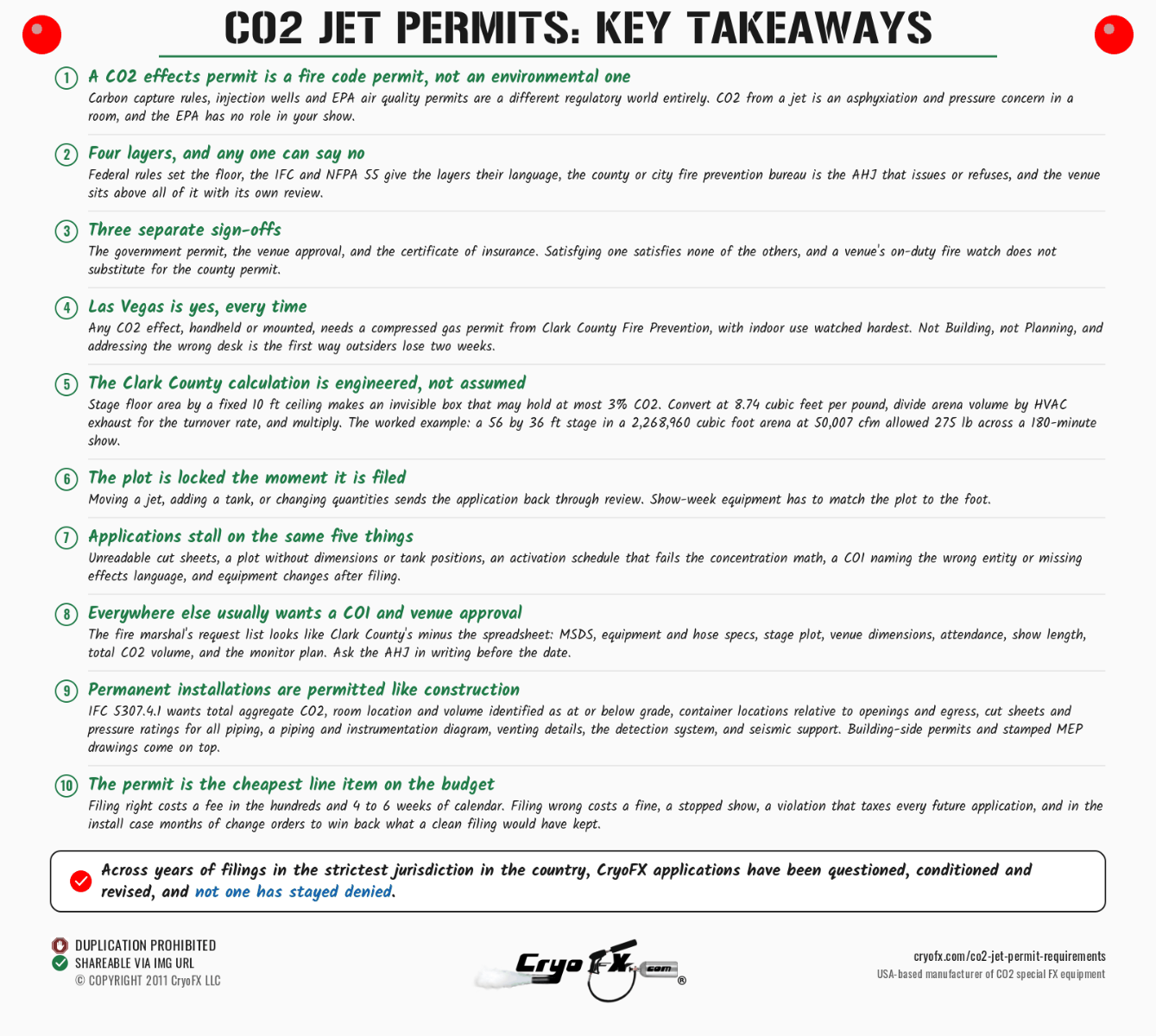
CO2 jets are legal to own and operate everywhere in the United States. Whether a given show needs an operating permit depends entirely on where the show is, and the answer runs from "yes, every time, no exceptions" in Las Vegas to "a certificate of insurance and the venue's blessing" across most of the country.
The map below runs the whole territory: the jurisdiction stack, the three separate sign-offs, the Clark County process in full because it's the strictest common jurisdiction and the model others borrow from, the permanent installation path, and the documentation CryoFX files week in and week out. We've filed more CO2 permits than any company we know of, our equipment cut sheets sit in fire prevention files across the country, and no application we've submitted has stayed denied.
First, the disambiguation
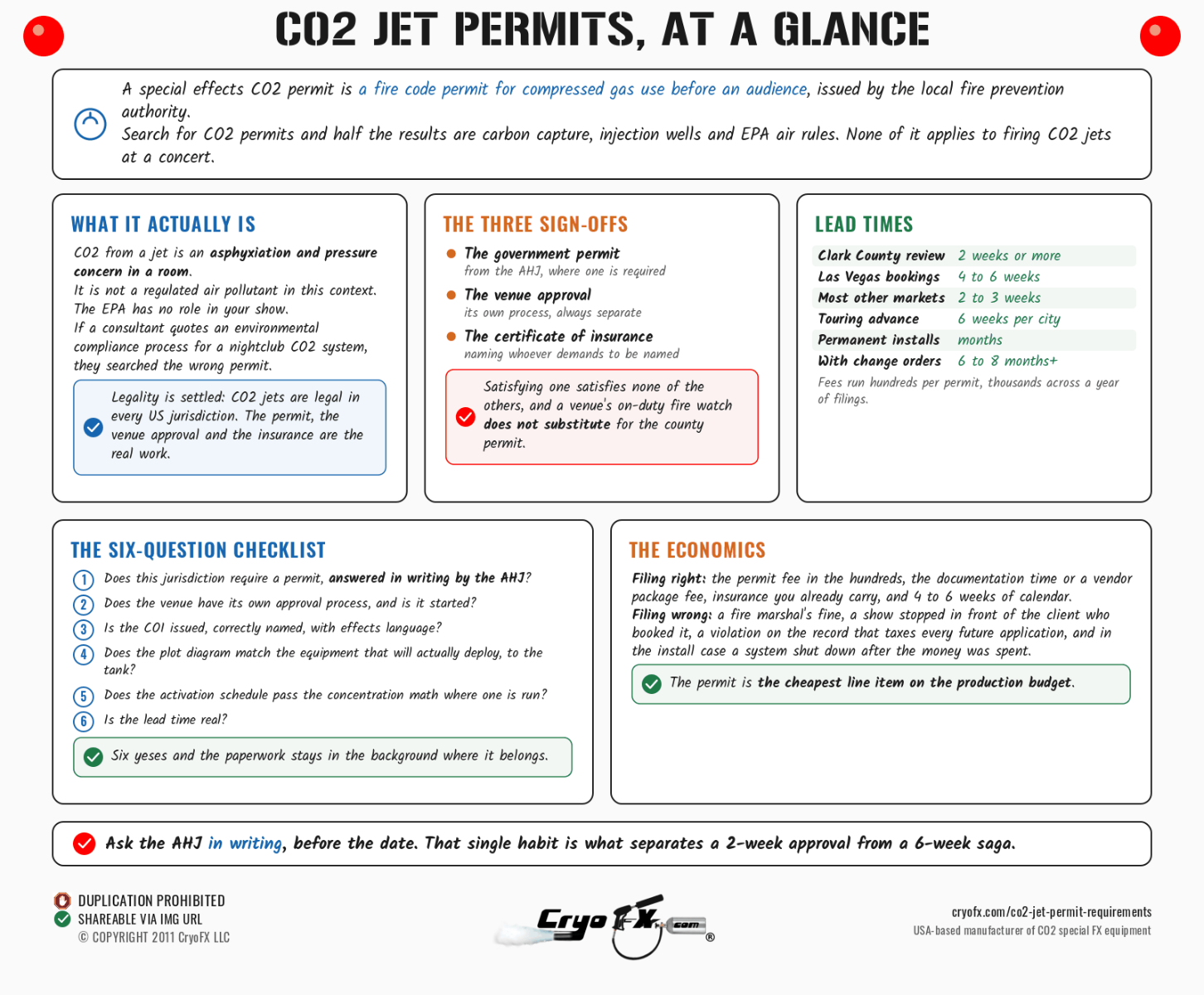
Search for CO2 permits and half the results have nothing to do with special effects. Carbon capture and sequestration projects, UIC Class VI injection wells, EPA air quality rules, preconstruction permits for stationary combustion turbines, waste permits, greenhouse gas reporting for major sources: that's the regulatory world for industrial carbon dioxide as an emission or a sequestration commodity, run through environmental regulations, the federal register, and state environmental agencies.
None of it applies to firing CO2 jets at a concert. A special effects CO2 permit is a fire code permit for compressed gas use before an audience, issued by the local fire prevention authority. CO2 from a jet is an asphyxiation and pressure concern in a room, and it is not a regulated air pollutant in this context; the EPA has no role in your show. If a consultant quotes you an environmental compliance process for a nightclub CO2 system, they've searched the wrong permit.
The jurisdiction stack
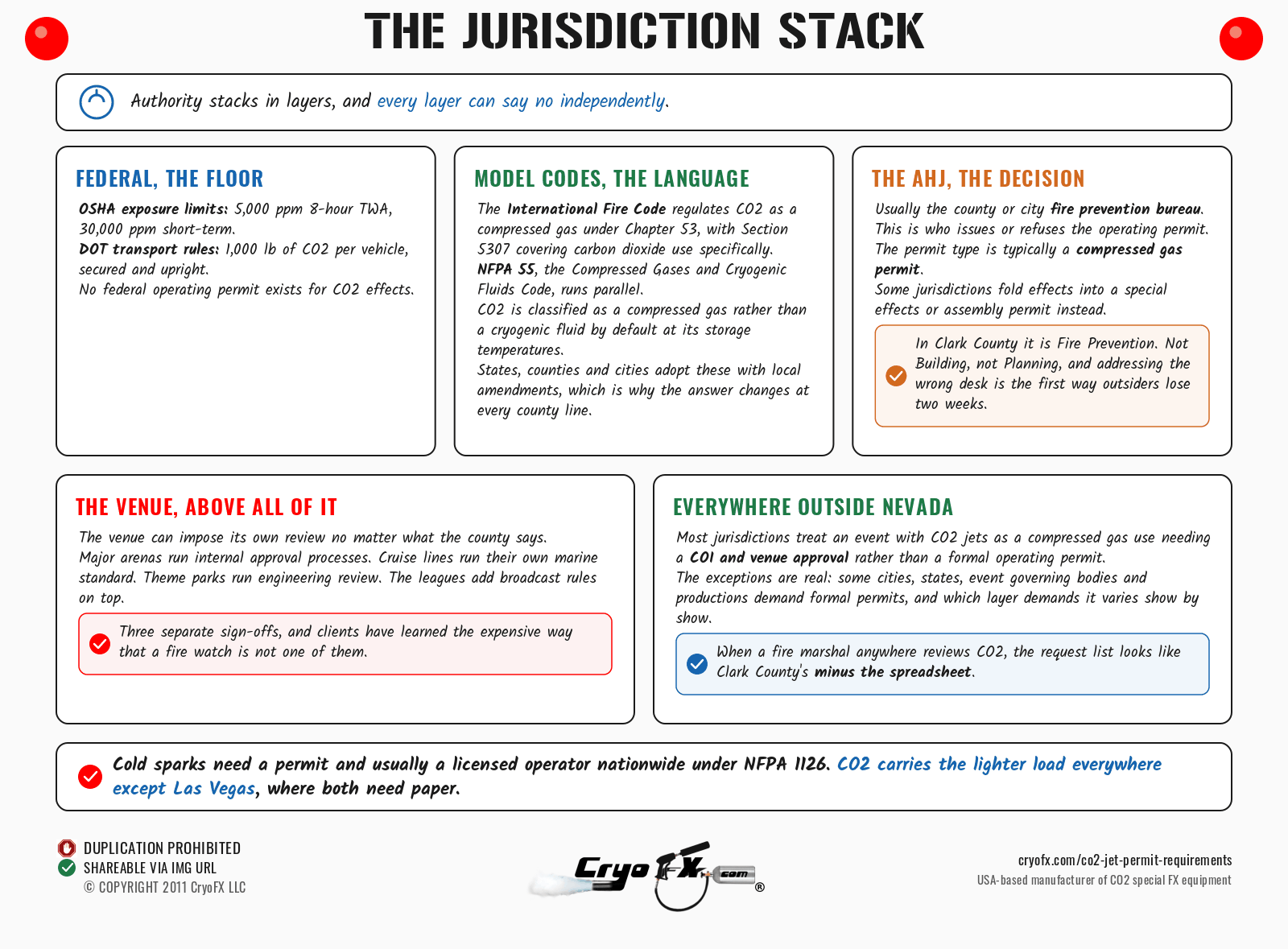
Authority stacks in layers, and every layer can say no independently.
Federal codes set the floor: OSHA exposure limits (5,000 ppm 8-hour TWA, 30,000 ppm short-term) and DOT transport rules (1,000 lb of CO2 per vehicle, secured and upright). No federal operating permit exists for CO2 effects.
Model codes give the layers their language: the International Fire Code regulates CO2 as a compressed gas (Chapter 53), with Section 5307 covering carbon dioxide use specifically, and NFPA 55, the Compressed Gases and Cryogenic Fluids Code, running parallel. CO2 is classified as a compressed gas rather than a cryogenic fluid by default at its storage temperatures. States, counties, and cities adopt these codes with local amendments, which is why the answer changes at every county line.
The authority having jurisdiction (AHJ), usually the county or city fire prevention bureau, is who actually issues or refuses the operating permit. The type of permit is typically a compressed gas permit; some jurisdictions fold effects into a special effects or assembly permit instead.
Above all of it sits the venue, which can impose its own review no matter what the county says. Major arenas run internal approval processes (the Crypto.com Arena review is a good example of the breed), cruise lines run their own marine standard, theme parks run engineering review, and the leagues add broadcast rules on top.
That makes three separate sign-offs for a permitted show: the government permit, the venue approval, and the certificate of insurance naming whoever demands to be named. Satisfying one satisfies none of the others, and a venue's on-duty fire watch does not substitute for the county permit; we've watched clients learn that one the expensive way.
Las Vegas and Clark County, in full
In Las Vegas the answer is yes, every time: any CO2 effect, handheld or mounted, requires a permit, with indoor use the case the county watches hardest. Clark County Fire Prevention issues it. Not the Building Department, not Planning, and addressing the application to the wrong desk is the first way outsiders lose two weeks.
What makes Clark County the strictest common jurisdiction is that the safety case is engineered rather than assumed. The bureau's own engineers built a spreadsheet calculation, and every application submits it. Here's the methodology, with a real worked example.
Draw an invisible box over the stage: the stage's floor area with a fixed 10-foot ceiling. A 56 by 36 foot stage gives 2,016 square feet of floor and a 20,160 cubic foot box. The box may hold at most 3% CO2, the short-term exposure threshold: 605 cubic feet of gas. Convert gas volume to weight at 8.74 cubic feet per pound and the box allows about 69 lb of CO2 per air change. Now bring in the building: arena volume divided by HVAC exhaust capacity gives the air turnover rate.
A 2,268,960 cubic foot arena with 50,007 cfm of exhaust turns its air over every 45 minutes, so a 180-minute show gets 4 turnovers, and 69 lb per turnover times 4 is 275 lb of allowable CO2 for the show. The requested tanks on that filing, 4 fifty-pound and 4 twenty-pound cylinders, totaled 280 lb, close enough that the schedule got tuned to fit.
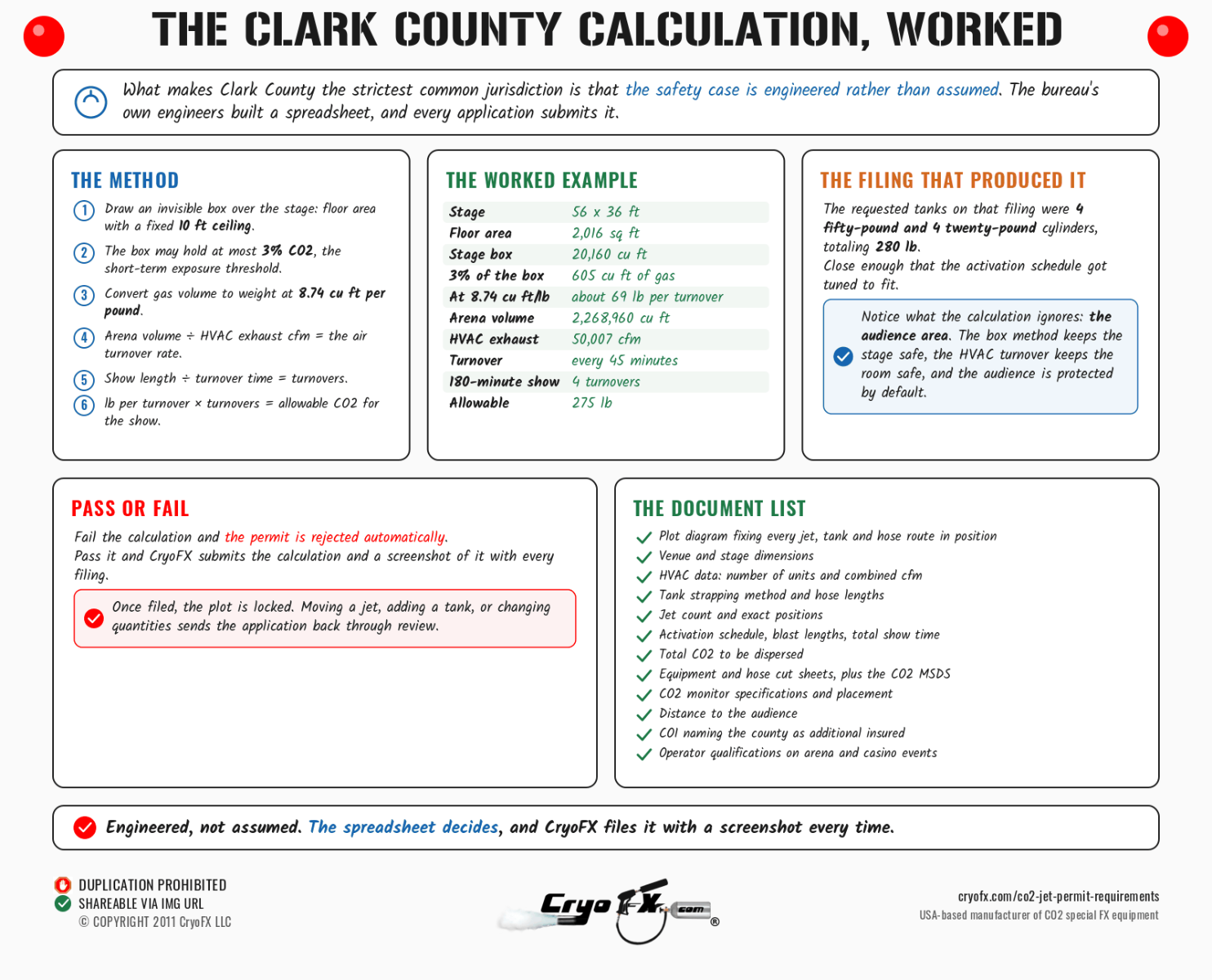
Notice what the calculation ignores: the audience area. The box method keeps the stage safe, the HVAC turnover keeps the room safe, and the audience is protected by default. Fail the calculation and the permit is rejected automatically; pass it and CryoFX submits the calculation and a screenshot of it with every filing.
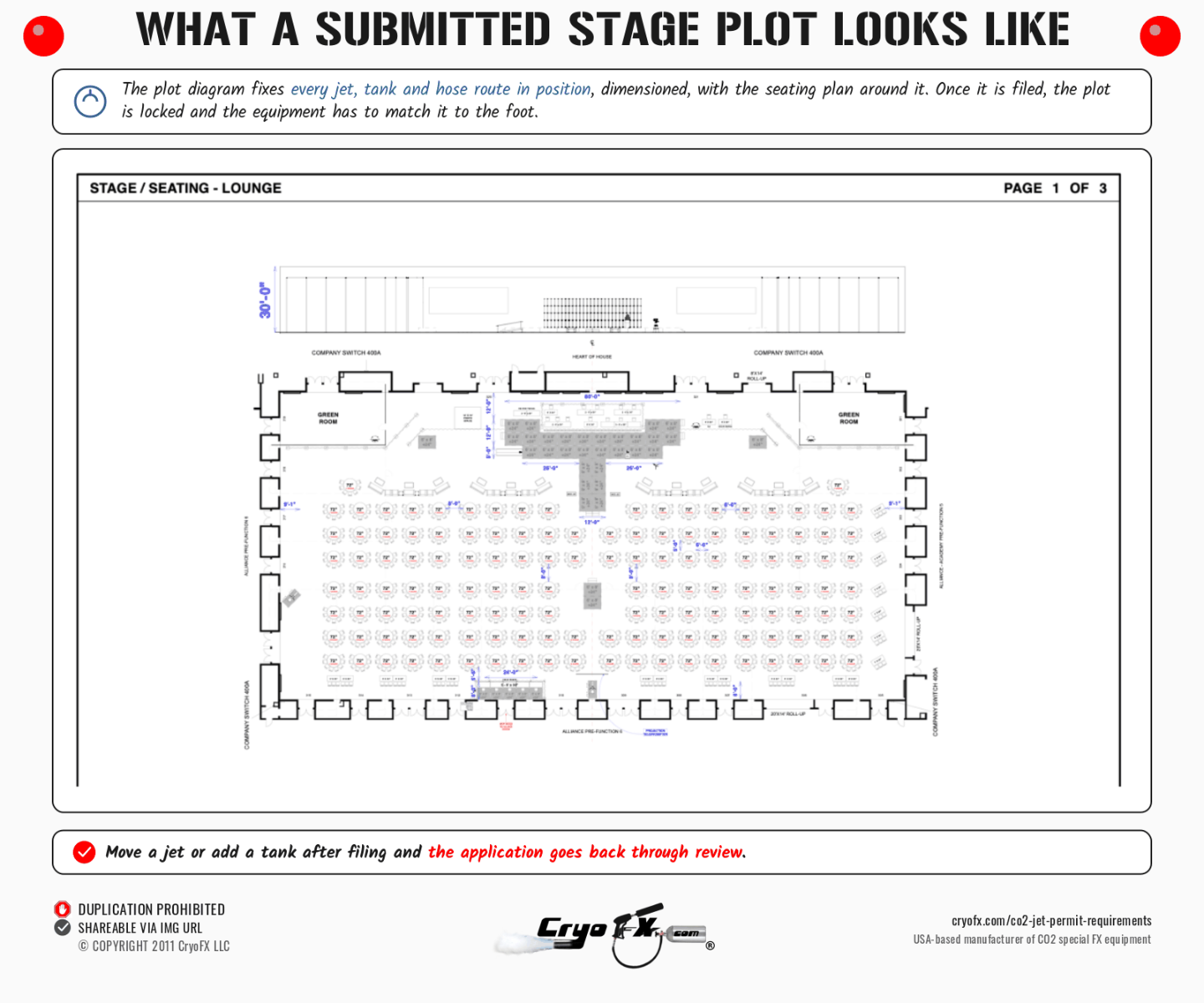
The document list around that calculation, assembled the same way every time: a plot diagram fixing every jet, tank, and hose route in position (a stage and seating plan with equipment positions dimensioned); venue and stage dimensions; the HVAC data, meaning the number of units and their combined cfm; the tank strapping method; hose lengths; jet count and exact positions;
The activation schedule, blast lengths, and total show time; total CO2 to be dispersed; equipment and hose cut sheets; the CO2 material safety data sheet; CO2 monitor specifications and placement; distance to the audience; and a certificate of insurance naming the county as additional insured. Arena and casino events add operator qualifications to the package.
Process mechanics: the review takes 2 weeks or more, which is why Las Vegas events book 4 to 6 weeks out. Once filed, the plot is locked; moving a jet, adding a tank, or changing quantities sends the application back through review. Fees run in the hundreds per permit, thousands across a year of filings, and CryoFX covers the permit fee inside its documentation package.
Conditional approvals and requests for additional information are routine, in-person demonstrations happen, and a complex show can turn into a significant discussion with the bureau before the stamp lands. Operate without the permit and the fire marshal fines you, and the violation sits on your record, making every future application harder.
Clients who file alone get stonewalled, then a request for more information, then a second review round, spending several times the effort; CryoFX files with direct access to the county's permit system and the history that makes reviewers comfortable.
The cautionary tale that shows the system working: a brand-new CO2 installation at a Las Vegas nightclub was shut down by the fire department during an ongoing risk assessment, after install, and we told the client plainly that no amount of money could bypass the process.
The fix took 6 to 8 months of change orders and more than 20 live demonstrations, testing sensors at specific CO2 concentrations, and produced a system with electronic flow monitoring that shuts the CO2 off automatically if a valve stays open too long, tied into the venue's ADT life safety panel. Clark County subsequently amended local fire code to incorporate elements of what that system pioneered, and the fire department called it the most sophisticated system of its kind.
Everywhere else
Outside Nevada, most jurisdictions treat an event with CO2 jets as a compressed gas use needing a certificate of insurance and venue approval rather than a formal operating permit. That's the common pattern across most major cities, and the exceptions are real: some cities, states, event governing bodies, and productions demand formal permits, and which layer demands it varies show by show.
Too many cities have asked us for formal permits to list, and plenty never have. The operating rule that never fails: ask the AHJ, in writing, before the date. When a fire marshal anywhere reviews CO2, the request list looks like Clark County's minus the spreadsheet: MSDS, equipment spec sheets, hose specs, stage plot, venue dimensions, attendance, show length, total CO2 volume, and the monitor plan.
Having the CryoFX cut sheet package ready is usually the difference between a same-week approval and a stall, and necessary permits secured early are the cheapest line item on any production budget.
One comparison worth knowing when your event weighs effects: cold spark machines need permits and usually a licensed operator in most jurisdictions nationwide, because NFPA 1126 classifies them as pyrotechnic devices. CO2 jets carry the lighter permitting load everywhere except Las Vegas, where both need paper.
Permanent installations
A fixed system is a construction project, permitted like one. The application documentation under IFC Section 5307.4.1 for fixed CO2 systems includes: the total aggregate quantity of liquid CO2 in pounds or cubic feet; the location and total volume of the room where the system operates, identified as at or below grade; container locations relative to equipment, building openings, and means of egress; manufacturer specifications and pressure ratings with cut sheets for all piping and tubing;
A piping and instrumentation diagram showing supports and remote fill connections; container venting details down to vent line size, material, and termination; the alarm and detection system; and seismic support for the containers. Signage at the room entrance carries the code's required asphyxiation warning, containers indoors refill only from a remote outdoor connection, and the gas detection system alarms at 5,000 ppm supervisory and 30,000 ppm evacuation with sensors within 12 inches of the floor.
On top of the fire package come the building-side permits: stamped mechanical, electrical, and plumbing drawings, a low-voltage plan covering the DMX and the CO2 alarm, piping and electrical permits, sometimes a state-level pressure vessel registration for the tank, and staged inspections with live demonstrations. The permit process for a clean install runs months; complex projects with change orders have run 6 to 8 months and beyond, and one hotel project carried over $250,000 in change orders before sign-off. Three departments touch it all (fire prevention, building, planning), and navigating them is a skill in itself; project developers who arrive without it pay 2 to 5 times the cost in delays and refiling.
What CryoFX files for you
The permit application, the calculation and its screenshot, the plot diagram, the cut sheets, the MSDS, the monitor plan, the COI coordination, and the fee, plus the conversation with the reviewer that experience makes short. For installs, CryoFX Designs produces the stamped drawings and walks the staged inspections, demonstrations included. The permitting process is a deliverable we hand over finished, and it's the part of the industry where our filing history does the selling: jurisdictions have seen our equipment before, and paper that's been approved a hundred times approves faster the hundred and first.
[CALCULATOR BLOCK: CO2 CONVERSION CALCULATOR HERE, converting pounds of CO2 to cubic feet of gas for the application's aggregate quantity and stage-box lines]
The complete safety context behind every requirement here is on the CO2 jet permit and safety guide pillar, with the chemical documentation at the CO2 material safety data sheet. Equipment with permit-ready cut sheets is on the CryoFX catalogue under CO2 jets for sale.
Who files, and the week-by-week timeline
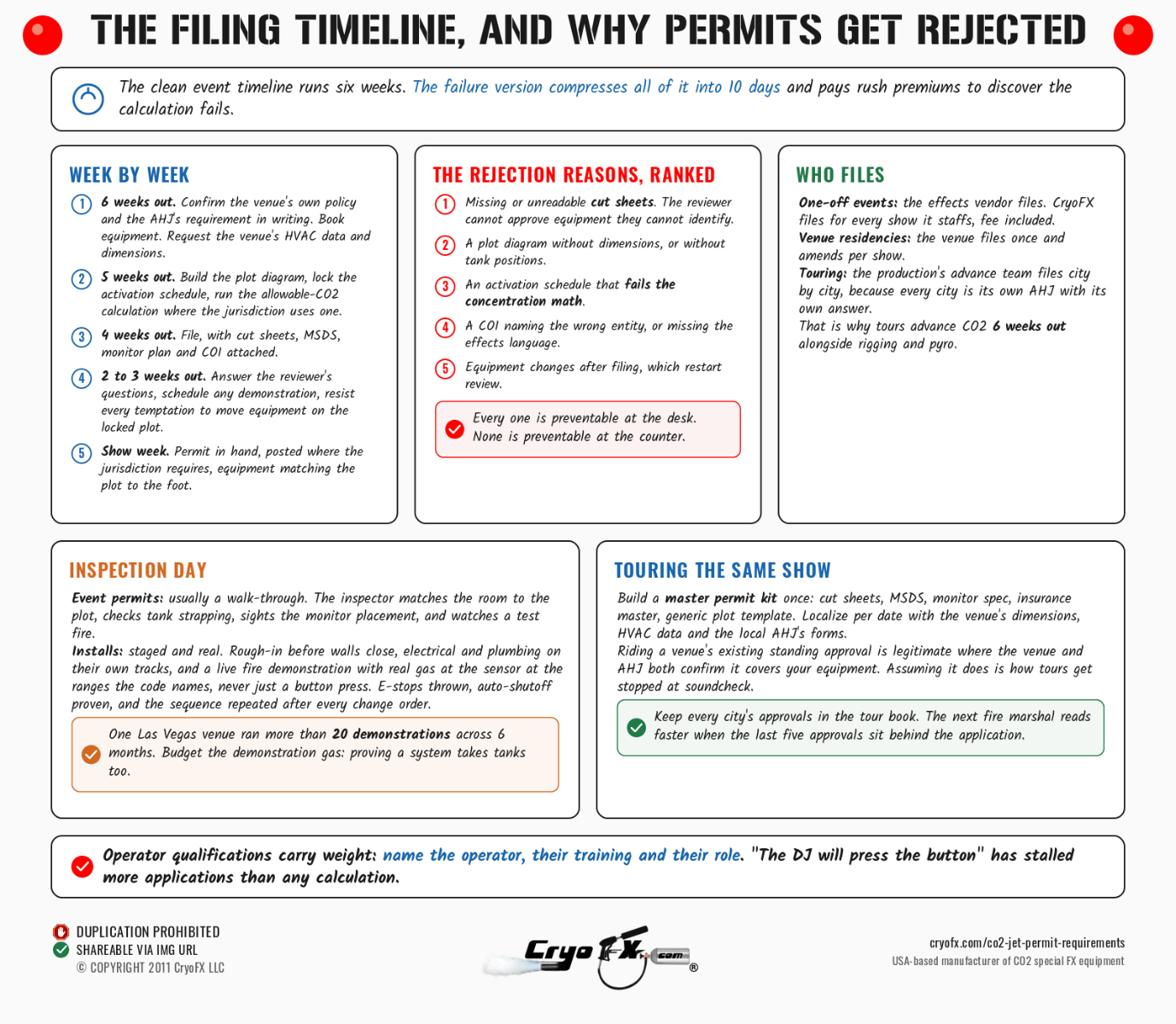
Who files depends on who profits from the paper existing. For one-off events, the effects vendor files (CryoFX files for every show it staffs, fee included); for venue residencies, the venue files once and amends per show; for touring productions, the production's advance team files city by city, and every city is its own AHJ with its own answer, which is why tours advance CO2 6 weeks out alongside rigging and pyro.
The clean event timeline runs like this. Six weeks out: confirm the venue's own policy and the AHJ's requirement in writing, book equipment, request the venue's HVAC data and dimensions. Five weeks out: build the plot diagram, lock the activation schedule, run the allowable-CO2 calculation where the jurisdiction uses one. Four weeks out: file, with cut sheets, MSDS, monitor plan, and COI attached. Two to three weeks out: answer the reviewer's questions, schedule any demonstration, resist every temptation to move equipment on the locked plot. Show week: permit in hand, posted where the jurisdiction requires, equipment matching the plot to the foot. The failure version of this timeline compresses all of it into 10 days and pays rush premiums to discover the calculation fails.
What inspection day looks like
For event permits, inspection is usually a walk-through: the inspector matches the room to the plot, checks tank strapping, sights the monitor placement, and watches a test fire. For installs, it's staged and real. Rough-in inspections check the routing and conduit before walls close, electrical and plumbing inspections run on their own tracks, and the fire demonstration is live: sensors tested at specific CO2 concentrations (real gas at the sensor, at the ranges the code names, never just a button press), e-stops thrown, auto-shutoff proven, and the sequence repeated after every change order. One Las Vegas venue ran more than 20 of these across 6 months. Bring the same patience to inspection day that the drawings brought to review, and budget the demonstration gas: proving a system takes tanks too.
Insurance, in permit terms
The COI is a permit document, so write it like one. Limits of $1 million per occurrence and $2 million aggregate cover most jurisdictions and venues; larger buildings ask for a $5 million umbrella, and arena work runs higher. The certificate names the additional insured exactly as the jurisdiction or venue demands (in Clark County, the county itself), states CO2 special effects in the description of operations, and comes from a policy where the carrier has confirmed in writing that CO2 effects are covered, because a general liability policy that's silent on effects is a dispute waiting for a claim.
Occurrence policies age better than claims-made for this work. Operators running steady calendars carry annual coverage with workers' comp and commercial auto where venues require them; one-off productions buy per-event policies and attach them to the filing.
The rejection reasons, ranked
Applications stall on the same five things, in order: missing or unreadable cut sheets (the reviewer can't approve equipment they can't identify); a plot diagram without dimensions or without tank positions; an activation schedule that fails the concentration math; a COI naming the wrong entity or missing the effects language; and equipment changes after filing, which restart review. Every one is preventable at the desk, none is preventable at the counter, and the difference between a 2-week approval and a 6-week saga is almost always which desk caught it.
Touring: the same show, twenty jurisdictions
A tour's CO2 package is identical in every city; its paperwork isn't. The advance pattern that works: build a master permit kit once (cut sheets, MSDS, monitor spec, insurance master, generic plot template) and localize it per date with the venue's dimensions, HVAC data, and the local AHJ's forms. Six weeks out per city, the advance asks each AHJ the same written question and files where the answer is yes.
Venues that host touring product weekly usually maintain their own standing effects approvals, and riding a venue's existing paperwork is legitimate where the venue and AHJ both confirm it covers your equipment; assuming it does is how tours get stopped at soundcheck. Keep every city's approvals in the tour book, because the next city's fire marshal reads faster when the last five approvals sit behind the application, and a tour that files clean in Las Vegas has effectively pre-cleared the hardest reviewer in the country.
Operator qualifications, and who the permit trusts
CO2 effects don't require a licensed pyrotechnician the way flame and sparks do, but permit packages for arenas and casinos ask who operates and what qualifies them, and the answer carries weight in review. A qualifying answer names the operator, their training (manufacturer training, internal certification, show history), and their role on show night.
CryoFX staffs permitted events with techs who've been through our internal training, field tests, and question series, and that roster is part of why our filings move: the reviewer has seen the same names on approved shows before. Self-operating renters in permit jurisdictions should expect the qualification question and have a real answer, because "the DJ will press the button" has stalled more applications than any calculation ever has.
The economics of doing it right
Count the costs on both paths, because the comparison is the argument. Filing right: the permit fee (hundreds), the documentation time or the vendor's package fee, insurance you already carry, and 4 to 6 weeks of calendar. Filing wrong or not at all: a fire marshal's fine, a show stopped in front of the client who booked it, a violation on the record that taxes every future application, and in the install case, systems shut down after the money was spent, with 6 to 8 months of change orders to win back what a clean filing would have kept.
CryoFX has watched both movies enough times to spoil the endings: the permit is the cheapest line item on the production budget, and operators who build the permitting process into the show schedule get their shows fired on time in every city. The record backs the posture: across years of filings in the strictest jurisdiction in the country, CryoFX applications have been questioned, conditioned, demonstrated, and revised, and not one has stayed denied, because the package walks in complete and the equipment behind it has been reviewed a hundred times before. That file history is transferable; every client show files on top of it.
A checklist to close on
Before any CO2 show, run the six questions. Does this jurisdiction require a permit, answered in writing by the AHJ? Does the venue have its own approval process, and is it started? Is the COI issued, correctly named, with effects language? Does the plot diagram match the equipment that will actually deploy, to the tank?
Does the activation schedule pass the concentration math where the jurisdiction runs one? And is the lead time real: 4 to 6 weeks in Las Vegas, 2 to 3 elsewhere, months for installs? Six yeses and the paperwork stays in the background where it belongs, and the show fires on schedule.
Frequently asked questions
Do CO2 jets need a permit? In Las Vegas, yes, every time, for any CO2 effect indoors. In most other US jurisdictions, event use needs a certificate of insurance and venue approval rather than a formal permit, and the AHJ's written answer is the only one that counts. Permanent installations need permits everywhere.
Are CO2 jets legal? Yes, in every US jurisdiction. Legality is settled everywhere; the operating permit, venue approval, and insurance are the real work.
Do I need a permit for CO2 jets in Las Vegas? Yes, a compressed gas permit from Clark County Fire Prevention, supported by the county's stage-box calculation, a locked plot diagram, cut sheets, MSDS, monitor plan, and a COI naming the county. Review takes 2 weeks or more, so book 4 to 6 weeks out.
What documents does the fire marshal need for CO2 jets? The MSDS, equipment and hose cut sheets, a stage plot with equipment positions, venue and stage dimensions, attendance and show length, total CO2 volume, the activation schedule, tank strapping method, and the CO2 monitor plan. Las Vegas adds the HVAC data and the allowable-CO2 calculation.
How long does a CO2 jet permit take? Two weeks or more for a Clark County event permit. Months for permanent installations, and 6 to 8 months or longer when change orders and repeated demonstrations enter the picture.
What happens if I use CO2 jets without a permit? In permit jurisdictions, a fine from the fire marshal and a violation on your record that shadows every future application. Repeat filings from a flagged applicant get harder, not easier.
Does a venue fire watch replace a permit? No. The venue's fire watch, the county permit, and the insurance certificate are three separate requirements, and each one can stop the show independently.
Do permanent CO2 jet installations need a permit? Yes, everywhere: fire permits under IFC 5307.4 with the full documentation list, plus building and electrical permits with stamped MEP drawings, staged inspections, and live demonstrations of the detection and shutoff systems.
___
CryoFX® is the leading manufacturer, designer, and global supplier of CO2 special effects equipment and custom special effects systems
for Theme Parks, Sporting Arenas, Mega Nightclubs & Day Clubs , TV/FILM & large scale events & installs in any industry requiring Co2 Systems.
CryoFX LLC Global Headquarters • 3859 S Valley View Blvd, Suite 2, Las Vegas, NV 89103 • 1.855.527.9639
Updated - 09/06/2026.