
CO2 Jet Safety Guide: Guidelines, Hazards, And Setup Explained
CO2 Jet Safety Guide: Hazards, Clearances & Operating Procedures | CryoFX
CO2 Jet Safety Guide: Guidelines, Hazards, And Setup Explained
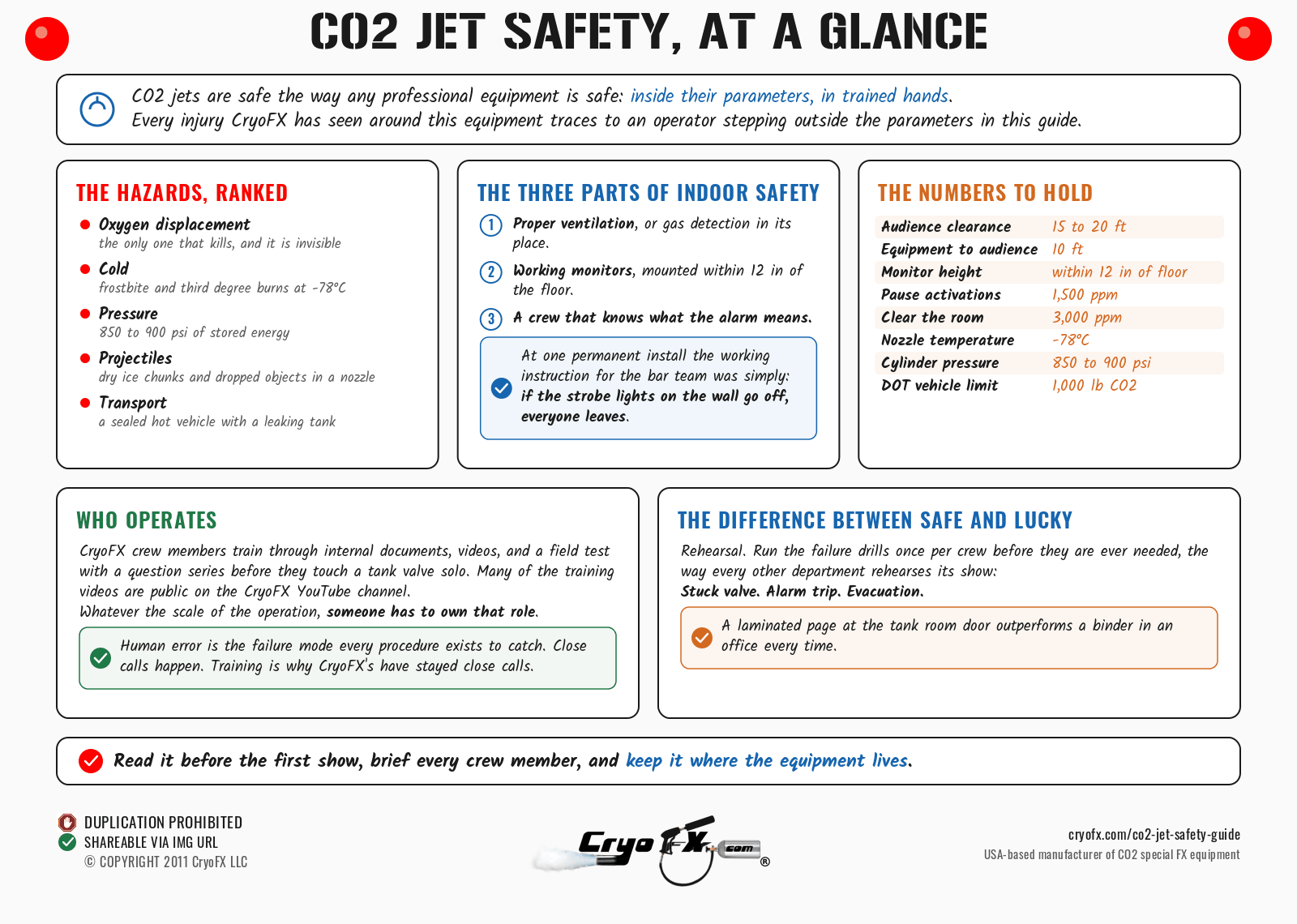
CO2 jets are safe the way any professional equipment is safe: inside their parameters, in trained hands. CryoFX equipment has been reviewed and approved by more fire agencies than any competitor we know of, and every injury we have ever seen around this equipment traces to an operator stepping outside the parameters this guide lays out.
Read it before the first show, brief every crew member on it, and keep it where the equipment lives. It's written for installers, venue operators, production teams, mobile DJs, and event professionals running stationary jets; handheld units share most of it, with the handheld-specific rules living on the cannon side of the site.
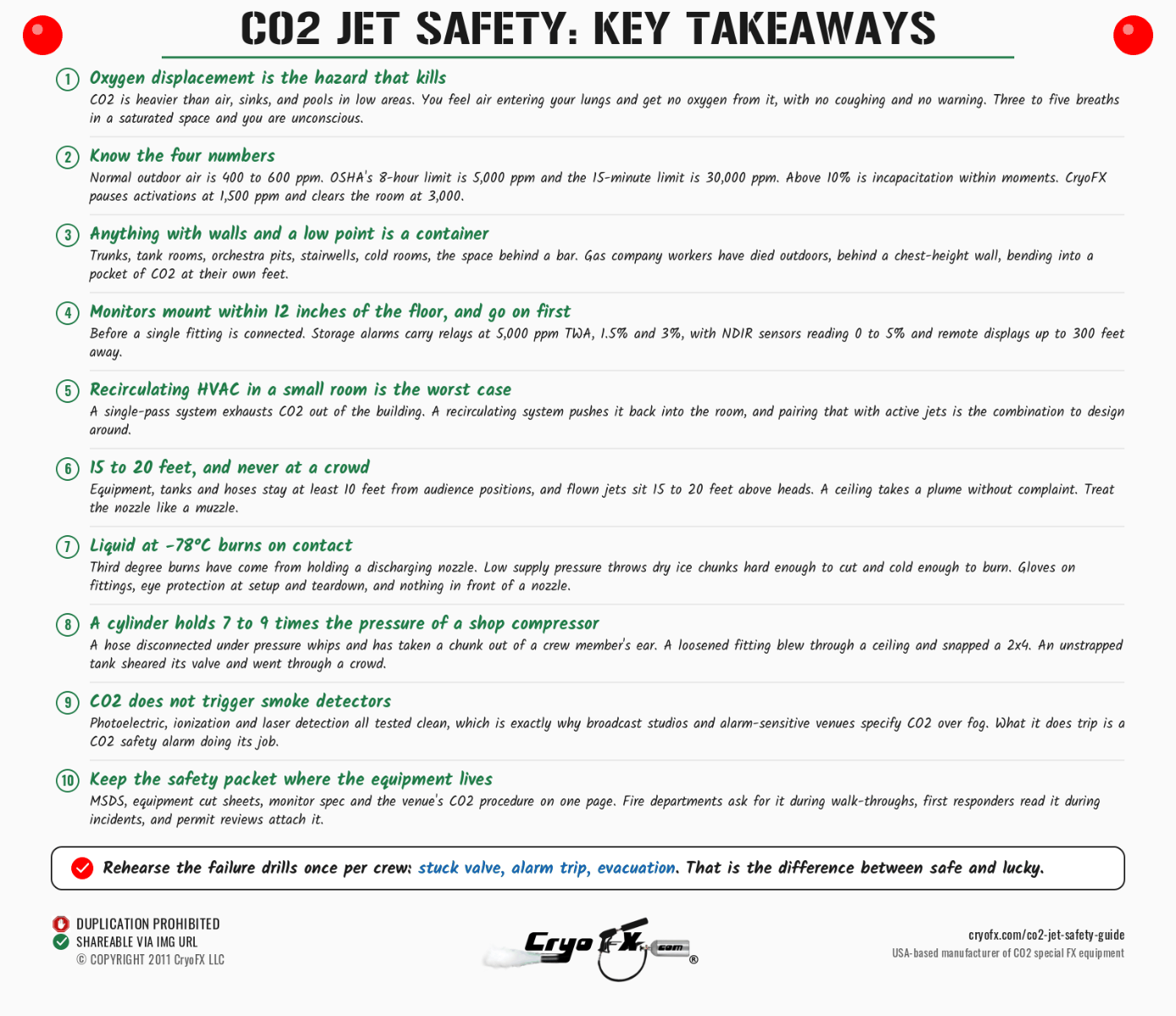
The hazard that kills: CO2 displaces oxygen
Everything else in this guide can injure. This one is fatal, and it's invisible.
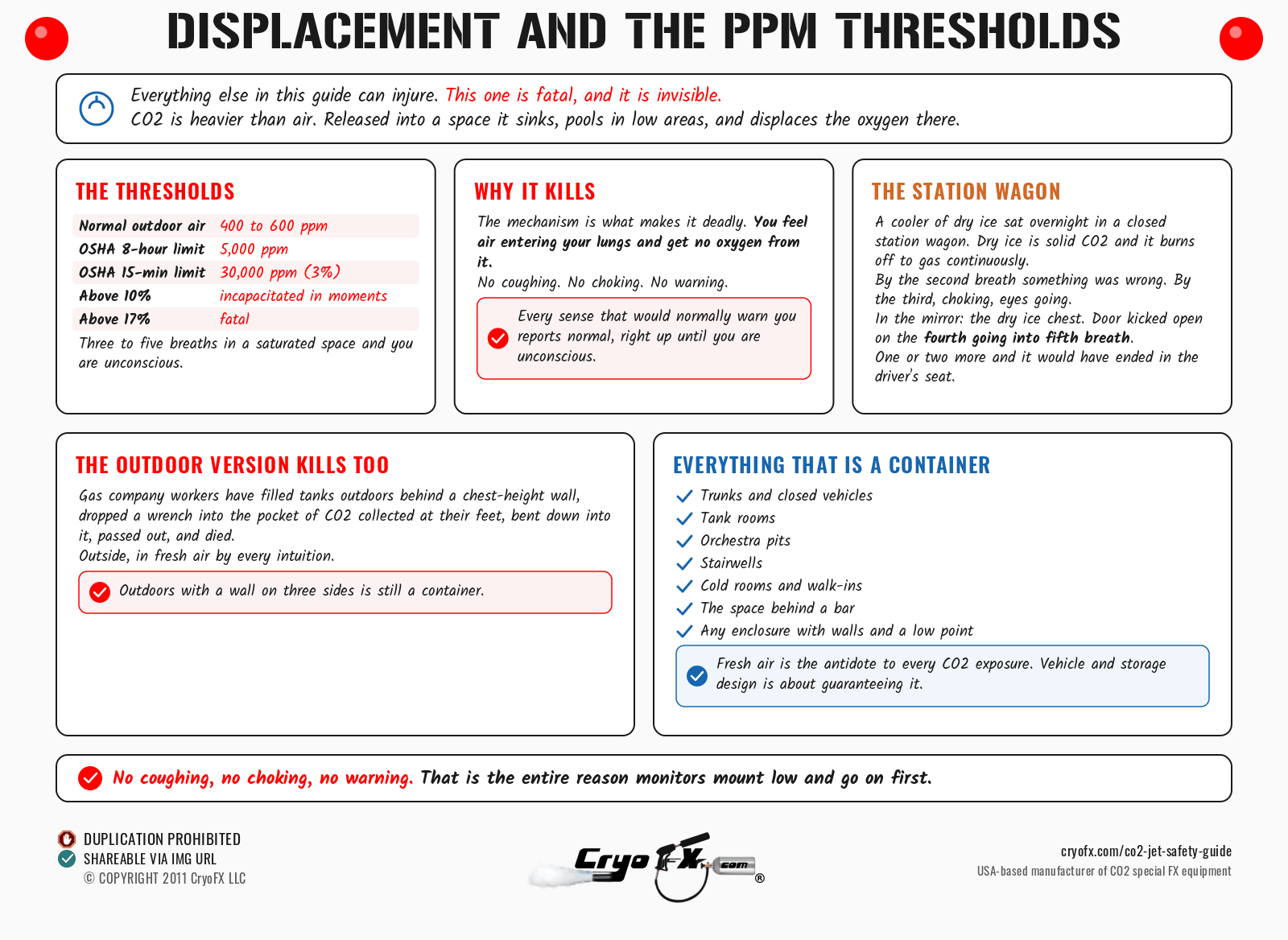
Carbon dioxide gas is heavier than air. Released into a space, it sinks, pools in low areas, and displaces the oxygen there. Normal outdoor air carries 400 to 600 ppm of CO2. OSHA's 8-hour workplace limit is 5,000 ppm, the 15-minute short-term limit is 30,000 ppm (3%), and at high concentrations above 10% a person is incapacitated in moments. The mechanism is what makes it deadly: you feel air entering your lungs and get no oxygen from it. No coughing, no choking, no warning. Three to five breaths in a saturated space and you're unconscious.
Kris Mullins, CryoFX's founder, survived exactly this. A cooler of dry ice (the solid form of carbon dioxide, which continuously burns off to CO2 gas) sat overnight in his closed station wagon. He got in, closed the door, started the car. By the second breath something was wrong; by the third he was choking and his eyes were going; in the mirror he saw the dry ice chest, understood, and kicked the door open on what he counts as his fourth going into fifth breath. One or two more and he would have died in the driver's seat. He tells that story in every training class, because two more breaths would have ended it differently.
The outdoor version kills too. Gas company workers have filled tanks outdoors behind a chest-height wall, dropped a wrench into the pocket of CO2 collected at their feet, bent down into it, passed out, and died, outside, in fresh air by every intuition. Any enclosure with walls and a low point collects CO2: trunks, tank rooms, orchestra pits, stairwells, cold rooms, the space behind a bar. Treat every one of them as a container.
Monitoring and ventilation, by the numbers
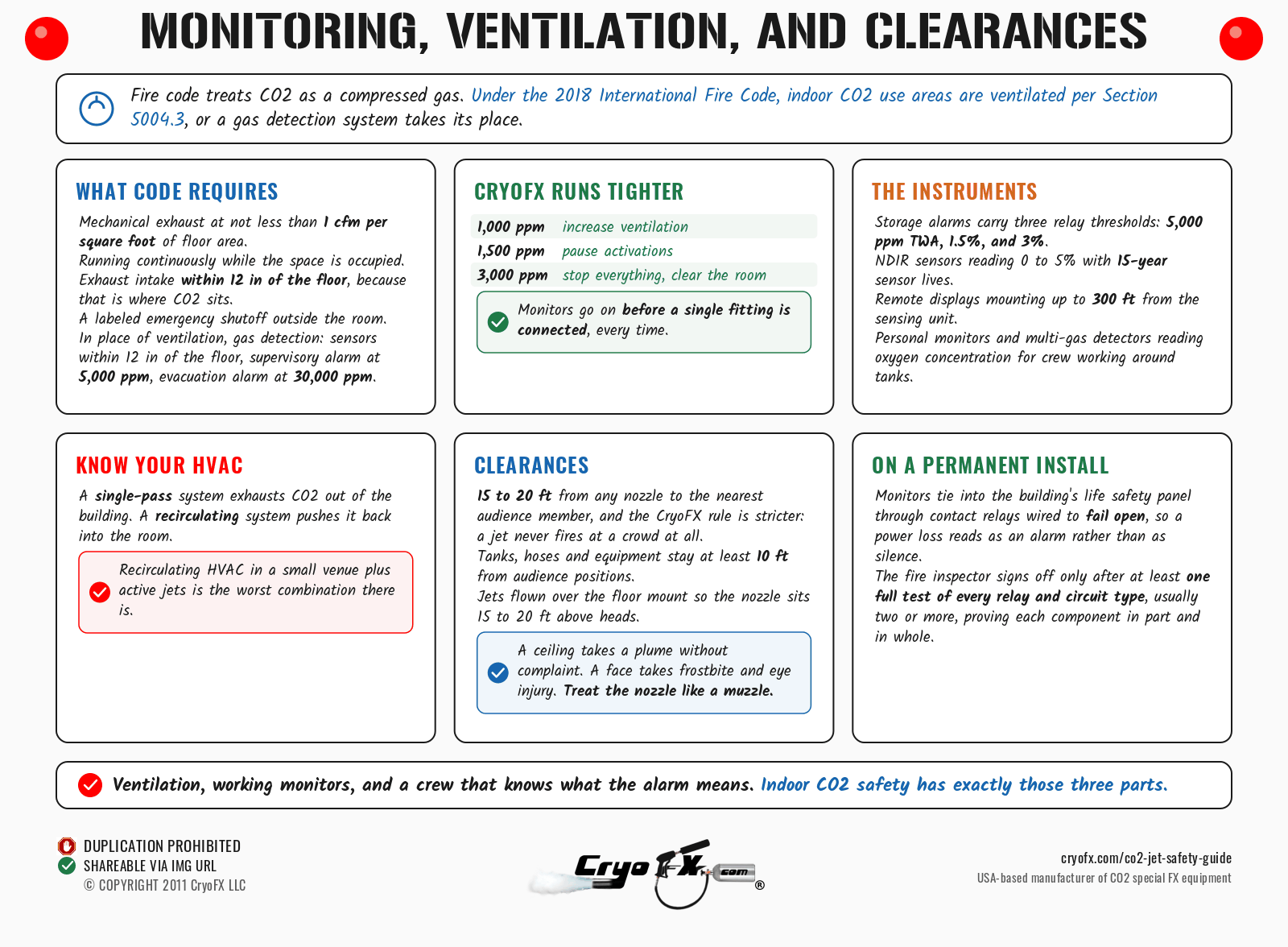
Fire code treats CO2 as a compressed gas. Under the 2018 International Fire Code, indoor CO2 use areas are ventilated per Section 5004.3: mechanical exhaust at not less than 1 cfm per square foot of floor area, running continuously while the space is occupied, with the exhaust intake within 12 inches of the floor because that's where CO2 sits, and a labeled emergency shutoff outside the room. In place of mechanical ventilation, code accepts a gas detection system: sensors within 12 inches of the floor, a supervisory alarm at 5,000 ppm, and an evacuation alarm in the room at 30,000 ppm.
CryoFX's own operating thresholds run tighter than code. At 1,000 ppm, increase ventilation. At 1,500 ppm, pause CO2 activations and hold until levels drop. At 3,000 ppm, stop every effect and clear the room. A CO2 safety monitor is the instrument that makes those numbers real: our storage alarms carry three relay thresholds (5,000 ppm TWA, 1.5%, and 3%), NDIR sensors reading 0 to 5% with 15-year sensor lives, and remote displays that mount up to 300 feet from the sensing unit; personal monitors and multi-gas detectors that read oxygen concentration cover crew working around tanks. Monitors go on before a single fitting is connected, every time.
Two more rules the numbers imply. Know your HVAC: a single-pass system exhausts CO2 out of the building, and a recirculating system pushes it back into the room, which makes recirculating HVAC in a small venue plus active jets the worst combination there is. And brief the staff in plain language; at one permanent install the working instruction for the bar team was simply "if the strobe lights on the wall go off, everyone leaves." Proper ventilation, working monitors, and a crew that knows what the alarm means. Indoor CO2 safety has exactly those three parts.
On a permanent installation the monitors tie into the building's life safety panel through contact relays wired to fail open, so a power loss reads as an alarm rather than as silence. The fire inspector signs off on that tie-in only after at least one full test of every relay and circuit type, and usually two or more, proving each component and each section of the system in part and in whole.
Clearances
Fifteen to 20 feet from any jet nozzle to the nearest audience member, and CryoFX's own rule is stricter: a jet never fires at a crowd at all. Tanks, hoses, and equipment stay at least 10 feet from audience positions. Jets flown over the floor mount so the nozzle sits 15 to 20 feet above heads. A ceiling takes a plume without complaint. A face takes frostbite and eye injury, so the jet gun logic applies to every stationary unit: treat the nozzle like a muzzle.
Cold: frostbite and dry ice
Liquid CO2 leaves the nozzle at about -78°C (-109°F). Direct contact causes frostbite and burns; we've seen third-degree burns on a hand that held a discharging nozzle too long. The plume's temperature climbs with distance (roughly -30 to -40°C at 5 feet, near ambient by 20), which is what the clearance distances encode. Low supply pressure or rapid phase change can throw chunks of dry ice, solid carbon dioxide, hard enough to cut and cold enough to burn, and those chunks discolor spray tans on contact, a complaint we have actually fielded at Las Vegas pools.
Rapid expansion of the liquid is the whole effect; respect what it does to skin. Gloves for anyone handling fittings, eye protection during setup and teardown, and no one's limbs or face in front of a nozzle, ever. If a jet freezes up mid-show (a valve stuck open from back-to-back cycling), shut the tank, kill power to the valve, and let it thaw; forcing it is how hands get burned.
Pressure: the hazard people laugh at until it isn't funny
A CO2 cylinder sits at 850 to 900 psi, 7 to 9 times a shop air compressor. The stored energy stories all end the same way. A hose disconnected under pressure whips; one took a chunk out of a crew member's ear on tour. A fitting loosened on a pressurized line blew through a ceiling and snapped a 2x4, and the crew laughed; a 2x4 is a skull. An unstrapped tank pulled over by its own hose sheared its valve and went through a crowd, and a person reportedly lost a leg. A 50 lb steel tank with the valve knocked off went through a house and 100 feet into the air on video.
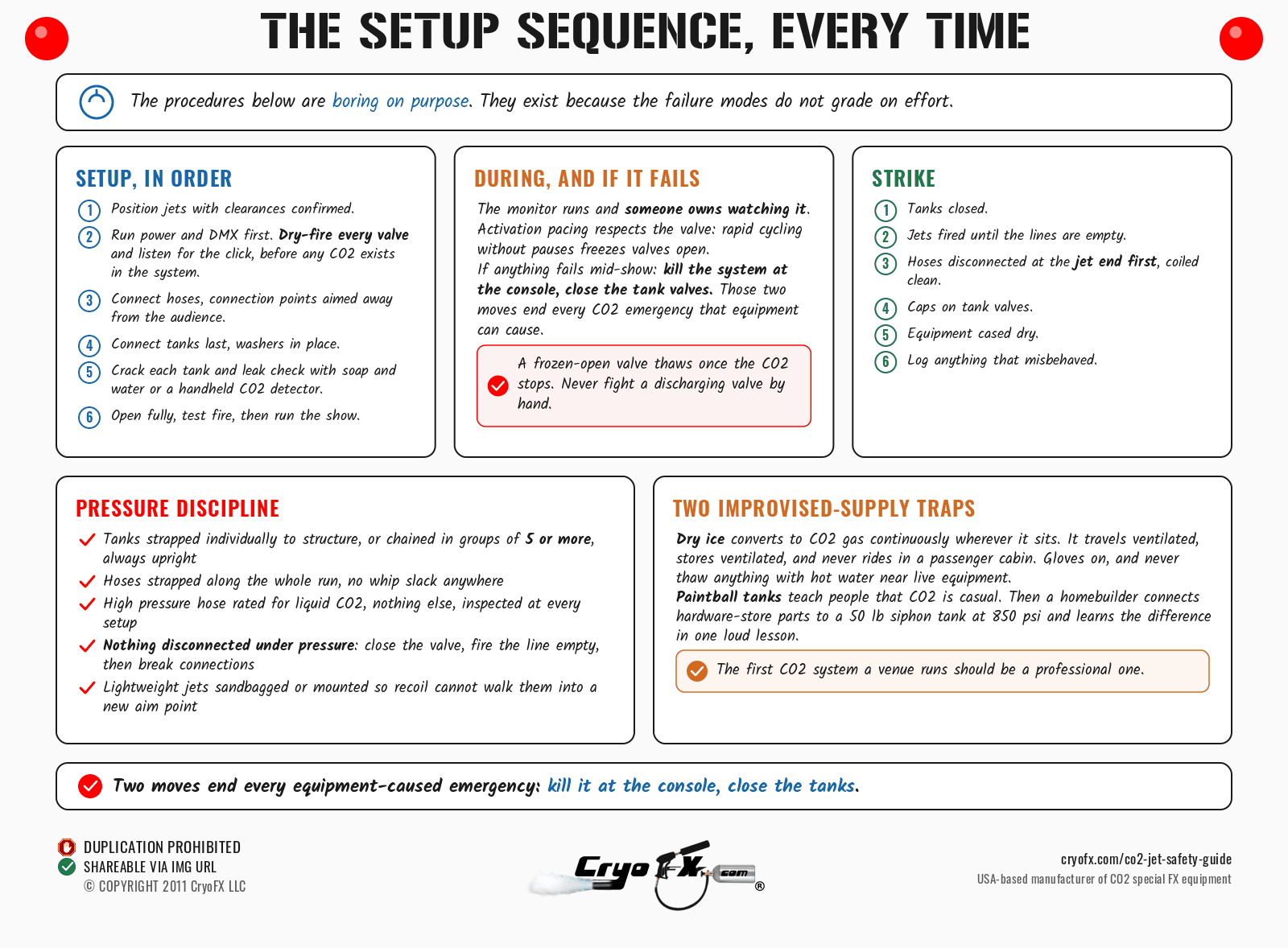
Non-rated hose fails as bubbles that pop as loud as a 12-gauge shotgun beside your head. So: tanks strapped individually to structure or chained in groups of 5 or more, always upright. Hoses strapped along their whole run, no whip slack anywhere. High-pressure hose rated for liquid CO2, nothing else, inspected at every setup. Nothing, ever, disconnected under pressure: close the tank valve, fire the jet until the line is empty, then break connections. Lightweight jets get sandbagged or mounted so recoil can't walk them into a new aim point mid-show, because a cheap jet that blows itself over is suddenly firing somewhere no one planned.
Transport and storage
Tanks ride upright and secured, windows cracked, never in a closed trunk, never in a hot sealed vehicle; aluminum tanks in a hot car can explode and take the car with them. DOT caps transport at 1,000 lb of CO2 per vehicle. Storage in shade is fine even in Las Vegas heat (relief valves open at 2,300 to 2,800 psi, far above what a shaded tank reaches), and storage indoors follows the monitoring and ventilation rules above. Fresh air is the antidote to every CO2 exposure; vehicle and storage design is about guaranteeing it.
The procedures
Setup, in order. Position jets with clearances confirmed. Run power and DMX first and dry-fire every valve, listening for the click, before any CO2 exists in the system. Connect hoses, connection points aimed away from the audience. Connect tanks last, washers in place. Crack each tank and leak-check with soap and water or a handheld CO2 leak detector. Open fully, test fire, then run the show.
During the show. The monitor runs, someone owns watching it, and activation pacing respects the valve: rapid cycling without pauses freezes valves open. Best practices here are boring on purpose.
If anything fails mid-show. Kill the system at the console, close the tank valves. Those two moves end every CO2 emergency that equipment can cause; what they can't fix, the evacuation thresholds above already covered.
Strike. Tanks closed. Jets fired until lines are empty. Hoses disconnected at the jet end first, coiled clean, caps on tank valves, equipment cased dry. Log anything that misbehaved.
Who operates. CryoFX crew members train through internal documents, videos, and a field test with a question series before they touch a tank valve solo, and many of the training videos are public on the CryoFX YouTube channel. Whatever your operation's scale, someone has to own that role, and human error is the failure mode every procedure above exists to catch. Close calls happen; training is why ours have stayed close calls.
Fire alarms, and what CO2 doesn't do
CO2 does not trigger smoke detectors. CryoFX has tested photoelectric, ionization, and laser detection directly, and the plume trips none of them, which is exactly why broadcast studios and alarm-sensitive venues specify CO2 over fog. What CO2 does trip is a CO2 safety alarm doing its job, and the fire department may require exactly that protection. Keep the safety data sheets (the CO2 MSDS) with your equipment documentation; every permit package includes them and first responders expect them.
[CALCULATOR BLOCK: CO2 ROOM SAFETY CONCENTRATION ESTIMATOR HERE, so operators can enter room volume and CO2 released and see the resulting ppm]
The full operating context, from tanks to installation to permits, lives in the CO2 jet safety and operations guide on the pillar, and the complete chemical reference is the CO2 material safety data sheet. Equipment with the ratings this guide assumes, monitors included, is on the CryoFX catalogue under CO2 jets for sale.
Dry ice, paintball tanks, and the improvised supply problem
Two adjacent hazards deserve their own paragraphs. Dry ice is solid carbon dioxide, and it converts to CO2 gas continuously wherever it sits: a cooler of it in a closed vehicle or a walk-in is the founder's station wagon story waiting to repeat, so dry ice travels ventilated, stores ventilated, and never rides in a passenger cabin. Handle it with gloves (it burns skin on contact), and thaw nothing frozen with hot water near live equipment; warm air and patience are the tools.
Improvised supply is the other pattern we intercept. Paintball guns and their small CO2 cylinders teach people that CO2 is casual, and then a homebuilder connects hardware-store parts to a 50 lb siphon tank at 850 psi and learns the difference in one loud lesson. Show supply is rated equipment end to end: siphon tanks, high-pressure hose built for liquid CO2, rated valves, and fittings that match. The first CO2 system a venue runs should be a professional one, because the failure modes above don't grade on effort.
Documentation and first responders
Keep a safety packet with the equipment: the MSDS sheet, the equipment cut sheets, the monitor spec, and the venue's CO2 procedure on one page. Fire departments ask for exactly this during walk-throughs, first responders read it during incidents, and permit reviews attach it. Alarm systems tied to the monitors close the loop: when the threshold trips, the room hears it, the panel logs it, and in permitted venues the fire department expects the record to exist. Safety guidelines only work when the people in the building can find them, and a laminated page at the tank room door outperforms a binder in an office every time.
The real difference between a safe operation and a lucky one is rehearsal: run the failure drills (stuck valve, alarm trip, evacuation) once per crew, before they're ever needed, the way every other department rehearses its show.
Frequently asked questions
Are CO2 jets safe? Yes, operated inside their parameters: rated equipment, siphon tanks, clearances, monitoring indoors, and trained hands. Every injury we've seen traces to an operator outside those parameters, never to compliant equipment running as designed.
Are CO2 jets safe indoors? Yes, with ventilation or gas detection per IFC Sections 5307 and 5004.3, CO2 monitors mounted within 12 inches of the floor, and activation pacing matched to the room. CO2 doesn't trigger smoke detectors, so indoor use is routine in clubs, arenas, and studios.
Can CO2 jets cause frostbite? Yes. The liquid leaves the nozzle at -78°C and direct contact burns skin; we've seen third-degree burns from a held nozzle. Clearances, gloves, and never putting a body part in the plume are the controls.
How far should a CO2 jet be from the audience? 15 to 20 feet from nozzle to the nearest person, with equipment, tanks, and hoses at least 10 feet from audience positions. CryoFX's own rule: never fire at a crowd at all.
What ventilation do CO2 jets need? Per the 2018 IFC: mechanical exhaust at 1 cfm per square foot with the intake within 12 inches of the floor, or a gas detection system alarming at 5,000 and 30,000 ppm. CryoFX pauses effects at 1,500 ppm and evacuates at 3,000.
What CO2 level is dangerous? OSHA's limits are 5,000 ppm over 8 hours and 30,000 ppm over 15 minutes. Above 10% concentration a person is incapacitated within breaths, without coughing or warning, because the lungs fill with air that carries no oxygen.
Do CO2 jets set off fire alarms? No. CryoFX's detector testing, covered above, found no trigger on any common sensor type. CO2 safety monitors are the sensor CO2 does trip, by design.
Can I transport CO2 tanks in my car? Upright, strapped, windows open, never in a closed trunk or hot sealed vehicle, never more than 1,000 lb of CO2 per DOT rules. A leaking tank in a sealed car is fatal within a few breaths.
What do I do if a CO2 jet sticks open during a show? Kill the system at the console and close the tank valves, in that order if you can reach both. A frozen-open valve thaws once the CO2 stops; never fight a discharging valve by hand.
___
CryoFX® is the leading manufacturer, designer, and global supplier of CO2 special effects equipment and custom special effects systems
for Theme Parks, Sporting Arenas, Mega Nightclubs & Day Clubs , TV/FILM & large scale events & installs in any industry requiring Co2 Systems.
CryoFX LLC Global Headquarters • 3859 S Valley View Blvd, Suite 2, Las Vegas, NV 89103 • 1.855.527.9639
Updated - 09/06/2026.