
CO2 Jet Vs Cold Sparks: Which Special Effect Is Right For Your Event
CO2 Jet vs Cold Sparks: Side-by-Side Effect Comparison | CryoFX
CO2 Jet Vs Cold Sparks: Which Special Effect Is Right For Your Event
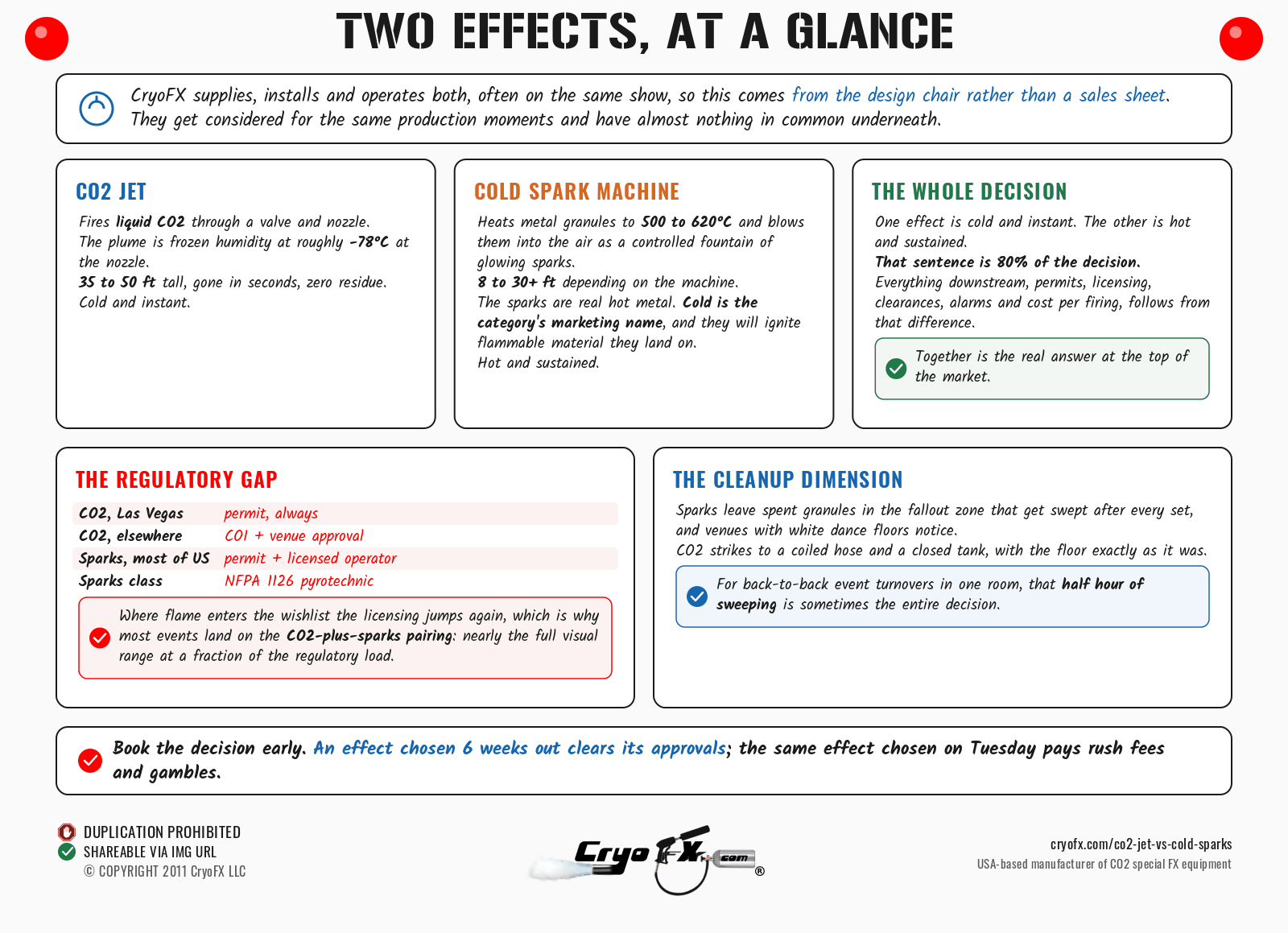
CryoFX supplies, installs, and operates both effects, often on the same show, so this comparison comes from the design chair rather than a sales sheet. The two devices get considered for the same production moments and have almost nothing in common underneath: one fires cold gas, the other throws glowing metal, and everything that matters downstream (permits, licensing, clearances, alarms, cost per firing) follows from that difference.
What each one actually is
A CO2 jet fires liquid CO2 through a valve and nozzle. The plume is frozen humidity at roughly -78°C at the nozzle, 35 to 50 ft tall, gone in seconds, zero residue. A cold spark machine heats metal granules to 500 to 620°C and blows them into the air as a controlled fountain of glowing sparks, 8 to 30+ ft depending on the machine. The sparks are real hot metal, "cold" is the category's marketing name, and cold sparks will ignite flammable material they land on. One effect is cold and instant, the other is hot and sustained, and that sentence is 80% of the decision.
Head to head
| CO2 jet | Cold spark machine | |
|---|---|---|
| Output | White CO2 plume, 35 to 50 ft | Gold spark fountain, 8 to 30+ ft |
| Temperature | -78°C at the nozzle | 500 to 620°C chamber; hot metal particles |
| Duration | Seconds per blast, instant dissipation | Sustained fountains, typically 30-second cycles |
| Permit | Las Vegas: always. Most other markets: COI and venue approval | Permit plus licensed operator in most jurisdictions nationwide (NFPA 1126 pyrotechnic device) |
| Clearance | 15 to 20 ft to audience, never fired at a crowd | 15 ft from everything, plus 20 to 25 ft of ceiling |
| Smoke alarms | Does not trigger (CryoFX tested photoelectric, ionization, laser) | Can trigger detectors |
| Residue | None | Spent granules; fallout zone needs a non-combustible surface |
| Extinguisher | Not applicable to the effect itself | Class D (metal fire); never water or ABC |
| Consumable | CO2 tanks, $65 to $85 for 70 to 90 seconds of output | Granules, ~$65 per pack for ~12 minutes of effect |
| Cost per minute of effect | Roughly $65 to $85 per minute | Roughly $5 to $6 per minute |
| Cost per typical cue | A 3-second blast: about $3.50 to $4.25 | A 20-second fountain: about $1.80 |
| Indoors | Yes, with monitoring and ventilation | Yes, with clearances, permit, Class D coverage |
| Outdoor wind | Plume shreds in strong wind | Sparks drift; wind widens the fallout zone |
| On camera | Bright white burst, reads instantly, vanishes clean | Golden sparkle, reads warm, sustained |
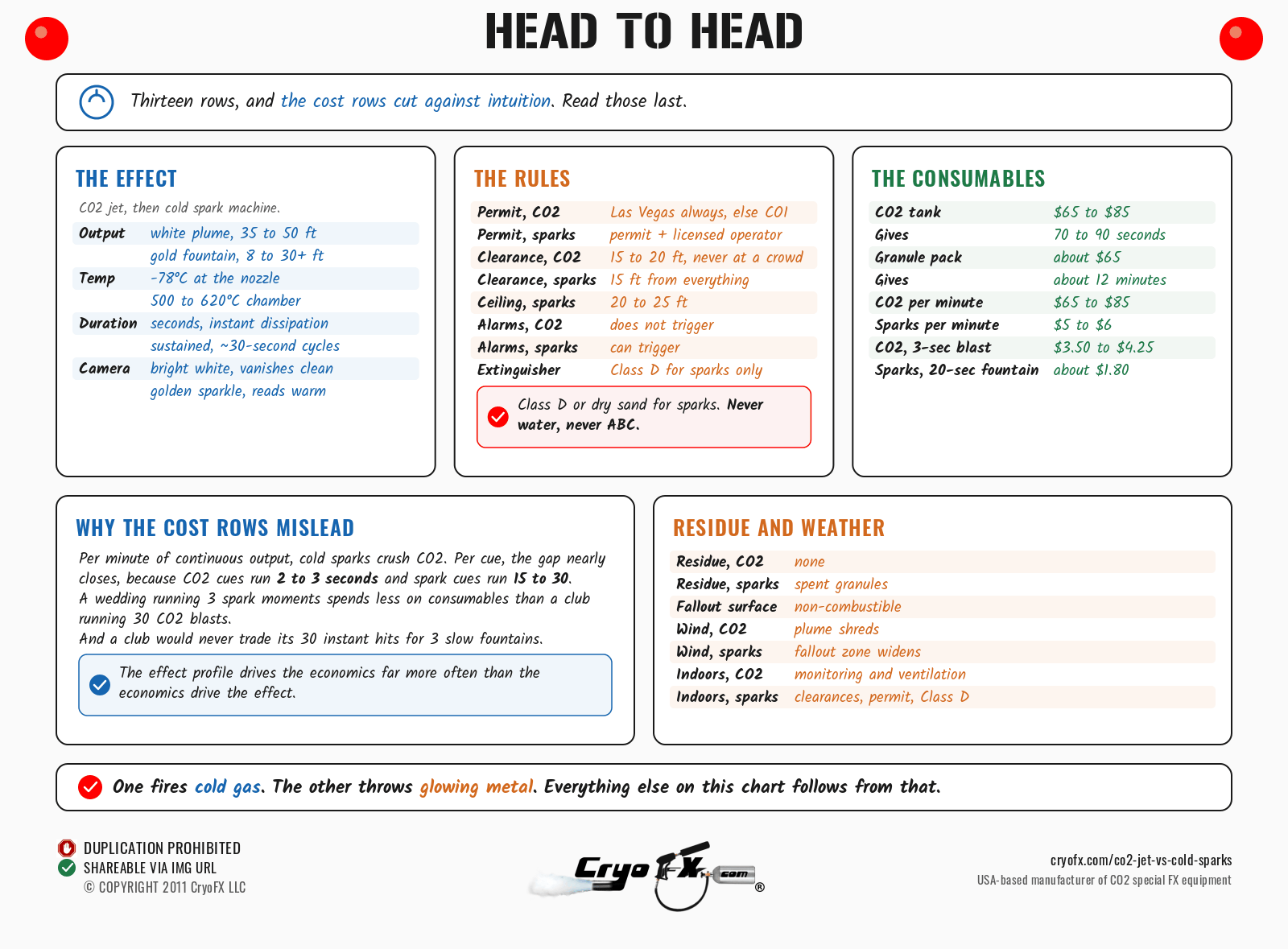
The cost rows deserve a second look because they cut against intuition. Per minute of continuous output, cold sparks crush CO2: a $65 granule pack runs about 12 minutes where $70 of CO2 runs 70 to 90 seconds.
Per cue, the gap nearly closes, because CO2 cues are 2 to 3 seconds and spark cues run 15 to 30. A wedding running 3 spark moments spends less on consumables than a club running 30 CO2 blasts, and a club would never trade its 30 instant hits for 3 slow fountains. The effect profile drives the economics far more often than the economics drive the effect.
Where each one wins
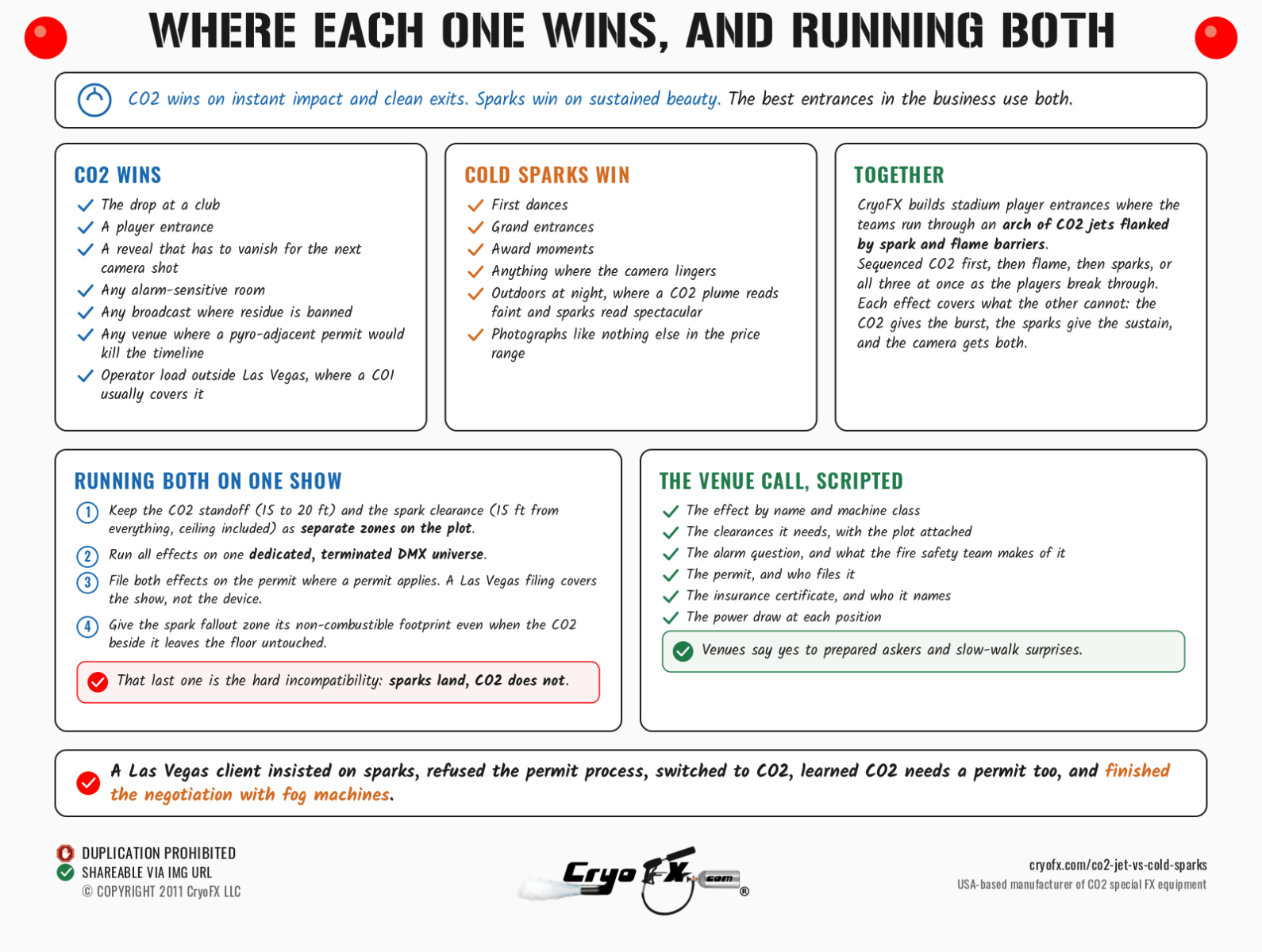
CO2 wins on instant impact and clean exits: the drop at a club, a player entrance, a reveal that has to vanish for the next camera shot, any alarm-sensitive room, any broadcast where residue is banned, and any venue where a pyro-adjacent permit would kill the timeline. It also wins on operator load outside Las Vegas, where a COI usually covers it.
Cold sparks win on sustained beauty: first dances, grand entrances, award moments, anything where the camera lingers. The fountain holds for the whole moment, reads gold and warm, and photographs like nothing else in the price range. They also win outdoors at night, where a CO2 plume reads faint and sparks read spectacular.
Together is the real answer at the top of the market. CryoFX builds stadium player entrances where the teams run through an arch of CO2 jets flanked by spark and flame barriers, sequenced CO2 first, then flame, then sparks, or all three at once as the players break through. Each effect covers what the other can't: the CO2 gives the burst, the sparks give the sustain, and the camera gets both.
Running both on one show
Keep the CO2 standoff (15 to 20 ft) and the spark clearance (15 ft from everything, ceiling included) as separate zones on the plot. Run all effects on one dedicated, terminated DMX universe. File both effects on the permit where a permit applies, because a Las Vegas filing covers the show, not the device. And know the one hard incompatibility: sparks land, CO2 doesn't, so the spark fallout zone needs its non-combustible footprint even when the CO2 beside it leaves the floor untouched.
One more data point from the field: a Las Vegas client once insisted on cold sparks, refused the county permit process, switched the request to CO2, learned CO2 needs a Clark County permit too, and finished the negotiation with fog machines. The permit stack is part of the effect choice, and pretending otherwise just reroutes the conversation the long way.
For the full CO2 side, mechanism through permits, see the complete CO2 jet guide; the spark side has its own equally deep home in the complete cold spark machine guide. Equipment for either effect, or both, is on the CryoFX catalogue under CO2 jets for sale.
The venue conversation, scripted
Booking either effect goes smoother when the venue call covers six points in one pass: the effect by name and machine class, the clearances it needs with the plot attached, the alarm question (CO2 doesn't trip smoke detection, sparks can, and the venue's fire safety team decides what that means in their building), the permit and who files it, the insurance certificate and who it names, and the power draw at each position.
Venues say yes to prepared askers and slow-walk surprises, and a wedding planner or DJ who arrives with that list reads as a professional rather than a risk. Where flame effects enter the wishlist as a third option, the licensing jumps again (licensed flame operators, fire-treated surroundings, and a different NFPA chapter), which is why most events land on the CO2-plus-sparks pairing: nearly the full visual range, a fraction of the regulatory load.
One more comparison dimension that decides indoor bookings: cleanup. Sparks leave spent granules in the fallout zone that get swept after every set, and venues with white dance floors notice. CO2 strikes to a coiled hose and a closed tank, with the floor exactly as it was, and for back-to-back event turnovers in one room, that half hour of sweeping is sometimes the entire decision.
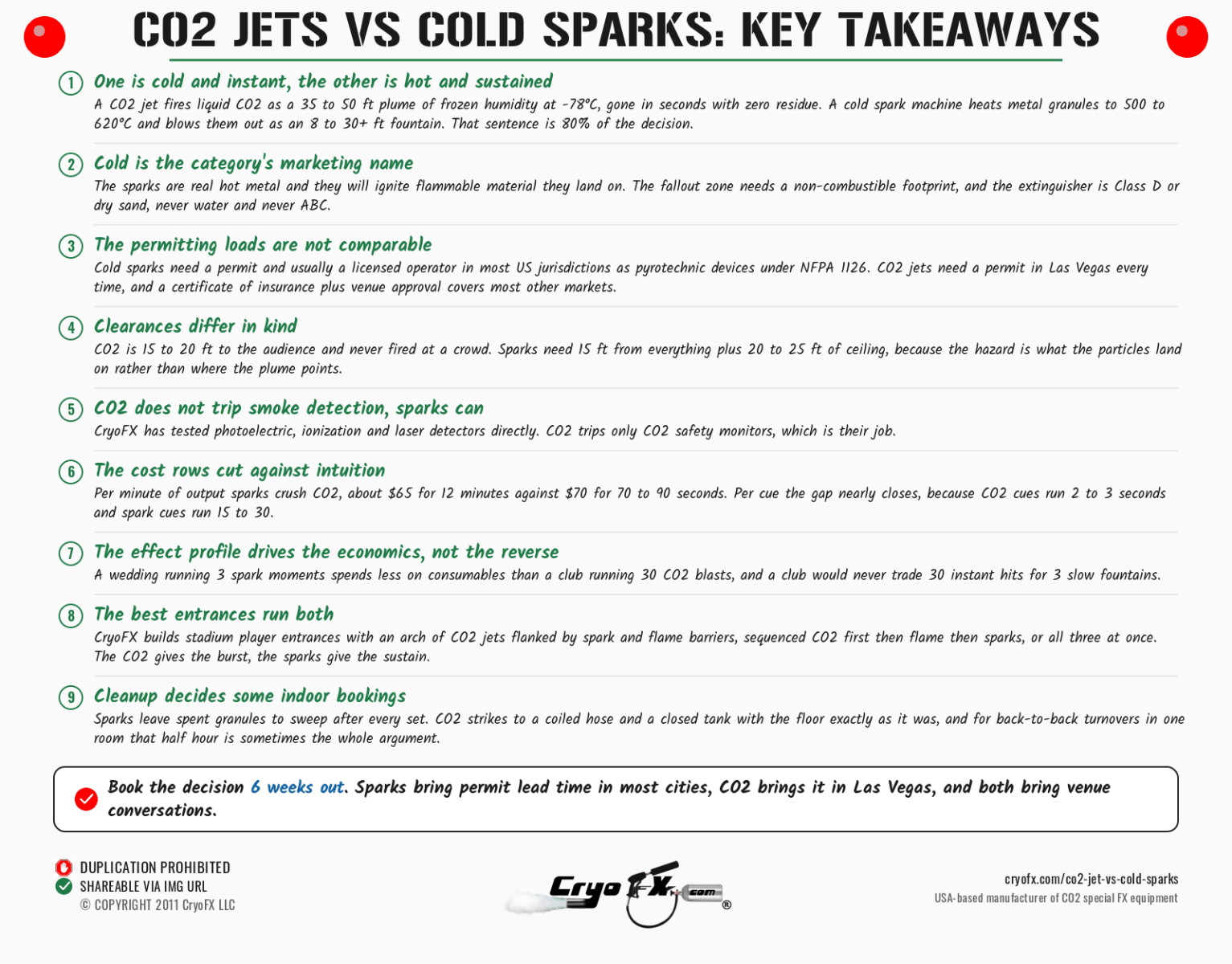
Whichever way a given event lands, book the decision early: sparks bring permit lead time in most cities, CO2 brings it in Las Vegas, and both bring venue conversations that go better with weeks than with days. An effect chosen 6 weeks out costs less and clears its approvals; the same effect chosen on Tuesday pays rush fees and gambles.
Frequently asked questions
What's the difference between a CO2 jet and cold sparks? A CO2 jet fires a cold white plume of liquid CO2 that vanishes in seconds and leaves nothing. A cold spark machine blows heated metal granules into a sustained golden fountain, with fallout, a hotter hazard profile, and pyrotechnic-class permitting.
Which needs a permit? Cold sparks need a permit and usually a licensed operator in most US jurisdictions, as pyrotechnic devices under NFPA 1126. CO2 jets need a permit in Las Vegas every time, and a COI plus venue approval covers most other markets.
Are cold sparks hot? Yes. The chamber runs 500 to 620°C and the particles are glowing metal that can burn skin and ignite flammables. "Cold" is the category's marketing name.
Can CO2 jets and cold sparks be used together? Yes, and the best entrances use both: CO2 for the burst, sparks for the sustain, sequenced or simultaneous, with each effect's clearance zone respected on the plot.
Which is cheaper to run? Per minute of output, cold sparks by a wide margin (about $65 for 12 minutes vs $70 for 70 to 90 seconds of CO2). Per typical cue the gap nearly closes, because CO2 cues last seconds and spark cues last half a minute.
Which sets off smoke alarms? Cold sparks can. CO2 doesn't, per CryoFX's own detector testing across every common sensor type. CO2 trips only CO2 safety monitors, which is their job.
Which is better for a wedding? Sparks for the first dance and the sustained romantic look; CO2 where the venue's alarms, ceiling, or permit timeline rule sparks out. Plenty of weddings run sparks for the dance and CO2 for the party set.
___
CryoFX® is the leading manufacturer, designer, and global supplier of CO2 special effects equipment and custom special effects systems
for Theme Parks, Sporting Arenas, Mega Nightclubs & Day Clubs , TV/FILM & large scale events & installs in any industry requiring Co2 Systems.
CryoFX LLC Global Headquarters • 3859 S Valley View Blvd, Suite 2, Las Vegas, NV 89103 • 1.855.527.9639
Updated - 09/06/2026.