
CO2 Jet vs Fog Machine: Real CO2, Simulation Jets, and The Cost Math between Them
CO2 Jet vs Fog Machine: Simulation Jets, Cost Per Use & Alarms | CryoFX
CO2 Jet vs Fog Machine: Real CO2, Simulation Jets, and The Cost Math between Them
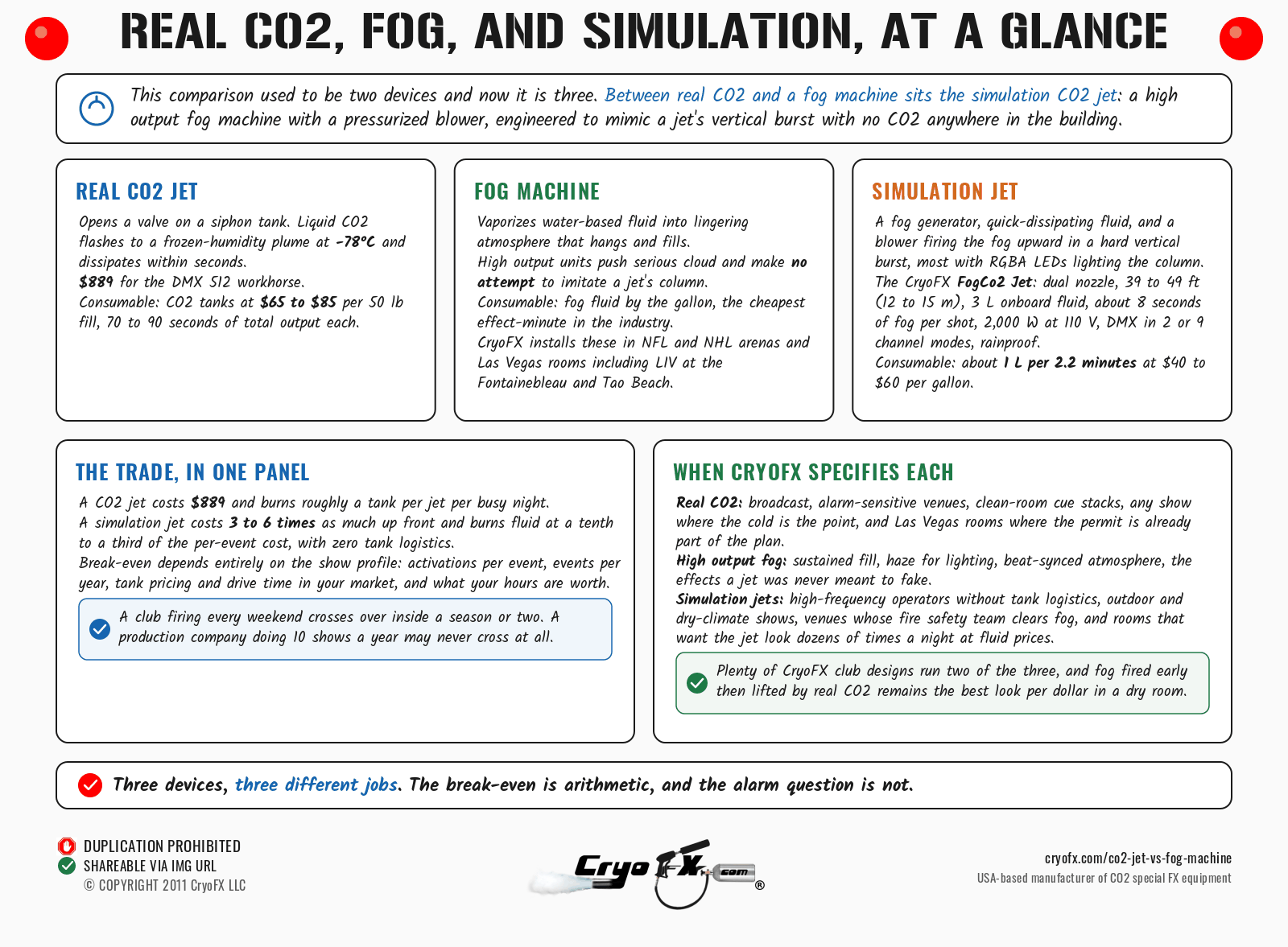
This comparison used to be two devices and now it's three. The CO2 jet fires liquid CO2: a cold white column, gone in seconds, nothing left behind. The fog machine heats fluid into atmosphere that hangs and fills. And between them sits the newest category, the simulation CO2 jet: a high-output fog machine with a pressurized blower and quick-dissipating fluid, engineered to mimic a CO2 jet's vertical burst without a tank of CO2 anywhere in the building. CryoFX manufactures the real thing, builds its own simulation unit, and installs high-output fog in NFL and NHL arenas and Las Vegas rooms including LIV at the Fontainebleau and Tao Beach, so the comparison below is how we spec them against each other, with the calculator that settles the money question at the bottom.
How each one works
A CO2 jet opens a valve on a siphon tank; liquid CO2 flashes to a frozen-humidity plume at -78°C and dissipates within seconds. Consumable: CO2 tanks, $65 to $85 per 50 lb fill, 70 to 90 seconds of total output each.
A conventional fog machine vaporizes water-based fluid into lingering atmosphere. High-output units (the class CryoFX installs where a room wants volume) push serious cloud but make no attempt to imitate a jet's column. Consumable: fog fluid by the gallon, the cheapest effect-minute in the industry.
A simulation CO2 jet combines a fog generator, quick-dissipating fluid, and a blower that fires the fog upward in a hard vertical burst, most with RGBA LEDs in the head to light the column. The CryoFX FogCo2 Jet is our build: dual nozzle, 39 to 49 ft (12 to 15 m) of throw, 3 L onboard fluid, roughly 8 seconds of fog per shot, 2,000 W at 110 V, DMX in 2 or 9 channel modes, rainproof. Consumable: about 1 L of fluid per 2.2 minutes of output, at $40 to $60 per gallon. No tanks, no gas logistics, no CO2 monitoring question.
The simulation jet market
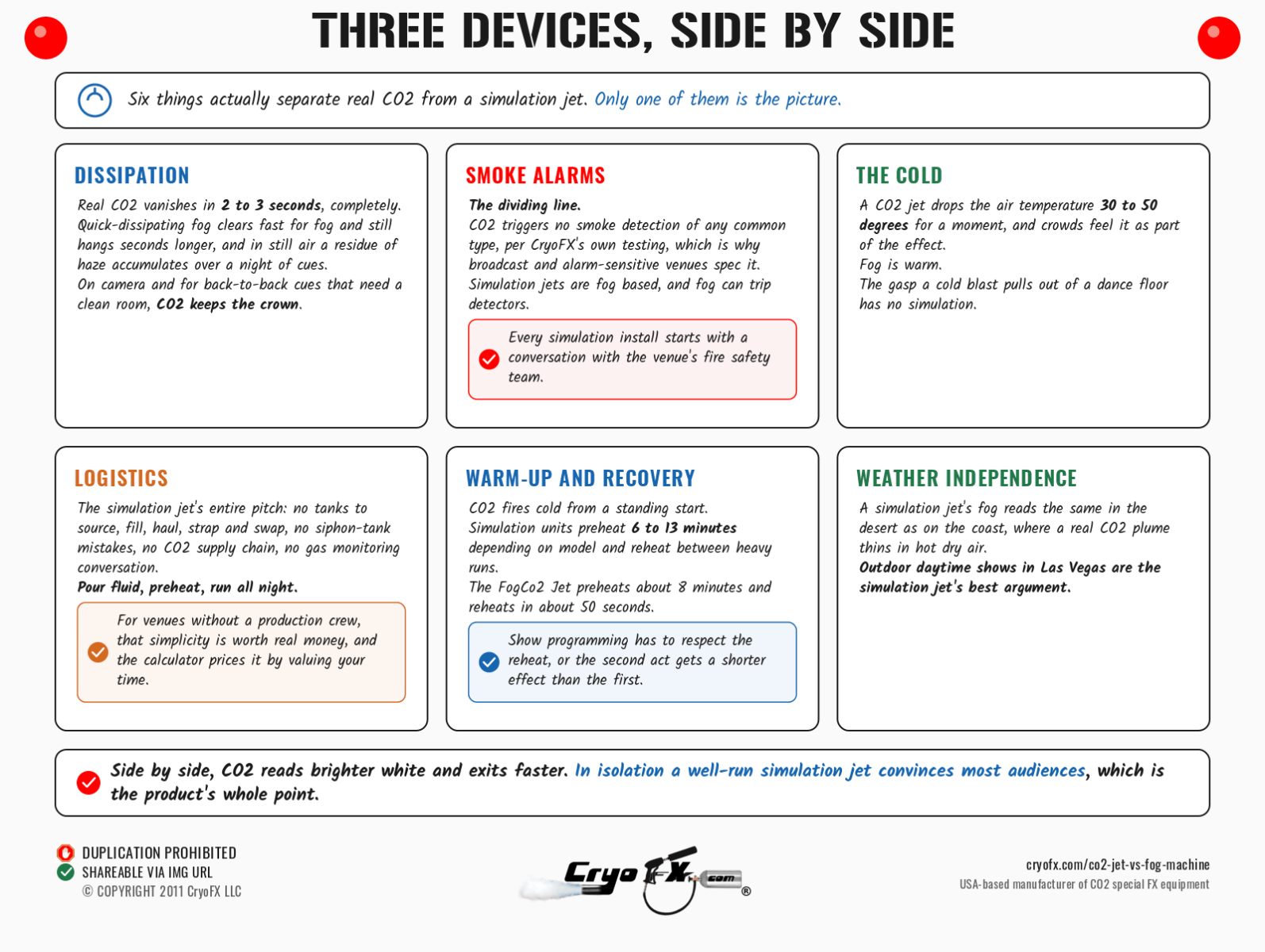
Five machines define the category right now, and naming them beats pretending they don't exist. The CryoFX FogCo2 Jet at $3,500 [EDITOR: CONFIRM FINAL PRICE, $3,500 WAS QUOTED EARLIER AND $3,500 IS THE CALCULATOR DEFAULT]. Froggy's Fog Hyperion TJ10 at about $3,800. Showven's Sonicboom ReCO2 at about $4,400. MagicFX's Eco2jet at about $4,900, a 220 V unit that needs a transformer in the US.
And Chauvet Professional's Vesuvio 4 IP at $5,200 street, still pre-order with specs the manufacturer marks preliminary, 208 V only. Fluid consumption clusters between 0.38 and 0.56 L per minute across the category, with one outlier: Chauvet publishes 22 ml/min, a figure 20 times lighter than every competitor, which we carry in the calculator as published, flagged, because quietly correcting a competitor's spec is worse than showing it with a warning. The calculator below has all five machines preset, and picking one auto-fills its price, fluid burn, power draw, and warm-up.
What actually separates real CO2 from simulation
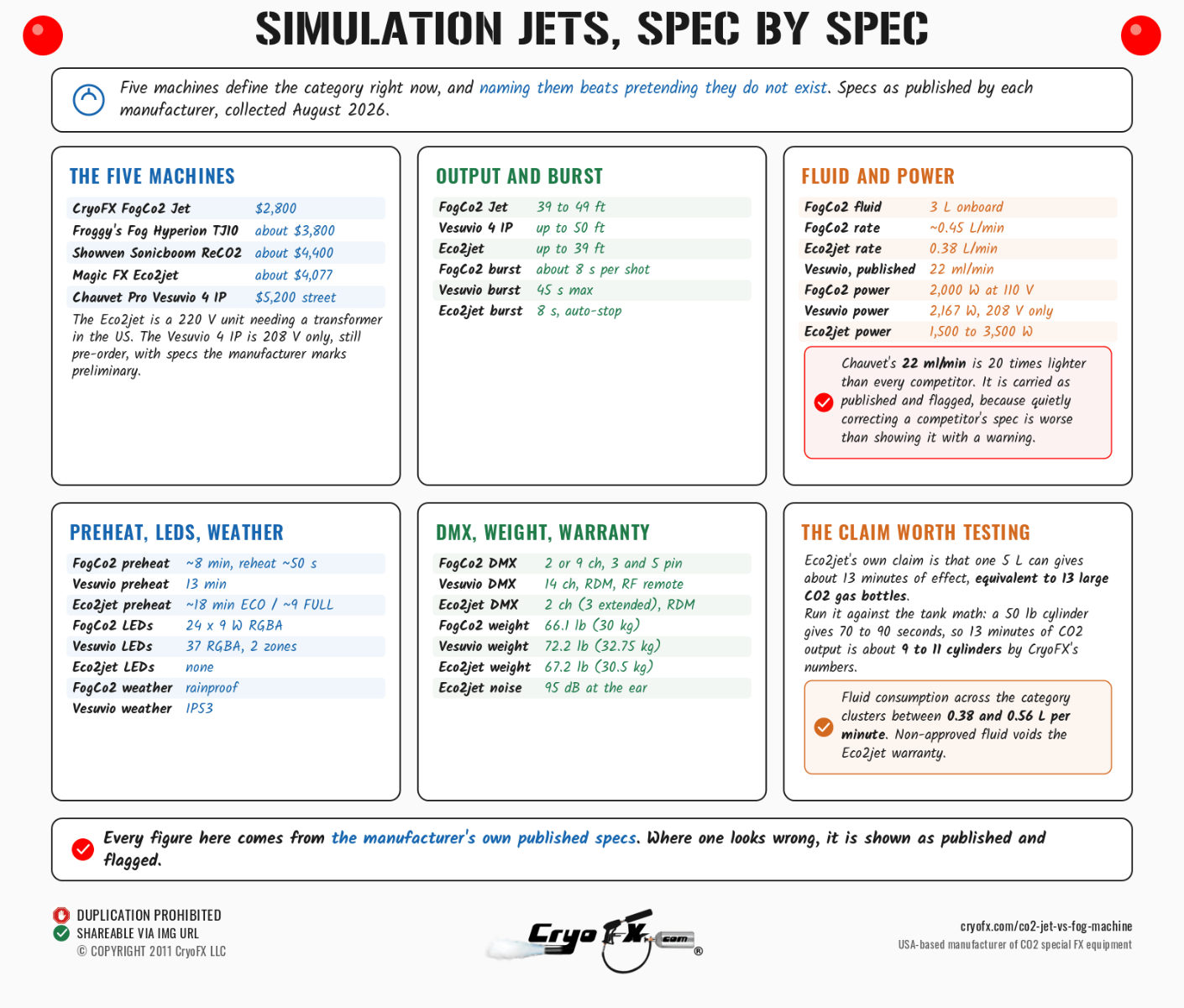
Dissipation. Real CO2 vanishes in 2 to 3 seconds, completely. Quick-dissipating fog clears fast for fog and still hangs seconds longer, and in still air a residue of haze accumulates over a night of cues. On camera and for back-to-back cues that need a clean room, CO2 keeps the crown.
Smoke alarms. The dividing line. CO2 triggers no smoke detection of any common type, per CryoFX's own testing, which is why broadcast and alarm-sensitive venues spec it. Simulation jets are fog-based, and fog can trip detectors; every simulation install starts with a conversation with the venue's fire safety team.
The cold. A CO2 jet drops the air temperature 30 to 50 degrees for a moment, and crowds feel it as part of the effect. Fog is warm, and the gasp a cold blast pulls out of a dance floor has no simulation.
Logistics. The simulation jet's entire pitch: no tanks to source, fill, haul, strap, and swap, no siphon-tank mistakes, no CO2 supply chain, no gas monitoring conversation. Pour fluid, preheat 8 minutes, run all night. For venues without a production crew, that simplicity is worth real money, and the calculator prices it honestly by valuing your time.
Warm-up and recovery. CO2 fires cold from a standing start. Simulation units preheat 6 to 13 minutes depending on model and reheat between heavy runs, which show programming has to respect.
Weather independence. A simulation jet's fog reads the same in the desert as on the coast, where a real CO2 plume thins in hot dry air. Outdoor daytime shows in Las Vegas are the simulation jet's best argument.
The money, and the calculator that settles it
The shape of the trade: a CO2 jet costs $889 and burns roughly a tank per jet per busy night; a simulation jet costs 3 to 6 times as much up front and burns fluid at a tenth to a third of the per-event cost, with zero tank logistics. Break-even depends entirely on your show profile: activations per event, events per year, tank pricing and drive time in your market, and what your hours are worth. A club firing every weekend crosses over inside a season or two; a production company doing 10 shows a year may never cross at all.
The calculator below runs the whole comparison: both machines' purchase prices (with the 5 simulation presets), your CO2 supply costs including drive and handling time at your hourly value, fluid and electricity on the simulation side, cost per activation for each, the cumulative cost curve, and the break-even in events and months. It also compares the CryoFX unit against whichever competitor you select, showing whether a costlier machine's cheaper operation ever repays its premium, and how long that takes.
[CALCULATOR BLOCK: CO2 JET VS SIMULATION JET COST PER BLAST AND BREAK-EVEN, simcalc3_co2_vs_simulation_jet_calculator_v3.html]
When CryoFX specifies each
Real CO2: broadcast, alarm-sensitive venues, clean-room cue stacks, any show where the cold is the point, and Las Vegas rooms where the permit is already part of the plan. High-output fog: sustained fill, haze for lighting, beat-synced atmosphere, the effects a jet was never meant to fake. Simulation jets: high-frequency operators without tank logistics, outdoor and dry-climate shows, venues whose fire safety team clears fog, and rooms that want the jet look dozens of times a night at fluid prices. Plenty of our club designs run two of the three, and the stacking trick from the dayclub playbook (fog fired early, lifted by real CO2) remains the best look per dollar in a dry room.
The full effects comparison, cold sparks and flame included, lives on the complete CO2 jet guide. The FogCo2 Jet, high-output fog units, and the real thing all sit together on the CryoFX catalogue under CO2 jets for sale.
Frequently asked questions
What is a simulation CO2 jet? A high-output fog machine with a pressurized blower and quick-dissipating fluid that fires a vertical fog column imitating a CO2 jet, without compressed CO2. The CryoFX FogCo2 Jet throws 39 to 49 ft with RGBA LEDs and DMX control.
Is a simulation CO2 jet cheaper than a real CO2 jet? It costs 3 to 6 times more up front and far less per event, since fog fluid at $40 to $60 a gallon replaces $65 to $85 tanks and all their logistics. The break-even depends on your firing schedule; the calculator on this page computes it for your numbers.
Do fog jets set off smoke alarms? They can, like any fog effect, and every install starts with the venue's fire safety team. Real CO2 triggers no smoke detection of any common type, per CryoFX's own testing.
How long does fog from a simulation jet last? Each burst runs about 8 seconds, and the quick-dissipating fluid clears within seconds after, faster than standard fog and slower than CO2's near-instant vanish. Light haze can accumulate over a heavy night indoors.
Can you tell the difference on camera? Side by side, yes: CO2 reads brighter white, exits faster, and carries no haze. In isolation a well-run simulation jet convinces most audiences, which is the product's whole point.
Which is better for a nightclub? A club with a crew and a tank program keeps real CO2 for the cold and the clean exits. A club without production staff, or in a hot dry market, gets more firings per dollar from a simulation jet, alarm conversation permitting. The busiest rooms run both.
Can I use both? Yes, and the best dry-climate designs do: simulation or fog bursts for volume, real CO2 for the cold hits, on one DMX universe with the cues interleaved.
What does a high-output fog machine cost to run? Fluid by the gallon makes it the cheapest effect-minute in production, which is why sustained atmosphere always goes to fog. It just can't do the column, the cold, or the instant exit.
___
CryoFX® is the leading manufacturer, designer, and global supplier of CO2 special effects equipment and custom special effects systems
for Theme Parks, Sporting Arenas, Mega Nightclubs & Day Clubs , TV/FILM & large scale events & installs in any industry requiring Co2 Systems.
CryoFX LLC Global Headquarters • 3859 S Valley View Blvd, Suite 2, Las Vegas, NV 89103 • 1.855.527.9639
Updated - 09/06/2026.